
Disclaimer: This article is provided for general business information and educational purposes. It does not constitute legal, financial or regulated professional advice. Market research agencies undertaking litigation-related work should obtain appropriate legal guidance concerning evidence, confidentiality, professional obligations and data protection. Marketing and SEO results vary, and no strategy can guarantee search engine rankings, enquiries or commercial contracts. A Website Is Not a Marketing Strategy.
Do Market Research Agencies Attract High-Paying Clients
Market research is an essential business tool used by organisations to understand their customers, competitors, industries and emerging opportunities. However, one sector that is sometimes overlooked by market research companies is the legal profession.
Law firms, solicitors, barristers, litigation teams and corporate legal departments can all benefit from specialist research services. From understanding public opinion and consumer behaviour to investigating markets during commercial disputes, research agencies can provide valuable evidence and commercial intelligence.
Yet, despite the demand for reliable research, many agencies struggle to attract high-value clients.
One common misconception is that investing in a professionally designed website will automatically generate enquiries. Unfortunately, this is rarely the case.
A website is a business asset, not a complete marketing strategy.
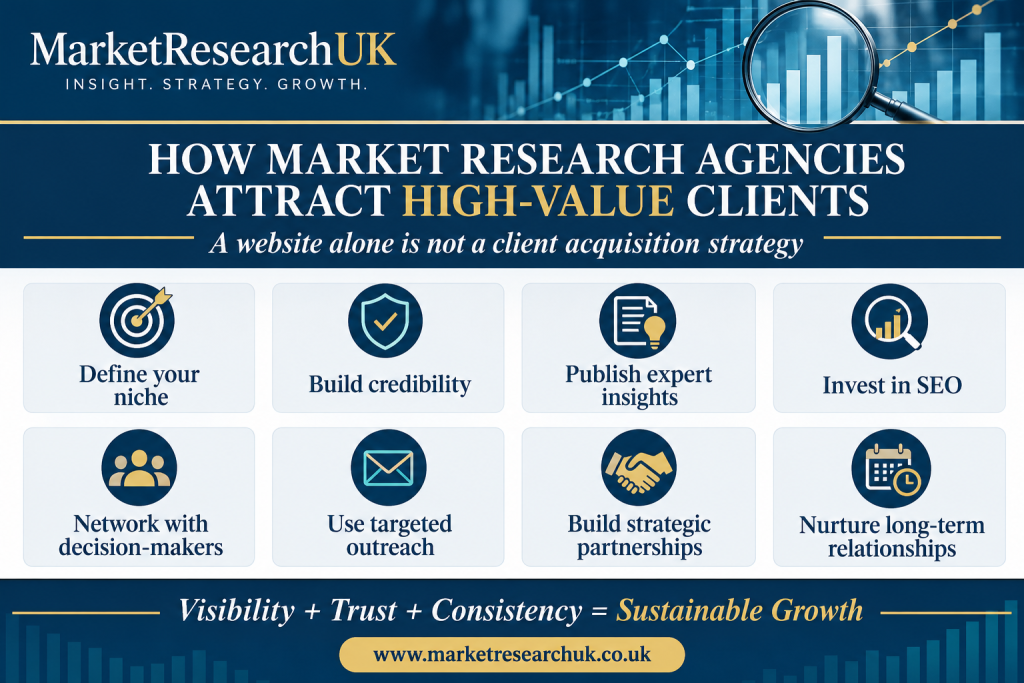
Attracting high-paying clients requires consistent marketing, search engine optimisation (SEO), networking, relationship building, specialist knowledge and a clear understanding of what potential clients need.
This article explores how lawyers use market research agencies, which industries offer opportunities for premium research contracts, and the essential steps market research businesses should take to increase their visibility, credibility and revenue.
Do Lawyers and Law Firms Use Market Research Agencies?
Yes. Lawyers and law firms commission market research and related specialist research services for various reasons, particularly when dealing with complex commercial litigation, intellectual property disputes, competition law, consumer protection, mergers and acquisitions, and regulatory investigations.
However, legal professionals do not necessarily approach research in the same way as conventional businesses.
A retailer might commission a survey to understand customer satisfaction, whereas a law firm may require carefully designed consumer research to help establish whether a trademark is confusingly similar to another brand.
Research commissioned for legal proceedings must be appropriate to the legal questions involved, with transparent methodologies and consideration of the applicable rules of evidence.
1. Intellectual Property and Trademark Disputes
Law firms may commission consumer perception surveys to investigate whether members of the public associate a particular brand, logo, product or name with an existing business.
Such research can potentially assist in disputes involving trademark infringement, passing off and consumer confusion.
However, courts scrutinise survey evidence carefully, and its admissibility and weight depend on the circumstances. A research agency should work closely with the instructing legal team before conducting litigation-related surveys.
2. Competition Law and Market Investigations
Market research agencies may support competition lawyers by analysing industry structures, market shares, consumer switching behaviour, pricing and barriers to entry.
This information can be valuable when advising businesses on competition investigations, acquisitions and market regulation.
3. Mergers and Acquisitions
Corporate law firms and their clients may require market intelligence when evaluating a potential acquisition.
Research can help identify competitors, market growth, customer concentration, commercial risks and future demand.
Although financial and legal due diligence are separate disciplines, commercial market research can complement both.
4. Consumer Protection and Misleading Advertising
Consumer research can help legal teams understand purchasing behaviour, consumer expectations and the potential impact of advertising claims.
Research may also support investigations into misleading marketing, unfair commercial practices and product-related disputes.
5. Employment Law and Workplace Research
Employment law specialists may use workplace surveys, organisational research and employee feedback to understand workplace culture, discrimination risks, employee engagement and recruitment trends.
Where sensitive personal data is involved, agencies must consider data protection, confidentiality and appropriate research ethics.
6. Personal Injury and Public Opinion Research
Certain legal disputes may benefit from research into public attitudes, consumer behaviour or the economic effects of an incident.
In some jurisdictions, lawyers also use jury research and trial simulations. In England and Wales, however, strict legal restrictions apply to jury-related activity, so agencies must not assume that practices used overseas are permissible in UK proceedings.
7. Legal Industry and Client Satisfaction Research
Law firms are themselves businesses competing for clients.
They may commission research into:
- Client satisfaction and service quality.
- Brand recognition and reputation.
- Demand for specialist legal services.
- Competitor positioning.
- Client acquisition and retention.
- Pricing expectations.
- Opportunities to expand into new geographical markets.
This creates opportunities for market research agencies to become long-term commercial partners rather than occasional suppliers.
What Makes Legal Market Research Different?
Research intended to inform litigation requires particular care.
Market research agencies must understand the importance of impartiality, confidentiality, reliable sampling, accurate reporting and appropriate record-keeping.
Where a researcher is instructed to provide expert evidence, additional legal and procedural obligations may apply, including the expert’s overriding duty to the court.
Not every market research report constitutes expert evidence, and not every survey will be accepted by a court.
Agencies seeking legal-sector clients should therefore distinguish between ordinary commercial research, litigation support and formal expert witness services.
Which Other Industries Pay for Specialist Market Research?
Law firms are not the only potential premium clients. Businesses with substantial commercial risks, significant investment decisions or complex regulatory requirements may be willing to commission specialist research.
| Industry | Potential research requirements |
|---|---|
| Legal services | Consumer perception, competition analysis, litigation support |
| Healthcare and pharmaceuticals | Patient insights, treatment preferences, healthcare market analysis |
| Financial services | Customer segmentation, investment research, regulatory trends |
| Technology and AI | Product validation, adoption research, emerging technologies |
| Property and construction | Location analysis, development feasibility, market demand |
| Government and public sector | Public consultations, policy evaluation, social research |
| Insurance | Customer behaviour, risk perceptions, claims experiences |
| Retail and e-commerce | Brand tracking, pricing research, customer experience |
| Renewable energy | Market feasibility, stakeholder research, adoption trends |
| Private equity | Commercial due diligence, competitor intelligence, market sizing |
The most profitable opportunities are not necessarily found in the largest industries. They often arise where an agency can demonstrate specialist expertise, reliable methodology and measurable commercial value.
How Can Market Research Companies Attract More High-Paying Clients?
Attracting premium clients requires more than advertising a list of services. Research agencies must position themselves as trusted specialists capable of solving complex business problems.
The following strategies can help agencies establish credibility, reach decision-makers and build a sustainable pipeline of opportunities.
1. Establish a Clear Market Position
Identify your ideal clients. Decide whether the agency specialises in legal research, healthcare, financial services, technology, consumer research or another defined sector.
Develop specialist expertise. Clients commissioning complex research need confidence that the agency understands their industry and terminology.
Create a compelling value proposition. Explain how research helps clients reduce uncertainty, make decisions, identify opportunities or manage commercial risks.
Avoid competing solely on price. Premium clients often prioritise expertise, accuracy, confidentiality and reliability over the cheapest quotation.
2. Build a Professional Website That Converts Visitors into Enquiries
Invest in professional website design. A well-structured website should communicate credibility, expertise and the services offered.
Create dedicated service pages. Develop separate pages for consumer research, legal market research, competitor analysis, feasibility studies and other specialisms.
Publish case studies. Demonstrate research methodologies, project outcomes and client benefits, subject to confidentiality obligations.
Include clear calls to action. Make it straightforward for potential clients to request a proposal, submit a research brief or enquire about services.
Improve accessibility and usability. Ensure the website works across devices and is accessible to people with disabilities.
Build trust. Display accurate business information, relevant credentials, professional memberships and genuine testimonials where permission has been obtained.
Provide transparent contact options. Offer a professional email address, secure enquiry form and a clear explanation of the next steps.
A professional website provides the foundation for digital marketing, but it cannot independently guarantee enquiries.
3. Invest in Search Engine Optimisation
Search engine optimisation is essential for businesses seeking visibility through Google, Bing and other search platforms.
Conduct keyword research. Identify phrases that potential clients actually search for, including specialist and commercially relevant terms.
Optimise website content. Create informative pages with descriptive titles, relevant headings, clear URLs and useful information.
Improve technical SEO. Address crawlability, indexing issues, broken links, redirects, canonical tags, structured data and mobile performance.
Submit XML sitemaps. Use Google Search Console and Bing Webmaster Tools to help search engines discover important pages.
Develop internal linking. Connect relevant articles, service pages and case studies to help visitors and search engines understand the website.
Earn reputable backlinks. Seek editorial references from relevant publications, professional organisations and trusted industry websites.
Monitor rankings and indexing. Track which pages appear in search results, which queries generate impressions and whether technical problems are preventing visibility.
Update content regularly. Review research articles, industry statistics, services and outdated information.
Why SEO Takes Time and Effort
One of the biggest misconceptions about launching a website is that it will automatically appear on the first page of Google.
In reality, there are several distinct stages:
- Discovery: A search engine becomes aware that a webpage exists.
- Crawling: Search engine software visits the page and examines its content.
- Indexing: The search engine decides whether to include the page in its searchable index.
- Ranking: Algorithms evaluate indexed pages to determine where they may appear for relevant searches.
Submitting a sitemap does not guarantee indexing. Equally, having a page indexed does not mean it will rank prominently.
New websites may take time to establish visibility, especially in competitive sectors. Some pages may never be indexed or rank for commercially valuable keywords.
SEO requires ongoing technical maintenance, high-quality content, strategic planning, competitor analysis and performance monitoring.
Getting a website indexed is not the same as getting it ranked, and getting it ranked is not the same as converting visitors into paying clients.
Understand the Difference Between Website Design and Digital Marketing
Website design and digital marketing are related but separate professional disciplines.
A website designer may specialise in visual layouts, branding, navigation, user experience and technical development.
A digital marketing specialist focuses on attracting relevant audiences, generating enquiries, increasing conversions and developing measurable marketing campaigns.
Some website designers offer SEO and digital marketing services, while others concentrate entirely on website design and development.
Not every website designer is a digital marketing expert, and some website designers do not provide SEO services at all.
Business owners should never assume that SEO, keyword research, content marketing, advertising or lead generation are automatically included in a website design package.
Before commissioning a website, businesses should ask:
- Does the package include technical SEO?
- Will keyword research be undertaken?
- Are page titles and meta descriptions included?
- Will the website be connected to Google Search Console and Bing Webmaster Tools?
- Will analytics and conversion tracking be configured?
- Does the provider offer ongoing content optimisation?
- Who will manage marketing after the website launches?
- Are marketing and SEO services included in the quotation or charged separately?
A beautifully designed website without a visibility strategy may struggle to attract potential clients.
Equally, a website that receives substantial traffic but has poor navigation, unclear messaging or ineffective enquiry forms may fail to convert visitors.
Website design, SEO and digital marketing work best when they are coordinated.
Develop a Comprehensive Digital Marketing Strategy
Content marketing: Publish informative articles, research findings, industry commentary and educational resources that demonstrate expertise.
LinkedIn marketing: Connect with solicitors, managing partners, business owners, procurement teams and corporate decision-makers.
Email marketing: Develop permission-based communications, newsletters and carefully targeted professional outreach, ensuring compliance with applicable UK marketing and data protection rules.
Pay-per-click advertising: Consider targeted Google Ads or LinkedIn campaigns to reach relevant business audiences.
Social media marketing: Share research insights, industry developments and practical business advice through appropriate channels.
Public relations: Contribute expert commentary to industry publications and relevant media outlets.
Thought leadership: Publish original findings, white papers and specialist reports that demonstrate the agency’s knowledge.
Video and webinars: Explain research methodologies, emerging trends and industry challenges through educational presentations.
Search visibility beyond Google: Consider Bing and AI-assisted search discovery as part of a wider visibility strategy.
Retargeting campaigns: Where lawful and supported by appropriate privacy controls and consent requirements, reconnect with previous website visitors through advertising.
Digital marketing should be coordinated rather than treated as a collection of unrelated activities.
Use Direct Business Development and Networking
Research potential clients. Identify law firms, corporate legal departments, consultancies and businesses likely to need specialist research.
Build a qualified prospect list. Focus on relevant organisations and decision-makers rather than sending generic messages to thousands of recipients.
Personalise outreach. Explain why the agency’s services are relevant to a particular business or sector.
Attend industry events. Participate in conferences, professional exhibitions and networking opportunities.
Join professional associations. Consider relevant organisations such as the Market Research Society and industry-specific business networks.
Develop referral partnerships. Build relationships with solicitors, consultants, accountants, marketing agencies and commercial advisers.
Respond to tenders. Monitor public procurement opportunities and private-sector invitations to tender.
Use professional directories. Maintain accurate listings in reputable research and business directories.
Follow up appropriately. Maintain a professional sales process while respecting recipients’ preferences and requests not to be contacted.
Build long-term relationships. Stay connected with existing clients and identify opportunities for repeat research assignments.
Premium business development is often relationship-driven. Trust and specialist knowledge can be more valuable than the number of unsolicited messages sent.
Offer Services That Justify Premium Fees
Bespoke research: Design projects around the client’s specific commercial or legal objectives.
Commercial due diligence: Provide evidence-based insights into market size, competition, demand and potential risks.
Competitor intelligence: Analyse competitors, market positioning, service offerings and emerging threats using lawful research methods.
Consumer perception studies: Investigate how customers understand brands, products, advertising and services.
Strategic consultancy: Help organisations interpret findings and understand their implications for business decisions.
Longitudinal research: Track changes in customer attitudes, industry conditions or brand awareness over time.
Research subscriptions: Offer recurring market intelligence, monitoring and reporting services.
Executive presentations: Deliver findings in clear, decision-ready formats for senior management teams.
Specialist legal-sector research: Work with legal professionals to develop appropriate methodologies for commercial disputes, regulatory matters and other legal needs.
The value of research lies not simply in collecting data but in turning reliable evidence into meaningful insights.
Demonstrate Credibility and Professional Standards
Use robust methodologies. Explain sampling, data collection, analysis and the limitations of findings.
Maintain data protection compliance. Understand applicable UK GDPR and Data Protection Act 2018 requirements.
Protect confidential information. Use appropriate contractual protections, access controls and secure handling procedures.
Publish genuine testimonials. Obtain consent before identifying clients or disclosing project details.
Develop ethical research practices. Ensure participants are treated fairly and sensitive information is handled responsibly.
Be transparent about AI. Explain how AI is used in research and retain appropriate human oversight.
Avoid unsupported claims. Never guarantee a particular legal outcome, business result or level of statistical certainty.
Maintain professional development. Keep up to date with industry standards, methodologies and relevant regulations.
Trust is particularly important when serving law firms, healthcare organisations and other clients handling sensitive information.
Improve Sales Processes and Client Retention
Use a customer relationship management system. Track enquiries, proposals, project stages and client relationships.
Qualify leads. Assess whether prospective clients have a genuine research requirement, an appropriate budget and decision-making authority.
Prepare professional proposals. Define objectives, deliverables, methodology, timescales, pricing and limitations.
Set clear payment terms. Use written contracts, appropriate deposits or milestone payments where suitable.
Measure conversion rates. Monitor how many enquiries become proposals and how many proposals become paying projects.
Offer ongoing support. Identify opportunities for repeat studies, annual reviews and research subscriptions.
Request referrals. Encourage satisfied clients to recommend the agency where appropriate.
Review profitability. Evaluate project costs, staff time, overheads and margins rather than focusing solely on turnover.
A smaller number of profitable, long-term clients can sometimes be more sustainable than a large number of low-value projects.
Why Market Research Companies Should Never Rely on Their Website Alone
A website can be available 24 hours a day, but that does not mean prospective clients will automatically find it.
There are millions of websites competing for attention, and businesses frequently underestimate the time, resources and expertise required to establish online visibility.
A website without marketing is comparable to opening an office without telling potential customers where it is located.
Even when a website begins ranking, there is no guarantee that its visitors will become paying clients.
A market research agency therefore needs multiple routes to market.
These should include organic search, direct outreach, professional networking, referrals, strategic partnerships, public relations, content marketing, paid advertising where commercially viable, and repeat business.
This diversified approach reduces dependence on any single marketing channel.
Search engine algorithms can change, advertising costs can rise and client demand can fluctuate.
A business that relies entirely on its website for enquiries may be vulnerable when traffic declines.
The objective should not simply be to attract website visitors. It should be to attract the right decision-makers, establish trust and convert suitable opportunities into profitable working relationships.
How Can Market Research Agencies Approach Law Firms?
Agencies interested in serving the legal sector should adopt a professional, research-led approach.
The first step is to identify law firms whose practice areas align with the agency’s capabilities.
For example, an agency specialising in consumer behaviour may find opportunities with intellectual property and advertising law teams, while a firm specialising in economic research may be better positioned to support competition law practices.
Research agencies should then prepare a concise introduction explaining their expertise, methodology and the types of problems they can help investigate.
A professional portfolio containing anonymised case studies, sample reports and methodological explanations can help demonstrate competence.
Where litigation-related work is involved, agencies should avoid presenting themselves as expert witnesses unless they have the appropriate expertise and can fulfil the relevant obligations.
They should also recognise that law firms may already work with economists, forensic specialists, expert witnesses and established research providers.
The most effective approach is to demonstrate how the agency complements these existing professional services.
The Role of Collaboration Between Market Research Agencies, Lawyers and Marketing Professionals
Collaboration can create opportunities that individual businesses may struggle to access independently.
A market research agency might work alongside a solicitor, economist, digital marketing consultant, website developer or specialist industry adviser.
Each professional contributes different expertise.
For example, a law firm could identify the legal questions that a consumer survey needs to address. A market research agency could design and administer the study, while a qualified expert may be required to interpret and present evidence in legal proceedings.
Separately, a digital marketing agency could help the research company communicate its services, improve online visibility and attract relevant commercial enquiries.
Collaborative arrangements should be supported by clear agreements covering responsibilities, confidentiality, fees, intellectual property, data protection and any applicable professional rules.
Businesses should also avoid arrangements that compromise research independence or create conflicts of interest.
A Practical 90-Day Marketing Plan for Market Research Agencies
| Period | Recommended action |
|---|---|
| Days 1–15 | Audit the website, technical SEO, indexing, content and existing marketing channels |
| Days 16–30 | Define target industries, develop specialist service pages and establish ideal client profiles |
| Days 31–45 | Publish authoritative articles, case studies and research insights |
| Days 46–60 | Begin carefully targeted outreach, LinkedIn networking and partnership development |
| Days 61–75 | Review analytics, improve conversion opportunities and test suitable advertising channels |
| Days 76–90 | Evaluate enquiries, proposals, marketing performance and potential recurring contracts |
This is a starting framework rather than a promise of results. Competitive sectors may require considerably longer to generate meaningful organic search visibility and a consistent pipeline of high-value enquiries.
Frequently Asked Questions
Do solicitors use market research companies?
Yes. Solicitors and law firms may commission market research for intellectual property disputes, competition matters, commercial transactions, client satisfaction studies and other business or legal requirements.
Can market research companies charge premium prices?
Yes, where pricing is justified by specialist expertise, project complexity, reliable methodologies, confidentiality requirements and the value delivered to clients.
Does having a website guarantee business leads?
No. A website must be supported by appropriate marketing, visibility, credibility and conversion strategies. Even a well-optimised website cannot guarantee enquiries.
Are website designers responsible for SEO?
Only where SEO is included in the agreed scope of work. Some website designers provide comprehensive digital marketing services, while others offer design and development alone.
How long does it take a website to rank on Google?
There is no guaranteed timeframe. Indexing and ranking depend on many factors, including technical accessibility, content quality, competition, relevance and search engine decisions. Some pages may never achieve prominent rankings.
What is the best way to find high-paying market research clients?
A combination of specialisation, professional referrals, targeted business development, strong case studies, SEO, thought leadership and long-term client relationships is often more effective than relying on one marketing channel.
Can AI replace market research agencies?
AI can assist with data processing, transcription, coding, analysis and reporting, but research quality still depends on appropriate study design, reliable data, critical interpretation, ethical safeguards and human accountability.
Conclusion
Market research agencies have opportunities to work with law firms, corporate legal departments, financial institutions, healthcare organisations, technology businesses and other industries that require reliable commercial intelligence.
However, attracting high-paying clients is not simply a matter of launching a website and waiting for enquiries.
A successful market research business needs a clear commercial strategy, specialist expertise, effective SEO, consistent digital marketing, professional networking and strong client relationships.
Website designers play an important role in establishing a company’s digital presence, but website development should not be confused with a comprehensive marketing service.
Some designers offer SEO, content development and digital marketing, while others do not. Business owners must understand exactly which services they are purchasing and what additional work will be required after launch.
Building online visibility takes time. Getting indexed does not guarantee rankings, and rankings do not guarantee paying clients.
For market research companies seeking sustainable growth, the most effective approach is to combine technical website optimisation with proactive business development, meaningful industry collaboration and a commitment to delivering high-quality research.
Ultimately, a website should support a company’s business development strategy, not be expected to replace it.
Further Reading & Resources
- Market Research UK: https://marketresearchuk.co.uk/
- LM Research & Marketing Consultancy: https://www.lmrmc.co.uk/
- UK Website Designers Group: https://ukwebsitedesigners.co.uk/
- Cymru Marketing Agency: https://cymrumarketing.com/
- Cymru Law – Legal Research and Content Support: https://cymrulaw.com/
- Semrush: https://www.semrush.com/lp/product-seo-challenges/en/
- SEO.com: https://www.seo.com/basics/glossary/seo/
- Moz.com: https://moz.com/learn/seo/what-is-seo
- AHREFS: https://ahrefs.com/seo
- Google Developers: https://developers.google.com/search/docs/fundamentals/seo-starter-guide


Renata The Editor of DisabledEntrepreneur.uk - DisabilityUK.co.uk - DisabilityUK.org - CMJUK.com Online Journals, suffers From OCD, Cerebellar Atrophy & Rheumatoid Arthritis. She is an Entrepreneur & Published Author, she writes content on a range of topics, including politics, current affairs, health and business. She is an advocate for Mental Health, Human Rights & Disability Discrimination.
She has embarked on studying a Bachelor of Law Degree with the goal of being a human rights lawyer.
Whilst her disabilities can be challenging she has adapted her life around her health and documents her journey online.
Disabled Entrepreneur - Disability UK Online Journal Working in Conjunction With CMJUK.com Offers Digital Marketing, Content Writing, Website Creation, SEO, and Domain Brokering.
Disabled Entrepreneur - Disability UK is an open platform that invites contributors to write articles and serves as a dynamic marketplace where a diverse range of talents and offerings can converge. This platform acts as a collaborative space where individuals or businesses can share their expertise, creativity, and products with a broader audience.