
Disclaimer: This article is based on non-confidential information supplied by Safir Ahmad, founder of Safir Innovations Ltd. Disabled Entrepreneur UK has not independently tested the proof of concept, verified the patent application or assessed the proposed system’s engineering, medical, regulatory or safety compliance. The publication of this article does not constitute an endorsement, investment recommendation, medical opinion or confirmation that the proposed product will be commercially or technically viable. Any future system would require appropriate professional research, risk assessments, user testing, engineering evaluation, regulatory consideration and product-safety approval before being offered for public use.
Article Updated: 29 September 2026: This article has been updated to include Safir Innovations’ involvement with Heriot-Watt University student engineering projects and the launch of its GoFundMe campaign.
An Innovation Inspired by Lived Experience
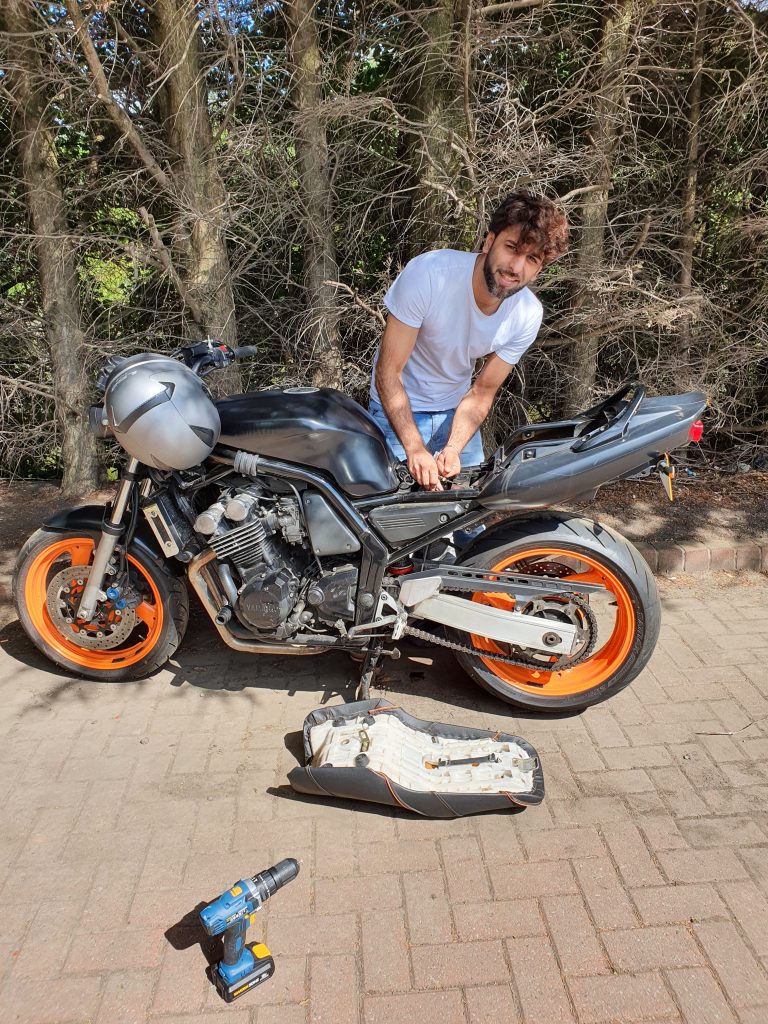
Safir Ahmad is the founder of Safir Innovations Ltd, an early-stage assistive technology company based in Scotland.
In July 2022, Safir was involved in a motorcycle accident that left him paralysed. He subsequently became a full-time wheelchair user and began experiencing challenges that may not always be apparent to people who do not use wheelchairs.
One of those challenges was prolonged contact with cold wheelchair components.
A wheelchair is not simply a piece of equipment used briefly during the day. For many wheelchair users, it is an essential part of everyday life. A person may remain in contact with the seat, armrests, backrest, footrests, joystick and other components for many hours in changing temperatures and environments.
Safir’s experience led him to consider whether wheelchair users could benefit from a purpose-designed, built-in heating system.
He is now developing a patent-pending concept through Safir Innovations Ltd.
Why Cold Wheelchair Components Matter
Cold contact points may be uncomfortable, but Safir believes the issue can extend beyond general discomfort.
Powered wheelchair users regularly interact with joysticks, control panels, armrests, seating systems, footrests and other components. Manual wheelchair users may also experience prolonged cold through push rims, frames and hand-contact areas.
During colder weather, these surfaces may become difficult or unpleasant to touch. For some users, cold conditions could potentially affect hand comfort, grip, dexterity or confidence when operating their wheelchair.
Individual experiences will differ considerably depending on a person’s disability, circulation, sensation, environment, wheelchair model and length of exposure.
Further independent research would therefore be needed to understand how widespread the problem is and which wheelchair users may benefit from a controlled heating system.
More Than a Heated Cushion
Safir’s proposed concept is not intended to be another heated seat cushion.
A conventional heated cushion generally warms a single area. Safir’s idea is to explore a wheelchair-specific system that could provide controlled warmth to several important contact points.
Depending on the eventual design and the findings of future testing, these areas could include:
- The joystick or control area.
- Armrests.
- The wheelchair seat.
- The backrest.
- Footrests.
- Hand-contact areas.
- Push rims on manual wheelchairs.
The principle has similarities to heated systems found in vehicles, but it would need to be designed specifically around wheelchair use and the requirements of disabled users.
Potential control options could include physical buttons, sensors, an application or a small display. However, the final design has not yet been determined, and any proposed control system would require accessibility and usability testing.
Safety Must Remain Central
Introducing heating components into a powered or manual wheelchair would require extensive professional consideration.
A responsible development process would need to examine matters including:
- Safe and controlled temperature limits.
- Prevention of overheating and hot spots.
- The needs of users with reduced or absent sensation.
- Battery consumption and power management.
- Compatibility with different wheelchair models.
- Water resistance and exposure to poor weather.
- Cleaning and infection-control requirements.
- Fire and electrical safety.
- Pressure care and seating considerations.
- The risk of interfering with wheelchair controls.
- Emergency shut-off mechanisms.
- Maintenance and long-term reliability.
A system that is suitable for one person may not be suitable for another. Particular caution would be necessary for anyone with impaired temperature sensation or an increased risk of burns or pressure damage.
For these reasons, Safir is currently concentrating on evidence, validation and technical understanding rather than attempting to bring an untested product directly to market.
An Early Proof of Concept
Safir has tested an early and limited proof of concept on his own powered wheelchair, beginning with warmth around the joystick area.
According to Safir, this initial test helped him recognise the potential practical value of the idea in everyday use. However, it was not a finished product, clinical study or independently validated prototype.
The next stage would involve developing a stronger evidence base around:
- Whether wheelchair users identify cold contact points as a significant problem.
- Which areas of a wheelchair would benefit most from controlled warmth.
- Appropriate and safe temperature ranges.
- Technical feasibility.
- Power and battery implications.
- Product design requirements.
- Accessibility and ease of operation.
- Relevant regulatory and safety standards.
Safir has deliberately avoided publishing detailed prototype images, wiring arrangements, battery-integration information, precise temperature settings or commercially sensitive construction details while the project remains at an early patent-pending stage.
September 2026 Update: Safir Innovations Begins Working With Heriot-Watt University Student Engineering Teams
Since this article was originally published, Safir Ahmad has provided Disabled Entrepreneur UK with a further update on the development of Safir Innovations and its proposed wheelchair-heating concept.
Safir Innovations has now begun working with two student teams at Heriot-Watt University as part of engineering design projects exploring wheelchair heating.
Safir recently met with the students and discussed some of the everyday challenges experienced by wheelchair users, including the practical issues that helped inspire the original concept.
The collaboration represents another step in exploring the engineering considerations surrounding wheelchair heating. However, the project remains at an early stage, and Safir has confirmed that public information will continue to remain general.
Student names, confidential technical information and details of their individual work will not be published while the projects are ongoing.
University Involvement Does Not Constitute Endorsement
It is important to clarify that Heriot-Watt University’s involvement relates to student engineering projects.
The university’s involvement should not be interpreted as an endorsement of Safir Innovations, the proposed wheelchair-heating system or any associated fundraising campaign.
The concept remains subject to further development, engineering assessment, testing, intellectual-property considerations and appropriate safety evaluation before its wider feasibility can be determined.
GoFundMe Launched to Support Patent Protection
Safir has also launched a GoFundMe campaign to support the next stage of the project.
The initial fundraising target is £10,000, which Safir states will contribute towards upcoming patent-protection costs associated with the innovation.
Engineering development and safety testing are expected to form a later and separately planned stage of the project.
Readers wishing to learn more can visit:
GoFundMe:
https://www.gofundme.com/f/help-safir-develop-wheelchair-heating-for-cold-days
Safir Ahmad – Founder Profile:
https://www.f6s.com/safir-a
Safir Innovations Profile:
https://www.f6s.com/safir-innovations
Editorial and Fundraising Disclaimer
Disabled Entrepreneur UK is reporting this development for editorial and informational purposes.
Publication of the GoFundMe campaign does not constitute an endorsement, financial recommendation or guarantee by Disabled Entrepreneur UK regarding Safir Innovations, the proposed wheelchair-heating technology, the fundraising campaign or the eventual development or commercial availability of any product.
Disabled Entrepreneur UK has not independently verified expenditure associated with the fundraising campaign and does not handle, administer or receive donations made through GoFundMe.
Anyone considering contributing to a crowdfunding campaign should carry out their own due diligence and review the information provided by the fundraiser and fundraising platform before making a financial contribution.
Continuing the Journey
When this article was first published, one of the central themes was the importance of bringing together lived experience, engineering expertise, research and responsible product development.
The involvement of student engineering teams provides an opportunity for the concept to be explored from a technical perspective while Safir continues working on intellectual-property protection and the wider development pathway.
There remains considerable work ahead before any wheelchair-heating system could potentially reach the market, including engineering design, prototype development, safety assessment, user testing and consideration of relevant regulatory requirements.
Nevertheless, this latest development represents another stage in Safir Ahmad’s journey from identifying an accessibility challenge through lived experience to investigating whether engineering could provide a practical solution.
Seeking Validation Rather Than Immediate Investment
Although many early-stage businesses begin by looking for financial investment, Safir says investment is not his main priority at present.
He is seeking people and organisations capable of helping him investigate the idea properly and responsibly.
Safir is particularly interested in connecting with:
- Wheelchair users.
- Occupational therapists.
- NHS and independent wheelchair services.
- Assistive technology specialists.
- Rehabilitation engineers.
- Product designers.
- Electrical and mechanical engineers.
- University researchers.
- Mobility-equipment companies.
- Medical technology and health-innovation organisations.
- Product-safety specialists.
- User-testing and accessibility professionals.
The support he is seeking may include user feedback, research collaboration, technical advice, prototype-development guidance, safety evaluation and introductions to potential industry partners.
Meaningful involvement from wheelchair users will be especially important. Products developed for disabled people should include disabled people throughout the research, design and testing process rather than treating them solely as end users.
The Long-Term Licensing Goal
Safir does not currently intend to manufacture and distribute the proposed system independently.
His longer-term aim is to develop enough evidence, research and technical understanding for the concept to be licensed to, or developed in partnership with, an established wheelchair, mobility or assistive technology company.
This approach could allow experienced manufacturers to examine how the technology might integrate with existing wheelchair designs, power systems, warranties and safety requirements.
Established manufacturers may also have access to the engineering teams, testing facilities, regulatory expertise and distribution networks necessary to investigate the concept on a larger scale.
Whether a licensing partnership will ultimately be possible will depend on the results of research, user demand, technical feasibility, intellectual property considerations, manufacturing costs and regulatory requirements.
Protecting the Intellectual Property
Safir states that a UK patent application has been filed and that the concept is currently patent pending.
Patent pending does not automatically mean that a patent will ultimately be granted. It indicates that an application has been submitted and remains within the relevant application or examination process.
Inventors should obtain independent advice from a qualified patent attorney before publicly disclosing technical information. Non-disclosure agreements may also be appropriate when entering detailed discussions with engineers, universities, designers or prospective commercial partners.
Safir has therefore limited his public description to the general purpose of the system and the problem it is intended to address.
Building a Digital Home for Safir Innovations
Safir Innovations Ltd already has a company website, providing an important foundation for presenting the business and its innovation professionally. As the project develops, the website will expand and be regularly updated to become a central source of official information for potential collaborators, researchers, investors and other interested organisations.
The website enables visitors to:
- Read Safir’s founder story and professional background.
- Learn about the aims of the project without accessing confidential or commercially sensitive information.
- Understand the type of support, expertise or collaboration being sought.
- View future research, development and testing updates.
- Make professional contact through an official communication channel.
- Discover whether partnership, funding or user-research opportunities are available.
- Follow the progress and achievements of Safir Innovations Ltd over time.
Maintaining a professional website under a branded domain name can also help distinguish official company information from inaccurate, outdated or unauthorised descriptions of the invention.
The website does not disclose the protected technical workings of the proposed system. Its purpose is to strengthen credibility, communicate the company’s objectives, showcase progress and provide a secure and professional route for relevant individuals and organisations to make contact.

Innovation Through Personal Experience
Some of the most valuable accessibility ideas emerge when disabled people identify problems through their own daily experiences.
Safir’s concept developed because he personally experienced prolonged contact with cold wheelchair components and questioned whether a better solution could be designed.
Lived experience alone does not remove the need for engineering, testing or independent evidence. However, it can identify overlooked problems and help ensure that research begins with the realities of daily life.
Safir’s next challenge will be to bring together lived experience, professional research, technical expertise, intellectual property protection and meaningful user involvement.
Call for Research and Industry Collaboration
Safir Innovations Ltd is currently interested in hearing from wheelchair users, occupational therapists, researchers, engineers, assistive technology specialists, universities, wheelchair services, mobility manufacturers and product-safety professionals who may be able to contribute to the responsible evaluation of the concept.
The project is at an early stage, and confidential technical information is not being disclosed publicly.
Website: https://www.safirinnovations.co.uk/
Public contact email: info@safirinnovations.co.uk
LinkedIn or professional profile: https://www.linkedin.com/in/safir-ahmad-726154394/
Conclusion
Safir Ahmad’s journey from a life-changing motorcycle accident to the founding of an assistive technology company demonstrates how lived experience can inspire new approaches to everyday accessibility challenges.
His proposed wheelchair heating system remains at an early validation stage, and significant research, engineering and safety assessment would be required before its wider potential could be determined.
By connecting with wheelchair users, researchers, clinicians, engineers and established mobility companies, Safir hopes to establish whether the concept can be developed into a safe, practical and commercially viable solution.
The next steps will be crucial: protecting the intellectual property, gathering reliable user evidence, building a professional digital presence and identifying experienced partners capable of evaluating the idea responsibly.


Renata The Editor of DisabledEntrepreneur.uk - DisabilityUK.co.uk - DisabilityUK.org - CMJUK.com Online Journals, suffers From OCD, Cerebellar Atrophy & Rheumatoid Arthritis. She is an Entrepreneur & Published Author, she writes content on a range of topics, including politics, current affairs, health and business. She is an advocate for Mental Health, Human Rights & Disability Discrimination.
She has embarked on studying a Bachelor of Law Degree with the goal of being a human rights lawyer.
Whilst her disabilities can be challenging she has adapted her life around her health and documents her journey online.
Disabled Entrepreneur - Disability UK Online Journal Working in Conjunction With CMJUK.com Offers Digital Marketing, Content Writing, Website Creation, SEO, and Domain Brokering.
Disabled Entrepreneur - Disability UK is an open platform that invites contributors to write articles and serves as a dynamic marketplace where a diverse range of talents and offerings can converge. This platform acts as a collaborative space where individuals or businesses can share their expertise, creativity, and products with a broader audience.