Medical Disclaimer: This article is provided for educational and informational purposes only and does not constitute medical advice, diagnosis or treatment recommendations. Cell and gene therapies are highly specialised treatments, and many applications discussed remain experimental. Patients should consult their GP, neurologist, geneticist, haematologist or other qualified healthcare professional before considering any treatment or clinical trial. Artificial intelligence is a research and decision-support technology, not a replacement for qualified medical professionals.
A New Era of Medical Innovation
Exploring the future of biotechnology, autoimmune disease treatments, CRISPR gene editing and personalised healthcare.
Medical science is entering an extraordinary period of technological development, with artificial intelligence (AI), cell therapy, gene therapy and gene editing increasingly converging to address some of humanity’s most challenging diseases.
Collectively, these technologies offer the potential to move beyond treating symptoms towards addressing underlying biological mechanisms, repairing certain genetic defects and modifying dysfunctional immune responses.
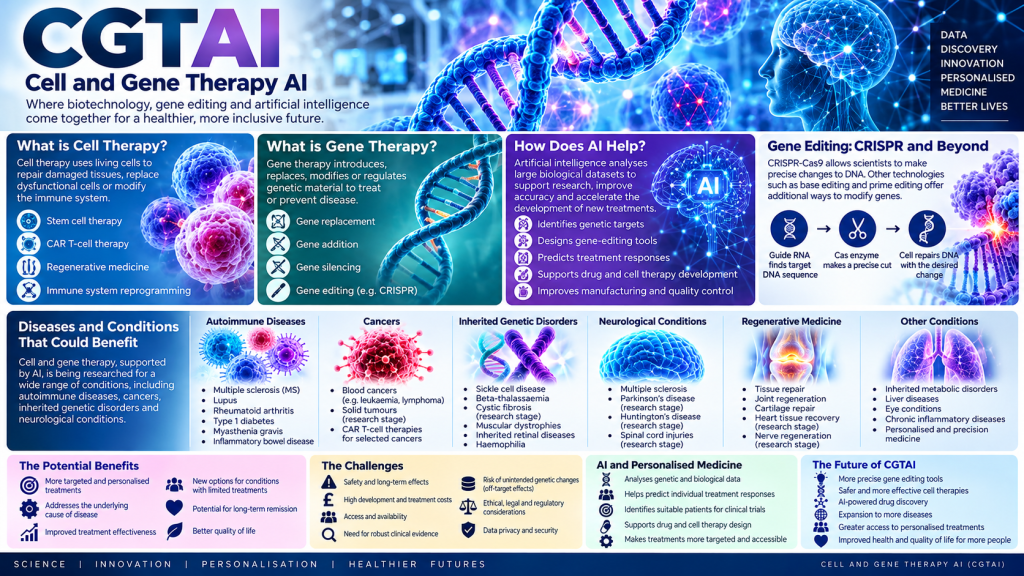
Cell and Gene Therapy AI (CGTAI) describes the intersection of these technologies, where AI assists researchers in understanding diseases, designing therapies, analysing genetic information and improving the development of personalised treatments.
For people living with chronic illnesses, including autoimmune conditions, neurological disorders, inherited diseases and certain cancers, these developments could offer new treatment possibilities.
However, while some cell and gene therapies are already approved for clinical use, others remain in early research and clinical trials. Distinguishing scientific progress from speculative claims is essential.
What Is Cell and Gene Therapy?
Although frequently discussed together, cell therapy and gene therapy are not identical.
Cell Therapy
Cell therapy involves introducing living cells into a patient’s body to repair damaged tissues, replace dysfunctional cells or alter immune-system activity.
Depending on the treatment, these cells may come from the patient or a compatible donor.
Examples include:
- Haematopoietic stem cell transplantation, which can rebuild the blood-forming and immune systems.
- CAR T-cell therapy, which modifies immune cells to recognise particular targets.
- Experimental regulatory T-cell therapies designed to control inappropriate immune responses.
- Investigational regenerative cell therapies intended to support tissue repair.
Gene Therapy
Gene therapy involves introducing, replacing, modifying or regulating genetic material to treat or prevent disease.
Some approaches deliver functional copies of genes, while others modify the patient’s existing DNA.
The US National Institutes of Health explains that gene therapy can involve gene transfer or genome editing, with different techniques designed to address particular genetic abnormalities.
Where Does Artificial Intelligence Fit In?
AI is not itself a cell or gene therapy. Rather, it can support the research, design, manufacture and evaluation of these treatments.
Researchers can use machine learning to examine large biological datasets, identify patterns and investigate therapeutic possibilities that would be difficult to evaluate manually.
This is particularly important in diseases involving complex interactions between genetics, immune function and environmental influences.
Understanding Gene Editing and CRISPR Technology
Gene editing allows scientists to make targeted changes to DNA.
One of the best-known technologies is CRISPR-Cas9, which uses a guide RNA to direct a Cas enzyme towards a particular DNA sequence.
The enzyme can cut the DNA, allowing cellular repair mechanisms to modify the genetic material.
Other technologies include base editing and prime editing, which can enable more specialised changes.
Gene editing is being investigated for inherited blood disorders, metabolic conditions, immune diseases and certain cancers.
However, editing DNA carries risks, including unintended genetic changes known as off-target effects. Researchers must assess these risks before treatments can be considered sufficiently safe.
How AI Could Improve Gene Editing
AI can support gene-editing research in several important ways.
Identifying genetic targets: Machine-learning models can analyse genetic and molecular information to help researchers identify genes or biological pathways associated with disease.
Designing CRISPR guide RNAs: AI can help predict which guide sequences are more likely to produce the intended genetic changes.
Predicting unintended edits: Computational models can identify potential off-target locations, although laboratory testing remains necessary.
Analysing treatment responses: AI can examine molecular, imaging and clinical data to identify patterns associated with treatment outcomes.
Supporting manufacturing: AI-assisted monitoring may help researchers improve consistency and quality control when producing complex cell-based medicines.
The ultimate objective is to make treatments more targeted, reproducible and accessible. However, the accuracy of these systems depends on the quality and representativeness of their training data.
Can Cell and Gene Therapy Help Autoimmune Diseases?
Autoimmune diseases occur when the immune system mistakenly attacks the body’s own tissues.
Rather than defending against harmful pathogens, immune cells contribute to inflammation, tissue damage and, in some conditions, progressive disability.
Researchers are investigating whether advanced cellular therapies could reprogramme or reset particular components of the immune system.
This is especially relevant to diseases that have not responded adequately to conventional medication.
Multiple Sclerosis (MS)
Multiple sclerosis is an immune-mediated neurological condition in which inflammatory activity damages myelin, the protective covering surrounding nerve fibres in the central nervous system.
This can lead to symptoms including visual disturbances, muscle weakness, impaired coordination, fatigue, cognitive difficulties and mobility problems.
Researchers are investigating CAR T-cell therapies that target certain immune cells involved in the disease.
In October 2025, University College London Hospitals reported that the first UK patient with MS had received an experimental CAR T-cell treatment as part of a clinical trial.
The MS Society also describes several early-stage trials investigating whether these treatments can safely reduce disease activity or slow progression.
Importantly, CAR T-cell therapy is not currently an established cure for MS. Its long-term effectiveness and safety remain under investigation.
Systemic Lupus Erythematosus (Lupus)
Lupus is a complex autoimmune disease that can affect the joints, skin, kidneys, blood and other organs.
Researchers are investigating whether CAR T-cell therapies can reduce or eliminate immune-cell populations responsible for driving severe autoimmune activity.
In June 2026, UCLH reported encouraging early results from its CARLYSLE clinical trial involving patients with severe, treatment-resistant lupus.
Five of the first six patients treated at the lower dose achieved remission according to standard lupus assessment criteria. However, the trial remains early-stage, and longer-term evidence is necessary.
Rheumatoid Arthritis
Rheumatoid arthritis is an autoimmune disease that causes inflammation, pain and progressive damage to joints.
AI-assisted research may help identify inflammatory pathways, predict treatment responses and support the development of more targeted immunotherapies.
Advanced cellular therapies are being investigated across autoimmune medicine, but gene editing and CAR T-cell approaches should not be regarded as established treatments for rheumatoid arthritis.
Type 1 Diabetes
Type 1 diabetes occurs when the immune system destroys insulin-producing beta cells in the pancreas.
Researchers are exploring stem-cell-derived insulin-producing cells as a possible way to restore insulin production.
Gene editing may eventually help protect transplanted cells from immune rejection, while AI could assist in analysing cell quality, glucose responses and treatment outcomes.
Significant challenges remain, particularly concerning immune protection, long-term safety and access.
Other Autoimmune Conditions
Additional areas of research include myasthenia gravis, systemic sclerosis and inflammatory muscle diseases.
Although these conditions differ considerably, researchers are investigating whether modifying specific immune-cell populations could provide benefits for patients with severe disease.
A 2026 scientific report described early-phase studies of CAR T-cell therapies across several treatment-resistant autoimmune conditions.
Which Other Diseases Could Benefit From Cell and Gene Therapy AI?
| Disease or condition | Potential therapeutic application |
|---|---|
| Sickle cell disease | Approved gene-edited stem-cell therapy for eligible patients |
| Beta-thalassaemia | Gene-edited blood stem cells to improve haemoglobin production |
| Certain blood cancers | Approved CAR T-cell therapies for selected patients |
| Inherited retinal diseases | Gene replacement for certain genetic defects |
| Haemophilia | Gene therapy to support production of clotting factors in eligible patients |
| Muscular dystrophies | Gene-based treatments and ongoing research |
| Parkinson’s disease | Experimental cell replacement and regenerative approaches |
| Multiple sclerosis | Experimental immune-cell therapies |
| Lupus | Experimental CAR T-cell therapies |
These examples represent different levels of clinical development. Not every condition has an approved cell or gene therapy, and availability varies between countries.
A Real-World Example: CRISPR Treatment for Sickle Cell Disease
One of the clearest demonstrations of gene editing entering clinical medicine is Casgevy, a CRISPR-based treatment for certain patients with sickle cell disease and transfusion-dependent beta-thalassaemia.
The treatment involves collecting a patient’s blood-forming stem cells, editing them in a laboratory and returning them after preparatory treatment.
The editing process increases fetal haemoglobin production, helping address the underlying blood disorder.
In July 2026, the US Food and Drug Administration expanded its approval to eligible children aged two years and older. This followed earlier approval for older patients.
This is an important example of how gene editing can become a regulated medical treatment rather than remaining a laboratory concept.
Nevertheless, the treatment is intensive and carries substantial risks, including complications associated with the conditioning chemotherapy required beforehand.
It is also important to distinguish the use of CRISPR from AI: Casgevy is a gene-edited treatment, not proof that artificial intelligence is itself responsible for its clinical effectiveness.
Could AI Help Personalise Treatments?
Personalised medicine aims to tailor treatment decisions to the biological characteristics and clinical circumstances of individual patients.
Traditionally, patients with the same diagnosis may receive similar treatments, even though their responses can differ substantially.
AI could help researchers and clinicians examine information such as genetic variants, immune-cell activity, biomarkers, medical imaging and previous treatment responses.
Potential applications include predicting which patients might benefit from particular therapies, identifying possible adverse reactions and improving clinical trial design.
For example, two people diagnosed with MS may have different patterns of disease activity, disability progression and treatment response.
In the future, AI-assisted analysis may help clinicians understand these differences more precisely.
However, such predictions must be validated in appropriately designed clinical studies before being relied upon in patient care.
Could Cell and Gene Therapy Eventually Reverse Disease?
This is one of the most important questions in modern biotechnology.
The answer depends on the disease, the extent of existing damage and the mechanism of the treatment.
Some genetic conditions are caused primarily by a particular inherited defect. Correcting or compensating for that defect may produce profound and potentially lasting benefits.
Autoimmune diseases are often more complicated because multiple immune pathways, genetic susceptibilities and environmental influences may contribute to disease.
A treatment that successfully suppresses harmful immune activity may prevent further damage without reversing damage that has already occurred.
For example, stopping inflammatory activity in MS would not necessarily repair established nerve damage.
Consequently, disease remission, prevention of progression, tissue regeneration and cure are not interchangeable medical outcomes.
Researchers must establish which outcomes a therapy can genuinely deliver.
The Ethical and Legal Implications of Gene Editing and AI
As gene editing becomes increasingly sophisticated, important questions arise about patient rights, consent, genetic privacy and healthcare equality.
In the UK, relevant regulatory and legal frameworks include:
- The Human Tissue Act 2004, which regulates specified activities involving relevant human material in England, Wales and Northern Ireland.
- The Human Fertilisation and Embryology Act 1990, as amended, which regulates particular activities involving embryos and reproductive technologies.
- The UK General Data Protection Regulation and Data Protection Act 2018, which provide protections concerning personal information, including genetic and health data.
- The Human Medicines Regulations 2012 and applicable medicines regulation, under which the MHRA oversees the authorisation of relevant medicinal products.
Not every law applies to every form of cell therapy or research activity. The applicable framework depends on the material, intervention and purpose.
Gene editing also raises an important distinction between somatic editing, which affects the treated individual, and heritable germline editing, which could affect future generations.
The latter raises particularly significant ethical and regulatory concerns.
Accessibility and Disability Rights
Breakthrough treatments should not become available only to wealthy individuals or patients living near specialist medical centres.
People with disabilities may encounter additional barriers, including inaccessible trial locations, travel requirements, financial constraints and exclusion criteria.
Clinical researchers and healthcare organisations should consider accessibility, reasonable adjustments and equitable recruitment when developing and evaluating new therapies.
AI systems must also be assessed for bias, particularly where underrepresented populations may not be adequately reflected in training datasets.
The Challenges Facing Cell and Gene Therapy AI
Despite considerable scientific progress, several obstacles remain.
Safety: Gene editing can cause unintended changes, and some cell therapies can produce serious immune reactions.
Cost: Manufacturing personalised cellular medicines can be extremely expensive.
Long-term monitoring: Some treatments require years of follow-up to understand delayed adverse effects.
Data protection: Genetic and medical information is highly sensitive and requires appropriate safeguards.
Clinical evidence: Encouraging early trial results do not necessarily establish long-term effectiveness.
AI reliability: Computational predictions may be inaccurate, biased or difficult to interpret.
Access to treatment: Regulatory approval does not automatically guarantee NHS availability or funding.
Overcoming these challenges will require collaboration between scientists, clinicians, patients, regulators, technology developers and policymakers.
The Future of Cell and Gene Therapy AI
The next decade could bring significant advances in how scientists investigate and treat complex diseases.
AI-assisted genetic analysis, improved gene-editing technologies and more sophisticated cellular therapies may help researchers develop treatments that are safer, more targeted and potentially more effective.
For autoimmune diseases, one of the most promising research directions involves altering immune responses without permanently compromising the body’s ability to defend against infection.
For inherited genetic disorders, researchers are exploring ways to correct or compensate for disease-causing variants.
In regenerative medicine, scientists continue to investigate whether specialised cells could replace damaged tissues and restore biological functions.
Yet scientific progress must be accompanied by transparent evidence, robust regulation and realistic communication with patients.
Artificial intelligence can accelerate aspects of discovery, but it cannot replace the clinical trials, independent assessment and long-term monitoring necessary to establish safety and effectiveness.
Conclusion
Cell and Gene Therapy AI represents an important intersection of biotechnology and computational science.
By combining advanced cellular treatments, genetic engineering and AI-assisted analysis, researchers are exploring new approaches to diseases that have historically been difficult to treat.
For people living with autoimmune diseases such as multiple sclerosis and lupus, emerging cellular therapies provide legitimate reasons to follow scientific developments with interest.
For patients with certain inherited genetic disorders, gene editing has already moved into regulated clinical practice.
However, not every experimental treatment will succeed, and scientific breakthroughs should never be presented as guaranteed cures.
The greatest potential of CGTAI lies in its ability to support responsible research, improve treatment development and contribute towards a future in which more patients can access effective, evidence-based personalised medicine.
CGTAI.com – Cell and Gene Therapy AI & GenetherapyAI.com – Gene Therapy AI.
Specialist biotechnology domain names, for domain acquisition, leasing, or commercial enquiries, please use the website contact form below.
References and Further Reading
- National Institutes of Health: National Institutes of Health – Gene Therapy
- MS Society: MS Society – CAR T-Cell Therapy Research
- UCLH: UCLH – First UK Patient With MS Trialling CAR T-Cell Therapy
- UCLH: UCLH – CAR T-Cell Therapy Research in Severe Lupus
- FDA: FDA – Approved Cellular and Gene Therapy Products
- Cymru Marketing Journal (CMJUK): https://cymrumarketing.com/category/cell-and-gene-therapy-ai-marketing/
- Disabled Entrepreneur UK CGTAI: https://disabledentrepreneur.uk/category/www-cgtai-com/
- CRISPR-Cas9: https://www.origene.com/products/gene-expression/crispr-cas9
- PUB Med Central: https://pmc.ncbi.nlm.nih.gov/articles/PMC4975809/
- OriGene: https://www.origene.com/products/gene-expression/crispr-cas9/knockout-kits
- UCLH: https://www.uclh.nhs.uk/news/first-ms-patient-uk-trialling-car-t-cell-therapy-uclh
- UCLH: https://www.uclh.nhs.uk/news/i-can-participate-life-now-how-car-t-cell-therapy-transformed-katies-life-severe-lupus
- FDA: https://www.fda.gov/news-events/press-announcements/fda-approves-first-gene-therapy-young-children-sickle-cell-disease
- Human Tissue Act 2004: https://www.legislation.gov.uk/ukpga/2004/30/contents
- Human Fertilisation and Embryology Act 1990: https://www.legislation.gov.uk/ukpga/1990/37/contents
- Data Protection Act 2018: https://www.legislation.gov.uk/ukpga/2018/12/contents
- The Human Medicines Regulations 2012: https://www.legislation.gov.uk/uksi/2012/1916/contents
- Medicines & Healthcare Regulatory Agency: https://products.mhra.gov.uk/


Renata The Editor of DisabledEntrepreneur.uk - DisabilityUK.co.uk - DisabilityUK.org - CMJUK.com Online Journals, suffers From OCD, Cerebellar Atrophy & Rheumatoid Arthritis. She is an Entrepreneur & Published Author, she writes content on a range of topics, including politics, current affairs, health and business. She is an advocate for Mental Health, Human Rights & Disability Discrimination.
She has embarked on studying a Bachelor of Law Degree with the goal of being a human rights lawyer.
Whilst her disabilities can be challenging she has adapted her life around her health and documents her journey online.
Disabled Entrepreneur - Disability UK Online Journal Working in Conjunction With CMJUK.com Offers Digital Marketing, Content Writing, Website Creation, SEO, and Domain Brokering.
Disabled Entrepreneur - Disability UK is an open platform that invites contributors to write articles and serves as a dynamic marketplace where a diverse range of talents and offerings can converge. This platform acts as a collaborative space where individuals or businesses can share their expertise, creativity, and products with a broader audience.