Disclaimer: This content is provided for general information and awareness only. It explores approaches to building accessible, sustainable business operations for disabled entrepreneurs, employers, employees and SMEs, with reference to inclusive growth and long‑term sustainability. It does not constitute legal, financial, HR, or professional business advice. Organisations and individuals should seek guidance from qualified specialists regarding accessibility obligations, employment law, operational strategy, or sustainability compliance relevant to their specific circumstances.
Redefining Accessibility in Business Operations
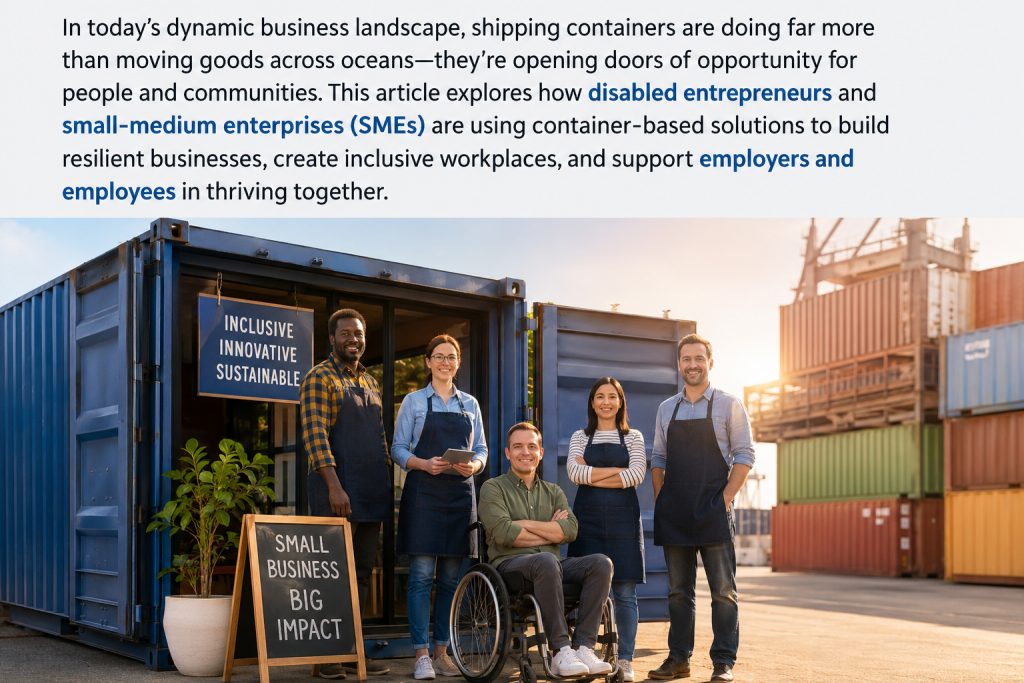
Accessibility and scalability are often treated as opposing forces in business. The assumption goes something like this: making operations more accessible, for employees, partners, or customers, adds friction, slows things down, and limits how big you can grow. But the most resilient, fast‑growing companies prove the opposite. When accessibility is built intentionally into operations, it becomes a growth multiplier rather than a constraint.
Accessibility isn’t just about physical spaces or compliance checklists. In operational terms, accessibility means systems that are easy to understand, enter, use, and adapt. It’s about removing unnecessary barriers, complex workflows, confusing layouts, rigid systems, that prevent people and processes from operating efficiently. When operations are accessible, teams onboard faster, errors decrease, and adaptability increases. That foundation supports scale rather than restricting it.
Simplicity Is the Gateway to Scale
One of the strongest links between accessibility and growth is simplicity. Complicated systems may feel sophisticated, but they’re difficult to scale because they rely too heavily on individual knowledge and constant oversight. Accessible operations are simple by design: clear workflows, standardized processes, and repeatable systems. Simplicity doesn’t reduce capability, it removes friction. And friction is one of the biggest silent killers of scalability.
Physical Accessibility Supports Operational Flow
For many businesses, especially those in logistics, construction, manufacturing, or distribution, accessibility starts with physical space. Congested facilities, unclear storage zones, or poorly planned layouts slow down movement and increase mistakes. Making operations physically accessible, clear paths, logical storage, modular layouts, allows work to flow smoothly, no matter how much volume increases. This is where flexible infrastructure becomes critical as businesses grow.
Modular Infrastructure Enables Inclusive Growth
Modularity is one of the most powerful principles for balancing accessibility and scale. Modular systems are easy to understand, adjust, and expand without disrupting existing operations. Instead of locking into rigid, permanent solutions too early, accessible businesses invest in infrastructure that evolves with demand. For regionally expanding companies, this often includes flexible on‑site solutions like containers for sale in Miami that provide scalable storage and workspace without forcing immediate facility expansion. Modularity reduces risk while increasing capacity.
Clear Systems Empower More People
Accessible operations don’t rely on a small group of experts to keep things moving. They empower more people to participate effectively. Clear documentation, visual systems, standardized tools, and defined responsibilities allow employees at every level to contribute without constant guidance. This matters enormously as teams grow. When institutional knowledge is built into systems instead of residing in individuals, scaling becomes smoother and less fragile.
Accessibility Improves Speed, Not Just Comfort
There’s a misconception that making things accessible slows them down. In reality, accessibility increases speed by reducing hesitation and error. When employees know exactly where materials go, how processes work, and what’s expected, decisions happen faster. Training becomes more efficient. Transitions between roles or shifts are smoother. Accessible operations move quickly because they’re predictable and intuitive.
Cost Control Thrives in Accessible Systems
Accessible operations are also easier to monitor and optimize financially. When systems are clear, waste is easier to spot. When workflows are standardized, inefficiencies stand out. Businesses with accessible operations tend to catch issues early, before they balloon into expensive problems. This financial clarity supports sustainable scaling by ensuring growth is funded by efficiency rather than debt or reactive spending.
Safety and Accessibility Scale Together
Operational safety is deeply intertwined with accessibility. Complex, cluttered, or poorly labeled environments create hazards that multiply as volume increases. Accessible operations prioritize clear pathways, defined zones, and intuitive systems that reduce the chance of mistakes. As scale increases, safety incidents don’t rise proportionally because the environment supports correct behavior by default. That stability is critical for long‑term growth.
Technology as an Accessibility Tool
Technology plays a major role in making operations accessible at scale, but only when it’s used thoughtfully. The best systems reduce cognitive load rather than adding to it. Dashboards that show essential data, inventory systems that mirror physical layouts, and communication tools that centralize information all make operations easier to navigate. When technology supports clarity instead of complexity, it becomes a powerful enabler of growth.
Inclusive Design Improves Resilience
Accessible operations are inherently more resilient. When systems are easy to understand and use, they can absorb change more effectively, new hires, new locations, new product lines. Resilience isn’t built by over‑engineering; it’s built by designing systems that people can quickly grasp and adapt. Inclusive operational design ensures growth doesn’t depend on perfect conditions or specific individuals.
Leadership Sets the Tone for Accessibility
Businesses that successfully scale without sacrificing accessibility almost always have leadership teams that value operations as much as vision. They ask practical questions: Can someone new understand this? Can this process handle double the volume? What happens if a key person is unavailable? Leaders who think this way build organizations where accessibility and scale reinforce each other instead of competing.
Accessibility Creates Momentum
When operations are accessible, confidence spreads. Employees trust systems. Managers trust data. Leaders trust execution. That trust creates momentum. Instead of constantly troubleshooting, teams can focus on growth initiatives, new markets, new services, new partnerships, knowing the operational foundation can support them.
Conclusion
Building accessible business operations doesn’t mean compromising ambition. In fact, accessibility is one of the most reliable paths to sustainable scale. By simplifying systems, prioritizing clarity, investing in modular infrastructure, and empowering people through thoughtful design, businesses create operations that grow stronger as they expand. Accessibility removes friction, unlocks participation, and creates the stability that real scale demands. When operations work for people, growth works for the business.