Disclaimer: This article is for informational and educational purposes only. It reflects general observations and publicly discussed viewpoints regarding UK economic conditions and should not be taken as financial or legal advice. Readers should seek professional guidance tailored to their individual circumstances.
A Changing Landscape for British Enterprise Amid Rising Financial Strain
Recent commentary, including that by Michael Mosbacher in The Telegraph, has reignited debate about whether the UK is losing its long-standing identity as a nation of entrepreneurs. Once known for its thriving family businesses and generational enterprises, Britain is now facing increasing concern over business closures, relocations, and workforce reductions.
A combination of rising taxes, economic uncertainty, and post-Brexit financial pressures has created an environment where many businesses, particularly small and family-run firms, are struggling to remain viable.
“From high street collapses to multinational relocations, the pattern is clear: the UK is becoming an increasingly difficult environment for businesses to sustain long-term growth without adaptation or relocation.”
Important Note To Remember
- Not all movements are solely due to “tax raids.”
- Other contributing factors include:
- Brexit trade friction
- Energy costs
- Supply chain disruption
- Globalisation strategies
However, taxation and regulatory burden are frequently cited as key contributing pressures, particularly for:
- Family businesses
- SMEs
- Agricultural enterprises
The Impact of Taxation on Family Businesses and Agriculture
One of the most contentious issues is the growing burden of taxation, particularly:
- Inheritance Tax (IHT) affecting family businesses
- Financial pressures on farmers and agricultural enterprises
- Increased operational costs linked to compliance and regulation
Family businesses, some of which have existed for generations, are now at risk of being dismantled simply due to the inability to meet inheritance tax liabilities. Similarly, the agricultural sector, already operating on tight margins, faces further strain, raising concerns about long-term sustainability and food security.
These pressures are not just financial; they are cultural. The loss of family-run enterprises represents the erosion of legacy, community identity, and economic diversity.
Consequences: Closures, Redundancies, and Offshoring
As a result of these mounting pressures, businesses are increasingly:
- Closing down permanently
- Making staff redundant to cut costs
- Relocating operations offshore to more favourable tax jurisdictions
This not only impacts employment levels but also weakens the UK’s economic resilience. When businesses leave, so too do innovation, tax contributions, and opportunities for future growth.
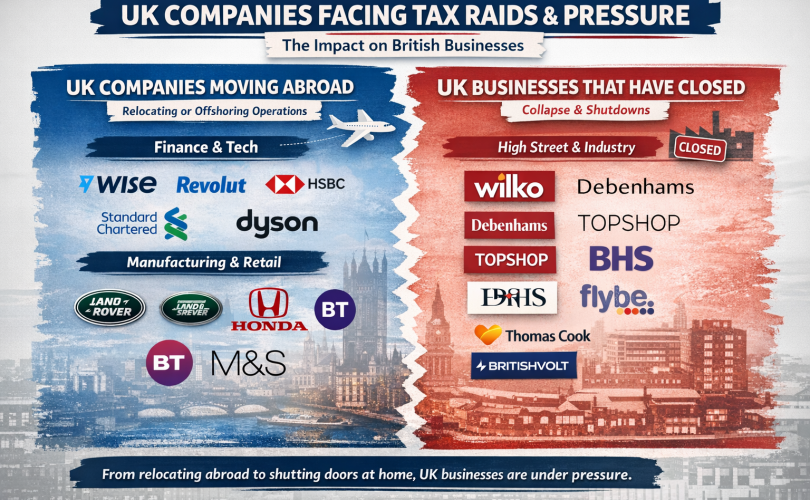
UK-Based Companies Moving Operations Abroad / Scaling Back UK Presence
These are UK-headquartered or UK-operating companies that have either moved, offshored, or significantly shifted activity abroad:
Finance, Tech & Corporate Relocation
- Wise – planning US listing shift
- Revolut – expanding HQ functions overseas (EU focus)
- HSBC – strategic shift toward Asia (Hong Kong focus)
- Standard Chartered – Asia/Africa operational focus
- Shell plc – simplified structure but globalised away from UK roots
- Unilever – restructuring with stronger EU footprint
- Arm Holdings – chose US listing over London
Manufacturing & Automotive
- Jaguar Land Rover – expanding production abroad (Slovakia/India)
- Nissan UK – reduced UK output, increased EU/Japan reliance
- Honda UK – Swindon plant closed (production moved abroad)
- Ford UK – engine plant closures, production shifted overseas
- BMW Group UK – MINI production uncertainty, some production abroad
Telecoms, Services & Outsourcing
- Lycamobile – moving roles offshore (India)
- BT Group – outsourcing jobs overseas
- Vodafone UK – restructuring with international consolidation
Retail & Consumer Businesses (Shifting Abroad / Scaling UK Down)
- Tesco – exited multiple international/UK operations, restructuring footprint
- Marks & Spencer – closing UK stores while expanding online/global
- Arcadia Group – collapse led to brands moving online/global ownership
- Dyson Ltd – moved HQ to Singapore
- INEOS – leadership and operations increasingly international
UK Businesses That Have Closed
These closures reflect the economic pressure environment, even if not all are directly due to tax:
Retail & High Street Collapse
- Wilko – collapsed (2023)
- Debenhams – high street stores closed
- Topshop – physical stores gone (Arcadia collapse)
- Dorothy Perkins – closed stores
- Burton Menswear – high street exit
- BHS – collapse
- House of Fraser – major closures
- Paperchase – administration
- Beales – department store closures
- Cath Kidston – UK stores closed
Hospitality & Leisure
- Prezzo – multiple closures
- Byron Burger – closures and restructuring
- Jamie’s Italian – collapsed chain
- Carluccio’s – closures
Manufacturing / Industry
- Britishvolt – collapsed battery startup
- Flybe – airline collapse
- Thomas Cook – major collapse
- Made.com – administration
- Safestyle UK – collapse
- McColl’s – administration and restructuring
Strategies for Businesses to Stay Afloat
Despite the challenges, there are practical steps businesses can consider to improve resilience:
1. Embracing Remote Work
Encouraging employees to work from home can:
- Reduce overheads (e.g., office space, utilities)
- Improve employee satisfaction and retention
- Increase productivity in certain sectors
2. Exploring Self-Employment Models
Businesses may consider:
- Transitioning some roles into self-employed or contractor positions
- Offering profit-sharing or equity-based incentives
This can reduce fixed payroll costs while empowering workers with a stake in the business’s success.
3. Downsizing and Digital Transformation
Particularly relevant for retail businesses:
- Downsizing physical premises
- Transitioning to e-commerce platforms
- Using pop-up shops to maintain a physical presence without long-term costs
4. Diversification of Revenue Streams
- Expanding product or service offerings
- Leveraging digital marketing and omnichannel strategies
- Collaborating with other businesses to share resources
Limitations of These Strategies
It is important to recognise that not all solutions are universally applicable. For example:
- Retail and manufacturing sectors often require physical presence
- Factory-based roles cannot easily transition to remote work
- Smaller businesses may lack the capital to invest in digital transformation
Nevertheless, adaptability remains key in navigating economic uncertainty.
Government Spending and Public Accountability
There is growing public discourse around how government spending impacts the wider economy. Questions are increasingly being raised about:
- The level of public sector salaries and bonuses
- The efficiency and productivity of certain roles
- Whether public funds are being allocated in a way that supports economic growth
Some argue that before imposing further financial burdens on businesses and vulnerable groups, there should be greater transparency and accountability in how taxpayer money is spent.
There are also calls for a broader conversation about fairness, particularly when policies affecting disabled individuals and those on benefits are introduced alongside rising costs of living.
A Call for Balance and Reform
The UK’s economic future depends on striking a balance between:
- Generating tax revenue
- Supporting businesses to grow and survive
- Protecting vulnerable populations
If entrepreneurship is to thrive once again, policies must encourage innovation, reward risk-taking, and protect legacy businesses rather than inadvertently pushing them toward closure or relocation.
Conclusion
Britain’s entrepreneurial spirit has long been one of its defining strengths. However, increasing financial pressures, particularly taxation and economic policy decisions, are testing the resilience of businesses across the country.
While businesses must adapt and innovate to survive, there is also a clear need for policymakers to carefully consider the long-term consequences of their decisions. Supporting enterprise is not just about economics—it is about preserving livelihoods, communities, and the very fabric of society.
Further Reading & Resources
- Britain used to be a nation of entrepreneurs – now we’re worse than the Germans
- Welsh Ambulance Service recruitment freeze means students consider moving abroad – BBC News
- Major bank to leave UK as Brits face £829 payout – in business since 1998
- UK Market Exodus: Companies that moved away from London listing in recent years | Reuters
- Rachel Reeves’ economic chaos could see 340k British businesses leave UK high streets
- Alistair Cunningham: Clients leaving and the cost to Britain | Money Marketing
- Major bank to leave UK after Rachel Reeves’ £750m change – in business since 1998 | UK | News | Express.co.uk
- London Stock Exchange suffers biggest exodus since financial crisis
- Why So Many Millionaires (and Businesses) Are Leaving the UK – And What the Government Must Do About It | LinkedIn
- E-scooter giant threatens UK exit as Labour’s ‘totally restrictive’ rules risk pushing another brand out


Renata The Editor of DisabledEntrepreneur.uk - DisabilityUK.co.uk - DisabilityUK.org - CMJUK.com Online Journals, suffers From OCD, Cerebellar Atrophy & Rheumatoid Arthritis. She is an Entrepreneur & Published Author, she writes content on a range of topics, including politics, current affairs, health and business. She is an advocate for Mental Health, Human Rights & Disability Discrimination.
She has embarked on studying a Bachelor of Law Degree with the goal of being a human rights lawyer.
Whilst her disabilities can be challenging she has adapted her life around her health and documents her journey online.
Disabled Entrepreneur - Disability UK Online Journal Working in Conjunction With CMJUK.com Offers Digital Marketing, Content Writing, Website Creation, SEO, and Domain Brokering.
Disabled Entrepreneur - Disability UK is an open platform that invites contributors to write articles and serves as a dynamic marketplace where a diverse range of talents and offerings can converge. This platform acts as a collaborative space where individuals or businesses can share their expertise, creativity, and products with a broader audience.