Depression, Trauma, and the Reality Behind the Smile
An in-depth look at depression, trauma, and PIP assessments, exploring why outward behaviour does not reflect mental health and how self-help strategies support recovery.
DISABLED ENTREPRENEUR – DISABILITY UK
Disability UK Online Health Journal – All In One Business In A Box – Forum – Business Directory – Useful Resources – Health – Human Rights – Politics
DISABLED ENTREPRENEUR – DISABILITY UK
Disability UK Online Health Journal – All In One Business In A Box – Forum – Business Directory – Useful Resources – Health – Human Rights – Politics
Browsing Category

An in-depth look at depression, trauma, and PIP assessments, exploring why outward behaviour does not reflect mental health and how self-help strategies support recovery.

Exploring the connection between energy, death, and consciousness. This reflective article examines physics, paranormal theories, memorial diamonds, grief, and personal experiences that raise questions about what may happen after we die.

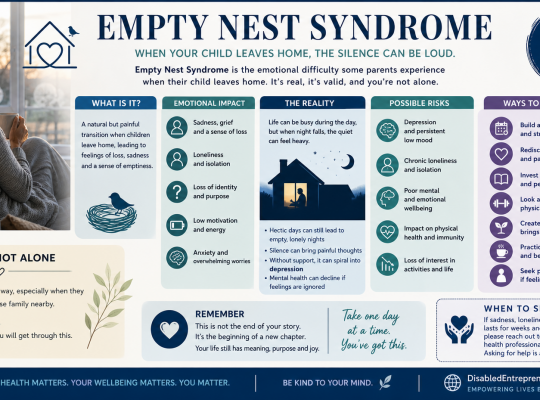
Young adult detachment issues and separation guilt affect both generations. Explore how empty nest syndrome and young adults’ guilt intersect, and how families can navigate independence with empathy.

Exploring the balance between freedom of expression and public harm — and why stronger legislation, trigger warnings, and editorial standards are urgently needed in media and social platforms.

An honest, first-person article on relationship breakups, unrequited love, divorce, and healing, offering practical guidance on what to do and what not to do when your heart is broken.

A personal reflection on taking things for granted, regret, grief, empty nest syndrome, and the connection to mental health—highlighting how loss teaches us the value of people and moments.

The Hall of Mirrors concept offers a compelling way to think about life, death, and consciousness within a multiverse framework. Rather than viewing the universe as singular and final, this perspective suggests the existence of multiple parallel universes emerging from identical initial conditions. At the moment of divergence, these universes are indistinguishable, yet over time they evolve independently due to minute quantum-level variations. Each universe becomes a near-reflection of the others, similar, but never exactly the same. Within this framework, death need not be understood as an absolute ending, but as a transition between states of existence.

People with OCD don’t “choose” their thoughts or compulsions. Telling someone to “just get over it” is dismissive, harmful, and perpetuates ableist attitudes. If someone has lived with OCD for decades and tried all known interventions, Cognitive Behavioural Therapy (CBT), Exposure and Response Prevention (ERP), medication, counseling, and even alternative therapies such as hypnosis, it is unjust to boil their suffering down to a fad.

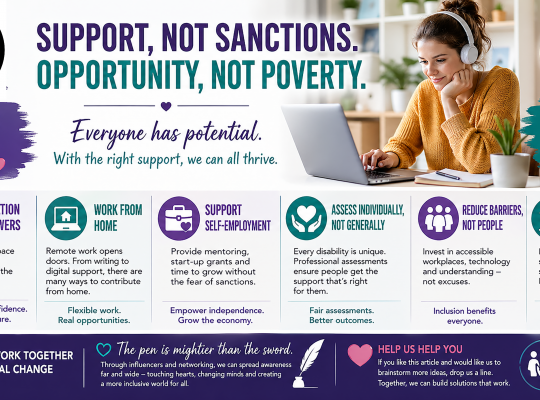
Labour is facing the prospect of another mass rebellion from its own MPs as concerns mount over proposed reforms to the universal credit system. The focus of unease is on changes to the assessment process for disability benefits, particularly the health element of universal credit (UC).

Invisible disabilities deserve recognition, understanding, and respect. Ableist attitudes rooted in ignorance and dismissiveness create barriers that can be just as disabling as the condition itself. Instead of questioning someone’s reality or minimising their struggles, we should listen, believe, and support. The lived experiences of those with invisible disabilities, like the editor who has battled OCD for decades, remind us that what cannot be seen can still have profound impact. True inclusivity means dismantling ableism and embracing empathy.