Disclaimer: This article is for informational and awareness purposes only and does not constitute medical, psychiatric, or legal advice. If you are struggling with your mental health, intrusive thoughts, anxiety, or obsessive-compulsive symptoms, seek support from a qualified healthcare professional, GP, therapist, solicitor, or emergency services if you are in immediate danger.
When Grief, Isolation, Anxiety, Financial Stress & Social Rejection Become Fuel for Obsessive Thoughts
Obsessive-Compulsive Disorder is often misunderstood as simply being about excessive cleaning or repetitive habits. In reality, OCD can be a debilitating mental health condition involving intrusive thoughts, compulsions, anxiety, fear, doubt, hypervigilance, and emotional distress.
For many people, OCD is not random. Trauma, prolonged grief, emotional neglect, rejection, humiliation, stress, financial pressure, and the way a person is treated by society can all contribute to symptoms developing or worsening.
A person may appear “high functioning” on the outside while privately battling intrusive thoughts, panic, compulsions, insomnia, self-doubt, and emotional exhaustion.
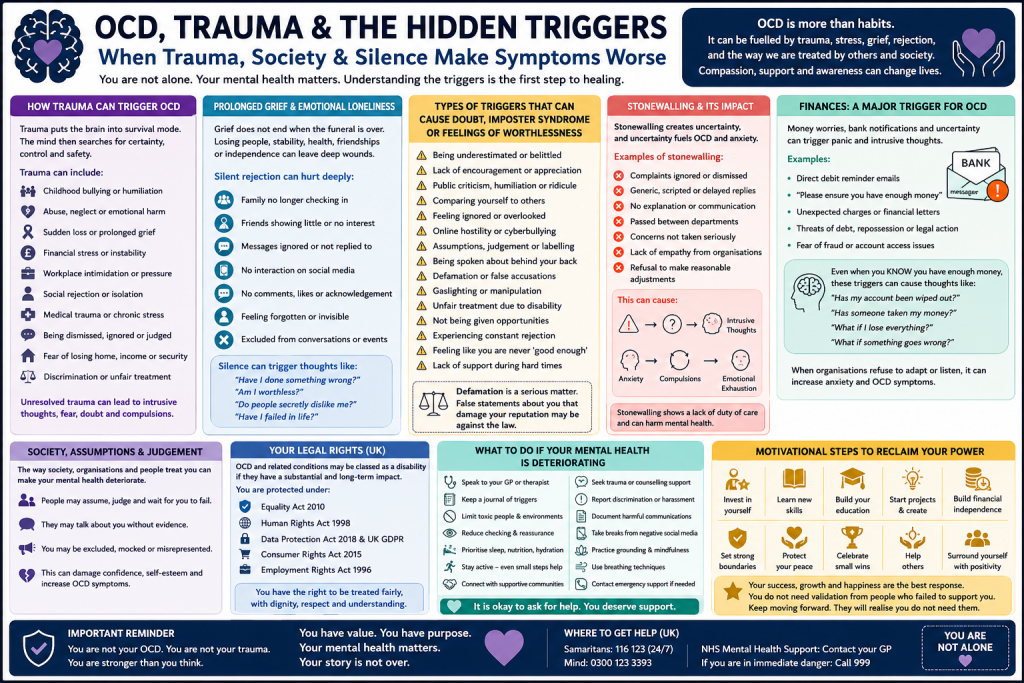
Trauma changes the nervous system. When a person experiences repeated emotional stress, betrayal, abandonment, abuse, discrimination, or prolonged uncertainty, the brain can become trapped in survival mode. This may lead to obsessive thinking patterns designed to seek certainty, control, reassurance, or safety.
How Trauma Can Trigger OCD
Trauma is not always one dramatic event. Sometimes trauma is cumulative.
It can include:
- Childhood bullying or humiliation
- Domestic abuse
- Emotional neglect
- Sudden bereavement or prolonged grief
- Financial instability
- Workplace intimidation
- Public shaming or ridicule
- Medical trauma
- Social isolation
- Being repeatedly dismissed or ignored
- Chronic stress from government agencies or organisations
- Feeling unsafe or unsupported
- Fear of losing housing, income, or independence
- Constant criticism or judgment
When trauma is unresolved, the brain may begin scanning constantly for danger or “what if” scenarios.
This is where OCD can become deeply connected to fear and uncertainty.
Prolonged Grief & Emotional Loneliness
Grief does not always end after a funeral.
Losing parents, siblings, partners, friendships, careers, health, financial security, or independence can leave lasting emotional wounds. Prolonged grief can create feelings of emptiness, loneliness, hopelessness, and emotional detachment.
When someone feels abandoned emotionally, the mind may become more vulnerable to intrusive thoughts and compulsive reassurance-seeking behaviours.
Some people experience what feels like “silent rejection” from the world around them.
Examples may include:
- Family members no longer checking in
- Friends showing little interest in your well-being
- Messages being ignored
- No interaction on social media
- No comments, likes, photos, or acknowledgements
- Feeling forgotten or invisible
- Being excluded from conversations or family events
Silence itself can become psychologically damaging.
For someone with OCD or anxiety, emotional distance may trigger thoughts such as:
- “Have I done something wrong?”
- “Why does nobody care?”
- “Am I worthless?”
- “Are people talking about me?”
- “Have I failed in life?”
- “Do people secretly dislike me?”
Over time, these thoughts may feed compulsive rumination and emotional distress.
Stonewalling & Its Psychological Impact
Stonewalling occurs when a person or organisation refuses to engage meaningfully, avoids communication, dismisses concerns, or leaves someone in prolonged uncertainty.
Stonewalling can severely worsen anxiety and OCD symptoms because uncertainty is often one of the biggest triggers for obsessive thinking.
Examples include:
- Complaints being ignored
- Generic scripted responses
- Delayed replies with no explanation
- Lack of empathy from institutions
- Being passed between departments
- Feeling dismissed when raising legitimate concerns
- Organisations failing to make reasonable adjustments
This can create a cycle of:
Fear → Doubt → Intrusive Thoughts → Anxiety → Compulsions → Emotional Exhaustion
Financial Anxiety & OCD
Finances are a major trigger for many people with OCD and anxiety disorders.
Even financially secure individuals may still experience panic triggered by notifications, reminders, warnings, or unexpected financial communications.
For example, automated banking emails stating:
“Please ensure you have enough money in your account” may trigger catastrophic thinking in someone with OCD, even when they know they have sufficient funds available.
The brain may instantly jump to intrusive thoughts such as:
- “Has my account been hacked?”
- “Has my money disappeared?”
- “What if something has gone wrong?”
- “What if I missed something important?”
- “What if I lose everything?”
This may lead to compulsive checking behaviours, repeated account monitoring, panic, insomnia, or heightened anxiety.
When organisations dismiss these concerns or refuse to adapt communication methods for vulnerable customers, it can feel dehumanising and emotionally harmful.
Society, Assumptions & Imposter Syndrome
Many people living with OCD also struggle with imposter syndrome.
They may constantly doubt themselves, their intelligence, their achievements, or their worth, even when they are hardworking, capable, and successful.
Triggers can include:
- Being underestimated
- Lack of encouragement
- Public criticism
- Social comparison
- Feeling ignored
- Online hostility
- Being treated differently because of disability
- Gaslighting
- Defamation or gossip
- Being judged without evidence
- Feeling unsupported during difficult times
Some individuals may feel that people around them are quietly waiting for them to fail because assumptions have already been made about them.
Being spoken about behind your back, misrepresented, or judged without evidence can deeply affect mental health, confidence, and self-esteem.
False accusations and damaging statements may also cross into areas of Defamation Law where reputational harm is caused through untrue statements communicated to others.
The Law, Mental Health & Disability Rights
Mental health conditions, including OCD, may qualify as disabilities under the Equality Act 2010 if they have a substantial and long-term impact on day-to-day activities.
Under the Equality Act 2010, organisations and employers may have duties relating to:
- Reasonable adjustments
- Non-discrimination
- Accessibility
- Fair treatment
- Protection from harassment
Relevant legal protections may also include:
- Human Rights Act 1998
- Data Protection Act 2018
- UK GDPR rights regarding personal data and sensitive information
- Consumer protection obligations
- Employer duties relating to workplace wellbeing
In some circumstances, repeated harassment, bullying, discrimination, or negligent treatment may contribute to mental health deterioration.
What To Do If Your Mental Health Is Deteriorating
If you feel your OCD, anxiety, or mental health worsening, it is important not to suffer in silence.
Practical Steps You Can Take
- Speak to your GP or mental health professional
- Keep a journal of triggers and symptoms
- Limit exposure to toxic people or environments
- Reduce compulsive checking behaviours gradually
- Avoid excessive reassurance-seeking
- Prioritise sleep, nutrition, and hydration
- Stay physically active where possible
- Connect with supportive communities
- Seek counselling or trauma therapy
- Report discrimination or harassment where appropriate
- Document harmful communications if needed legally
- Take breaks from negative social media environments
- Practice grounding and mindfulness techniques
- Contact emergency support services if you feel unsafe
Motivational Things You Should Do To Rebuild Confidence
The people who underestimate you do not define your future.
Sometimes the most powerful response is not revenge, it is progress.
Focus On:
- Building your education
- Learning new skills
- Starting projects
- Creating a business
- Exercising your mind daily
- Reading and self-development
- Setting boundaries
- Protecting your peace
- Building financial independence
- Publishing your work
- Helping others
- Celebrating small wins
- Creating routines
- Surrounding yourself with positive influences
- Refusing to let rejection define your worth
Success, growth, resilience, and self-respect often speak louder than arguments ever will.
You do not need validation from people who failed to support you.
Final Thoughts
Mental health deterioration rarely happens in isolation.
The way society, institutions, family members, workplaces, and communities treat people matters. Emotional neglect, stonewalling, uncertainty, financial stress, social rejection, and trauma can all intensify OCD symptoms and emotional suffering.
Compassion, communication, understanding, and reasonable adjustments are not weaknesses; they are part of a responsible and humane society.
No one should feel invisible, unheard, or psychologically exhausted simply for asking to be treated with dignity, respect and as an equal.
Further Reading & Resources
- Trauma-related pathways in obsessive-compulsive disorder: A systematic review of aetiology, symptom dimensions and severity – ScienceDirect
- Can trauma make you more susceptible to OCD? | NOCD
- OCD and Trauma: Understanding the Connection
- The Relationship Between PTSD and OCD
- OCD Triggers: How to Identify & Deal With Them
- Causes of OCD | Types of mental health problems | Mind
- Causes of OCD
- Overview – Obsessive compulsive disorder (OCD) – NHS
- An OCD Trigger: What It Is and Ways to Cope | Psych Central
- What Is Stonewalling and Why Does It Damage Relationships? | Psychology Today
- Why the Silent Treatment Is Emotional Abuse | Psychology Today
- What is stonewalling abuse and why do people do it? – Stowe Family Law
- Stonewalling | Relate
- OCD.Cymru
- cavuhb.nhs.wales/files/obsessive-compulsive-disorder/specialist-ocd-service-pdf/
- OCD and stigma | Types of mental health problems | Mind
- Breaking Down OCD Myths: Dispelling Misconceptions and Stigma | International OCD Foundation
- OCD and Stigma | OCD-UK
- Myths and Stereotypes about OCD – OCD Action


Renata The Editor of DisabledEntrepreneur.uk - DisabilityUK.co.uk - DisabilityUK.org - CMJUK.com Online Journals, suffers From OCD, Cerebellar Atrophy & Rheumatoid Arthritis. She is an Entrepreneur & Published Author, she writes content on a range of topics, including politics, current affairs, health and business. She is an advocate for Mental Health, Human Rights & Disability Discrimination.
She has embarked on studying a Bachelor of Law Degree with the goal of being a human rights lawyer.
Whilst her disabilities can be challenging she has adapted her life around her health and documents her journey online.
Disabled Entrepreneur - Disability UK Online Journal Working in Conjunction With CMJUK.com Offers Digital Marketing, Content Writing, Website Creation, SEO, and Domain Brokering.
Disabled Entrepreneur - Disability UK is an open platform that invites contributors to write articles and serves as a dynamic marketplace where a diverse range of talents and offerings can converge. This platform acts as a collaborative space where individuals or businesses can share their expertise, creativity, and products with a broader audience.