Disclaimer: Disabled Entrepreneur UK operates as part of an omnichannel network of websites owned and managed by The UK Website Designers Group. The information provided in this article is for general awareness only and should not be interpreted as legal or medical advice. For guidance on benefits eligibility, employment rights, or health-related matters, please consult appropriately qualified professionals.
Challenging Assumptions About “Non-Work-Limiting” Conditions. Why One-Size-Fits-All Judgements Fail Disabled Youth
Recent debate has intensified following a report by the Tony Blair Institute for Global Change suggesting that conditions such as moderate depression, ADHD, and lower-back pain should be considered“non-work-limiting.” Disability charities have strongly criticised this position, arguing that it oversimplifies complex, clinically recognised conditions and risks marginalising both young people and adults who rely on support such as Personal Independence Payment.
At the heart of the issue is a misunderstanding: disability is not binary. The impact of a condition varies widely depending on severity, co-morbidities, environment, and access to support. For young people in particular, many of whom are still developing, studying, or navigating early adulthood, these assumptions can be especially harmful.
The Importance of Diagnosis and Individual Assessment
Conditions like Attention Deficit Hyperactivity Disorder (ADHD) are neurodevelopmental disorders characterised by inattention, impulsivity, and hyperactivity. While some individuals manage well with treatment and structured environments, others experience profound difficulties with focus, time management, emotional regulation, and executive functioning. These challenges can make sustained employment extremely difficult, particularly in fast-paced or high-pressure roles.
Similarly, mental health conditions such as Depression, grief-related disorders, trauma, and Post-Traumatic Stress Disorder (PTSD) can significantly impair daily functioning. Symptoms may include fatigue, cognitive impairment, panic attacks, intrusive memories, and emotional instability. These are not simply “bad days”; they can be chronic and debilitating.
For individuals with Obsessive-Compulsive Disorder (OCD), everyday tasks may become overwhelming. Some people struggle to leave their homes due to contamination fears, repetitive compulsions, or severe anxiety. Suggesting such conditions are inherently “non-work-limiting” ignores the lived reality of those affected.
This is why professional assessment is essential. Qualified clinicians evaluate not just the diagnosis, but the functional impact on a person’s ability to carry out daily activities, including work.
When Work Is Possible, But Only Under Certain Conditions
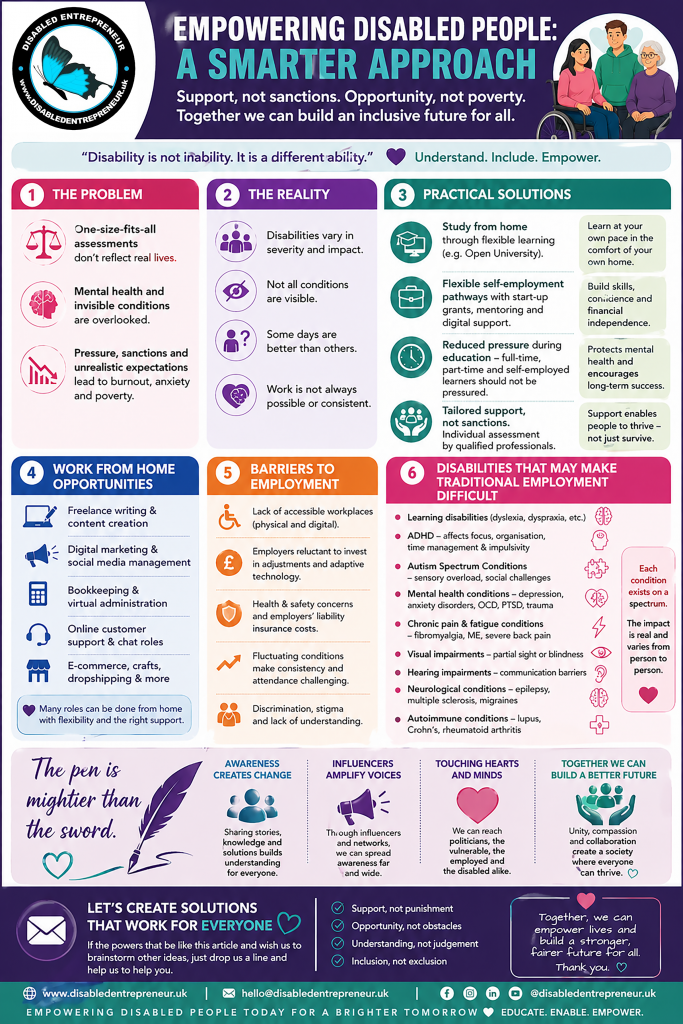
While some young people with disabilities may not be able to work in traditional environments, others can engage in work within the confines of their homes. Flexible, remote opportunities can offer a lifeline. These may include freelance writing, digital marketing, graphic design, bookkeeping, customer support via chat, content creation, or running an online business.
However, even home-based work is not universally accessible. Cognitive impairments, severe fatigue, chronic pain, or sensory sensitivities may still limit productivity or consistency. The assumption that “everyone can work from home” fails to account for these barriers.
Disabilities That May Limit Traditional Employment
There are numerous conditions, often invisible, that can make standard workplace environments unsuitable or unsafe. These include:
- Learning disabilities such as dyslexia or dyspraxia can affect comprehension, coordination, and task execution under pressure.
- Visual impairments, ranging from partial sight to blindness, which may require specialised technology or adaptations not always provided by employers.
- Hearing impairments can hinder communication in environments not equipped with assistive tools.
- Chronic pain conditions, such as fibromyalgia or severe back disorders, can make sitting, standing, or commuting intolerable.
- Autoimmune diseases like multiple sclerosis, where fatigue, mobility issues, and cognitive decline fluctuate unpredictably.
- Severe anxiety disorders, including agoraphobia, which may prevent individuals from leaving their homes.
- Neurological conditions, such as epilepsy, which pose safety risks in certain work environments.
- Developmental disorders such as autism spectrum conditions, where sensory overload and social interaction can be overwhelming.
Each of these conditions exists on a spectrum, but all can significantly impact a person’s ability to engage in “normal” work environments.
The Reality of Workplace Barriers
Even where individuals are willing and able to work, structural barriers remain. Employers are often reluctant to invest in accessible infrastructure, adaptive technologies, or tailored support. Adjustments required under equality legislation may be seen as costly or inconvenient.
There are also legitimate concerns around health and safety. Employers must consider risk assessments, reasonable adjustments, and obligations under employers’ liability insurance. For some roles, accommodating certain disabilities may present practical or financial challenges that businesses are unwilling, or unable, to meet.
Solutions That Support Abled & Disabled People Without Punishment
A more constructive approach would focus on enabling, not penalising. One practical solution is expanding access to flexible education through institutions like the Open University. Distance learning allows disabled people, young and old, to study at their own pace from home, reducing the stress of commuting, rigid schedules, and inaccessible environments. For individuals managing conditions such as Obsessive-Compulsive Disorder, Depression, or Post-Traumatic Stress Disorder, this model provides a realistic pathway to gaining qualifications without worsening their health. It is also a balanced outcome for the government: individuals build skills and future earning potential, while student finance systems are utilised as intended. Crucially, individuals studying full-time, as well as those studying part-time while working in self-employment, should not be pressured into additional employment demands, as doing so risks burnout, relapse, and long-term disengagement from both education and sustainable work.
Another effective solution would be a structured, supported pathway into self-employment and remote work. Many disabled individuals have the capacity to contribute economically, but not within traditional employment frameworks. Government-backed programmes could provide tailored mentoring, start-up grants, and access to digital tools, alongside easing of conditionality within systems like Universal Credit. Instead of quickly labelling people as “not gainfully self-employed,” there should be recognition that building a business takes time, particularly when managing a health condition. A phased model, where individuals are supported while developing income streams, with access to funding (business loans, grants, and angel investments) to help with business growth, would encourage independence without the fear of sanctions. This benefits both the individual, who gains confidence and financial autonomy, and the government, which ultimately reduces long-term reliance on benefits while fostering entrepreneurship and innovation.
If the government supported sole traders through accessible investments, grants, and loans, without requiring them to form limited companies or meet unrealistic turnover thresholds such as £250K, they would be better positioned to grow their businesses, create opportunities, and contribute meaningfully to the wider economy.
Supporting People with Learning Disabilities Into Meaningful Work
A constructive solution for people who are intellectually challenged or have learning disabilities. such as Down Syndrome or Attention Deficit Hyperactivity Disorder, is to move away from rigid employment expectations and instead build supportive, flexible pathways into work. Society and government can play a key role by investing in supported employment programmes, where individuals are paired with trained job coaches who help them learn tasks gradually, build confidence, and adapt to workplace environments. Rather than expecting immediate productivity, this approach focuses on long-term development, dignity, and independence.
Education also needs to evolve. Practical, hands-on learning, such as vocational training in areas like hospitality, crafts, digital skills, or logistics, can be far more effective than purely academic routes. Expanding accessible training through flexible institutions like the Open University or local community programmes can allow individuals to learn at their own pace, in ways that suit their abilities. Government incentives for employers, such as wage subsidies, tax relief, or grants for workplace adaptations, would also make businesses more willing to hire and retain disabled workers.
Social enterprises offer a powerful model. Businesses like Stand Out Socks demonstrate how inclusive employment can thrive when organisations are built with purpose. These models can be replicated across industries, cafés, online stores, packaging services, and digital content teams, where roles are tailored to individuals’ strengths rather than forcing people into unsuitable positions.
Footnotes:
How Entrepreneurs Can Create Opportunities
Entrepreneurs, especially disabled entrepreneurs, are uniquely positioned to lead change by designing businesses that are inclusive from the ground up. Some practical ways to do this include:
- Creating simple, structured roles with clear instructions and repetition, which can suit individuals with learning disabilities.
- Building micro-business teams, where tasks are broken down into manageable steps (e.g., packing orders, data entry, product assembly).
- Offering remote or home-based work reduces anxiety and accessibility barriers.
- Developing mentorship schemes, pairing experienced individuals with those entering the workforce.
- Using assistive technology, such as voice-to-text tools, visual prompts, and task management apps.
- Designing sensory-friendly workspaces with reduced noise and flexible environments.
- Partnering with charities and local organisations to identify talent and provide ongoing support.
- Encouraging self-employment pathways, where individuals can run small ventures such as crafts, reselling, blogging, or digital services.
- Creating co-operative business models, where disabled individuals collectively contribute and share in profits.
- Promoting inclusive hiring practices, focusing on ability rather than limitations.
A Smarter, Inclusive Future
The key is not to ask whether people with learning disabilities can work, but how work can be adapted to include them. With the right support, many individuals can contribute meaningfully, whether through employment, self-employment, or community-based enterprises.
By combining government support, forward-thinking entrepreneurship, and inclusive education, society can move away from exclusion and towards empowerment, creating opportunities where none previously existed.
Product-Based Social Enterprises
- Custom Candle & Wax Melt Brand
Simple pouring, labelling, and packing tasks with strong gifting appeal. - Greeting Cards & Stationery Business
Designed in-house or outsourced, with teams assembling, packaging, and fulfilling orders. - Branded Tote Bags & Merchandise
Printing, folding, packing, and order fulfilment are ideal for repetitive, structured roles. - Handmade Soap & Skincare Products
Measured processes with clear steps are good for routine-based work. - Subscription Gift Boxes
Monthly themed boxes (wellbeing, snacks, crafts) are assembled and packed by teams.
Food & Hospitality Concepts
- Inclusive Bakery or Biscuit Brand
Baking, decorating, and packaging tasks can be broken down into manageable steps. - Pre-Packaged Snack Boxes
Healthy snack packs for offices or online orders. - Coffee Cart / Mobile Café
Small, controlled environments with consistent routines.
E-Commerce & Fulfilment
- Order Packing & Fulfilment Service
Helping small businesses pack and ship products, scalable and process-driven. - Reselling / Upcycling Business
Sourcing, cleaning, photographing, listing, and shipping items.
Creative & Digital Work (with support tools)
- Print-on-Demand Designs
Simple graphics for t-shirts, mugs, and accessories. - Content Creation Team
Blogging, basic social media posting, or product descriptions with guidance. - Sticker & Badge Business
Designing (or outsourcing design), printing, cutting, and packing.
Craft & Assembly-Based Work
- Jewellery Making
Beads, bracelets, and simple assembly tasks with visual guides. - Pet Products Brand
Dog treats, toys, or accessories, huge market and repeat customers. - Seasonal Decorations Business
Christmas, Easter, and Halloween items are assembled and sold online.
Service-Based Ideas
- Shredding & Document Sorting Service
Secure, repetitive tasks for businesses. - Gardening & Plant Care Services
Simple outdoor tasks with routine structure. - Car Valeting / Cleaning Service
Step-by-step processes that can be taught and repeated.
Community & Cooperative Models
- Shared Workshop Space
Multiple small production lines under one roof. - Co-operative Online Store
Selling products made by different disabled creators. - Training-to-Employment Hubs
Learn → practice → earn model within the same business.
The Key to Success
What makes these ideas work isn’t just the product, it’s the structure behind it:
- Tasks are broken down into clear, repeatable steps
- There is routine and predictability
- People work to their strengths, not weaknesses
- There is purpose and pride in the output
This is where disabled entrepreneurs have a real advantage; they understand the barriers and can design businesses that remove them.
A Call for Empathy and Evidence-Based Policy
The suggestion that certain conditions should automatically be classified as “non-work-limiting” risks undermining the credibility of those who genuinely struggle. It also ignores the principle that disability is not defined solely by diagnosis, but by impact.
Young people on benefits like Personal Independence Payment are not choosing an easy path; they are navigating complex health challenges while trying to build a future. Policies must reflect compassion, clinical evidence, and lived experience, not broad assumptions.
Conclusion
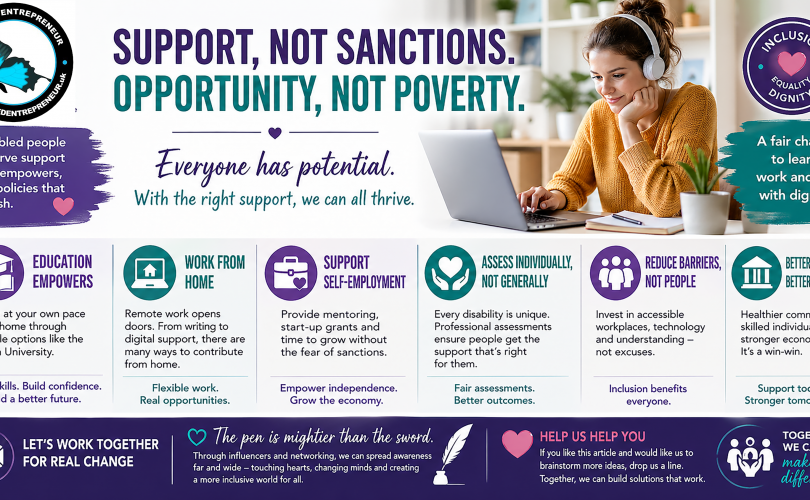
A powerful reminder is that the pen is mightier than the sword. Through the strength of words, storytelling, and strategic use of influencers and professional networks, awareness can be amplified far and wide. This collective voice has the ability not only to reach policymakers and influence political thinking but also to resonate with the vulnerable, the employed, and the disabled, creating understanding, unity, and meaningful change across all sections of society.
Constructive change begins with listening to lived experience rather than imposing assumptions that risk pushing vulnerable people further into hardship. Supporting disabled individuals, young and old, through education, flexible working pathways, and fair assessment systems is not just compassionate policy; it is economically sensible and socially responsible. If the powers that be find value in this article and wish to explore further ideas or collaborate on practical solutions, we welcome the opportunity to engage.
Simply drop us a line and help us to help you.
Further Reading & Resources
- Charities slam Tony Blair think tank report on disability benefits
- Pathways to Work: Reforming Benefits and Support to Get Britain Working Green Paper – GOV.UK
- Reform UK election manifesto: welfare benefits promises
- Blueprint for fundamental welfare reform for ‘getting people back into work’ | Disability Rights UK
- Reform UK manifesto 2024: 11 key policies analysed – BBC News
- Ableism: Challenging Assumptions About Disability | DISABLED ENTREPRENEUR – DISABILITY UK
- What are the PIP descriptors? – The Mental Health and Money Advice service
- Undiagnosed Autism / ADHD with PIP application — Scope | Online Community
- Unpacking Ableism: Recognizing and Challenging Disability Bias – Ability Together
- UK: Amnesty International and disabled people back UN concern over PIP and UC bill | Amnesty International UK


Andrew Jones is a seasoned journalist renowned for his expertise in current affairs, politics, economics and health reporting. With a career spanning over two decades, he has established himself as a trusted voice in the field, providing insightful analysis and thought-provoking commentary on some of the most pressing issues of our time.