Disclaimer: This article is for informational and educational purposes only and does not constitute legal advice. For specific legal concerns, please consult a qualified solicitor or legal professional.
Why Contracts Matter in Business, Work, and Home Life
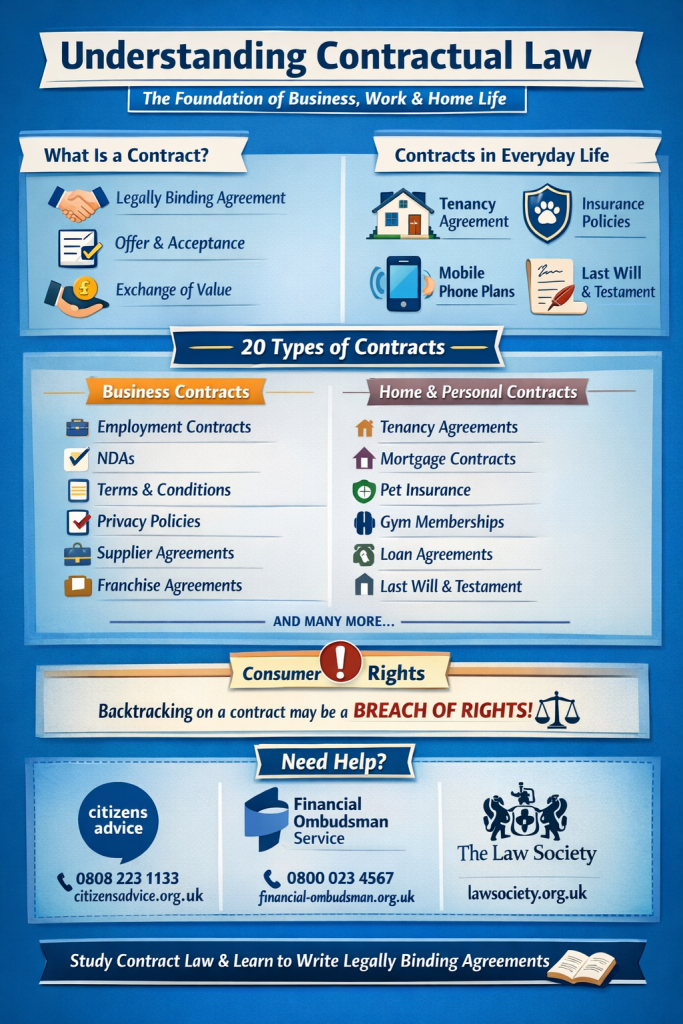
Contractual law is not just for solicitors or large corporations; it is the foundation of almost every agreement we enter into, often without even realising it. From signing employment contracts and agreeing to website terms to taking out insurance or writing a will, contracts shape our rights, responsibilities, and protections in both professional and personal life.
At its core, a contract is a legally binding agreement between two or more parties. For a contract to be valid under UK law, it typically requires:
- Offer
- Acceptance
- Consideration (something of value exchanged)
- Intention to create legal relations
Without contracts, there would be no structure, no accountability, and very little protection when disputes arise.
Contracts in Everyday Life: More Common Than You Think
Contracts are everywhere:
- Clicking “I agree” to a website’s terms and conditions
- Signing a tenancy agreement
- Taking out pet insurance
- Agreeing to a mobile phone plan
- Writing a last will and testament
Even documents like privacy policies and cookie policies form part of contractual relationships, especially in digital environments.
For example, if a pet insurer refuses to honour a policy that clearly states coverage in “black and white,” this could amount to a breach of contract and potentially a violation of consumer rights under UK law.
When Contracts Go Wrong: Consumer Protection
If a company backtracks on agreed terms, you may have legal grounds to challenge them.
Key organisations that can help:
- Citizens Advice
📞 England: 0808 223 1133
🌐 Advice: www.citizensadvice.org.uk - Trading Standards
(Access via Citizens Advice) - Financial Ombudsman Service
📞 0800 023 4567
🌐 www.financial-ombudsman.org.uk - The Law Society
🌐 www.lawsociety.org.uk
These organisations can guide you if you believe a contract has been breached or unfair terms have been applied.
20 Common Types of Contracts in Business (with Brief Descriptions)
- Employment Contract: Defines rights and duties between employer and employee
- Non-Disclosure Agreement (NDA): Protects confidential information
- Service Agreement: Outlines services provided and payment terms
- Partnership Agreement: Governs relationships between business partners
- Shareholder Agreement: Regulates company ownership and decisions
- Terms and Conditions: Rules users must agree to when using services
- Privacy Policy: Explains how personal data is collected and used
- Cookie Policy: Details tracking technologies used on websites
- Supplier Agreement: Sets terms between supplier and buyer
- Franchise Agreement: Allows use of a business model and brand
- Licensing Agreement: Grants permission to use intellectual property
- Distribution Agreement: Governs product distribution channels
- Consultancy Agreement: Defines independent contractor services
- Loan Agreement: Sets repayment terms for borrowed funds
- Joint Venture Agreement: Covers collaboration between businesses
- Agency Agreement: Allows one party to act on behalf of another
- Website Development Agreement: Defines the scope of digital services
- Maintenance Contract: Covers ongoing support services
- Affiliate Agreement: Governs commission-based partnerships
- Settlement Agreement: Resolves disputes without court action
20 Examples of Public and Home Contracts
- Tenancy Agreement
- Mortgage Agreement
- Utility Contracts (gas, electricity, water)
- Mobile Phone Contracts
- Broadband Agreements
- Insurance Policies (home, car, pet, life)
- Gym Membership Contracts
- Hire Purchase Agreements
- Credit Card Agreements
- Loan Agreements
- School/University Enrolment Agreements
- Care Service Agreements
- Subscription Services (Netflix, etc.)
- Parking Contracts (terms on signage)
- Travel Booking Terms (flights, hotels)
- Warranties and Guarantees
- Childcare Agreements
- Home Renovation Contracts
- Security System Monitoring Contracts
- Last Will and Testament
20 Further Business Contract Examples (Expanded Understanding)
- Advertising Agreement: Covers marketing campaigns
- Sponsorship Agreement: Defines brand partnerships
- Data Processing Agreement: Required under GDPR
- Outsourcing Agreement: Transfers business functions externally
- Software Licensing Agreement: Governs software usage
- SaaS Agreement: Subscription-based software terms
- Reseller Agreement: Allows resale of goods/services
- Influencer Contract: Governs social media promotions
- Event Management Contract: Covers organised events
- Construction Contract: For building and development
- Intellectual Property Assignment: Transfers ownership rights
- Royalty Agreement: Pays for ongoing use of assets
- Employment Settlement Agreement: Ends disputes
- Retainer Agreement: Ongoing legal or professional services
- Commission Agreement: Payment based on performance
- Export/Import Agreement: International trade terms
- Escrow Agreement: Holds funds until conditions are met
- Memorandum of Understanding (MoU): Non-binding intent
- Exclusivity Agreement: Restricts competition
- Indemnity Agreement: Protects against liability
Insurance and Wills: Contracts You Cannot Afford to Ignore
Insurance policies, whether for pets, health, or property, are contracts that must be honoured. If an insurer refuses to pay out despite clear policy wording, this may constitute:
- Breach of contract
- Misrepresentation
- Unfair terms under consumer law
Similarly, a last will and testament is a legally binding document that ensures your wishes are carried out after death. Errors or ambiguity can lead to disputes, making legal clarity essential.
Case Law in Contractual Law: Why It Matters
Case law plays a crucial role in shaping contractual law in the UK. Judicial decisions interpret how legal principles apply in real-life disputes, helping to clarify rights, obligations, and remedies when contracts are breached or contested. By studying case law, we gain a deeper understanding of how courts enforce agreements and protect parties from unfair practices.
Key Contract Law Cases (with Brief Descriptions)
- Carlill v Carbolic Smoke Ball Co (1893)
Established that advertisements can constitute a unilateral offer if clearly intended to be binding. - Balfour v Balfour (1919)
Confirmed that domestic agreements are generally not legally binding due to a lack of intention to create legal relations. - Merritt v Merritt (1970)
Distinguished from the Balfour agreements between separated spouses can be legally binding. - Entores Ltd v Miles Far East Corporation (1955)
Established rules for instantaneous communication, such as telex (now applied to email). - Felthouse v Bindley (1862)
Confirmed that silence cannot amount to acceptance of an offer. - Thornton v Shoe Lane Parking (1971)
Held that terms must be clearly brought to attention before a contract is formed. - Parker v South Eastern Railway (1877)
Established that reasonable notice of terms is sufficient, even if not read. - Olley v Marlborough Court Hotel (1949)
Terms displayed after contract formation are not binding. - L’Estrange v Graucob (1934)
A signed contract is binding, even if the terms were not read. - Central London Property Trust v High Trees House (1947)
Introduced promissory estoppel, preventing parties from going back on promises. - Foakes v Beer (1884)
Confirmed that part payment of a debt is not sufficient consideration for discharging the full debt. - Williams v Roffey Bros (1991)
Established that practical benefit can amount to valid consideration. - Hadley v Baxendale (1854)
Defined rules on remoteness of damage in breach of contract claims. - Victoria Laundry v Newman Industries (1949)
Clarified what losses are reasonably foreseeable in contract breaches. - Photo Production Ltd v Securicor (1980)
Confirmed that exclusion clauses can be valid if properly incorporated. - George Mitchell v Finney Lock Seeds (1983)
Applied the reasonableness test under the Unfair Contract Terms Act. - Spurling v Bradshaw (1956)
Introduced the “red hand rule” for particularly onerous contract terms. - Dunlop Pneumatic Tyre v New Garage (1915)
Distinguished between penalty clauses and enforceable liquidated damages. - Consumer Rights Act 2015 (Key Case Applications)
Courts assess whether contract terms are fair and transparent, especially in consumer contracts. - Office of Fair Trading v Ashbourne Management Services (2011)
Found gym contracts with long minimum terms to be unfair and unenforceable.
Conclusion: Learning Contract Law is Learning Life
Studying law, particularly contractual law, equips you with the ability to:
- Understand your rights
- Identify unfair terms
- Draft legally binding agreements
- Protect yourself and others
For aspiring legal professionals, learning how to draft contracts is a critical skill. It allows you to transform agreements into enforceable documents that stand up in court and safeguard all parties involved.
Whether in business, employment, or personal life, contracts are not optional; they are essential. Understanding them is not just a legal advantage; it is a life skill.


Renata is the Founder and Editor of DisabledEntrepreneur.UK and is currently developing a charity through DisabilityUK.org to support Disabled Start‑Ups and vulnerable individuals. She is also working toward establishing a Pro Bono Law Department to assist people across Wales.
An entrepreneur and published author, Renata leads a team producing content on politics, current affairs, health, disabilities, and business. She is a dedicated advocate for Mental Health, Human Rights, and Disability Discrimination.
Renata lives with OCD, Cerebellar Atrophy, and Rheumatoid Arthritis, and openly documents her journey to empower others navigating similar challenges.
Through the Disabled Entrepreneur Online Journal in collaboration with The UK Website Designers Group, she provides Digital Marketing, Content Writing, SEO, Website Creation, and Domain Brokering. The wider Disabled Entrepreneur – Disability UK platform is an open, collaborative space where contributors, creators, and domain sellers can share their expertise and connect with a broader audience.