
Disclaimer: “This article contains sensitive subject matter, including references to trauma, intrusive thoughts, and self-harm; reader discretion is advised.”. This content is for informational and awareness purposes only and does not constitute medical or legal advice. If you are experiencing distress or thoughts of self-harm, please contact a qualified healthcare professional or support service such as your GP or NHS 111. In an emergency, call 999.
Understanding Invisible Battles and the Misconceptions That Harm Claimants & Patients
Depression is not always visible. It does not always manifest as tears, silence, or withdrawal. Sometimes, it hides behind a smile, a polite conversation, or even laughter. Yet beneath that exterior, individuals may be battling relentless intrusive thoughts, unresolved trauma, and emotional exhaustion that no outward behaviour can accurately reflect.
For organisations such as General Practitioners (GPs) the Department for Work and Pensions (DWP), particularly in the assessment of Personal Independence Payment (PIP), there must be a deeper understanding: appearance does not equal wellbeing. A person can function outwardly while internally fighting a daily war.
“Not all disabilities are visible”.
The Meaning of Depression Beyond Stereotypes
Depression is more than feeling sad. It is a complex mental health condition that can include:
- Persistent low mood
- Intrusive or distressing thoughts
- Feelings of hopelessness or worthlessness
- Emotional numbness
- Fatigue and lack of motivation
- Difficulty concentrating
- Thoughts about death or self-harm (not always acted upon)
Crucially, depression is not linear. A person may have moments of laughter and still be deeply unwell. These moments do not negate their condition.
Trauma Does Not Disappear, It Lingers
Trauma is not something that can simply be “talked away.” Even after therapy, medication, or time has passed:
- Memories can be triggered unexpectedly
- News stories or social media can reopen emotional wounds
- Intrusive thoughts can persist, regardless of support systems
- The past can feel ever-present
There is currently no mechanism to erase traumatic memories. People learn to cope, not to forget.
The Problem with Surface-Level Assessments
PIP assessments often rely heavily on observable behaviour or brief interactions. However:
- A claimant smiling does not mean they are not struggling
- Leaving the house occasionally does not equate to full functionality
- Taking a holiday may be an act of survival, not leisure
- Discontinuing therapy may reflect self-management, not recovery
Recent reporting, such as this BBC News article on benefit scrutiny and mental health, highlights the growing concern that claimants are sometimes misunderstood or misjudged based on limited evidence.
Personal Independence Payments and going on holiday
When discussing Personal Independence Payment (PIP) claimants with mental health conditions, it is important to recognise that the vast majority of individuals are genuine in their claims, navigating complex and often invisible challenges that significantly impact their daily lives. However, as with any system, there may be a small minority who are not entirely truthful. This article is written for educational and advocacy purposes, and we do not support dishonesty or misrepresentation of symptoms. That said, fairness must apply in both directions. Claimants should be assessed based on medical evidence, lived experience, and functional impact, not assumptions or isolated observations. It can be both misleading and potentially discriminatory to presume that because someone has gone on holiday or appears outwardly well, they are fit to return to work or no longer meet eligibility criteria. Such assumptions may conflict with protections under the Equality Act 2010, which safeguards individuals from discrimination arising from disability, and the Human Rights Act 1998, particularly where dignity, respect, and fair treatment are concerned. Mental health conditions fluctuate, and participation in occasional activities can form part of coping or recovery, not evidence of full capability. Assessments must therefore remain objective, evidence-based, and free from bias.
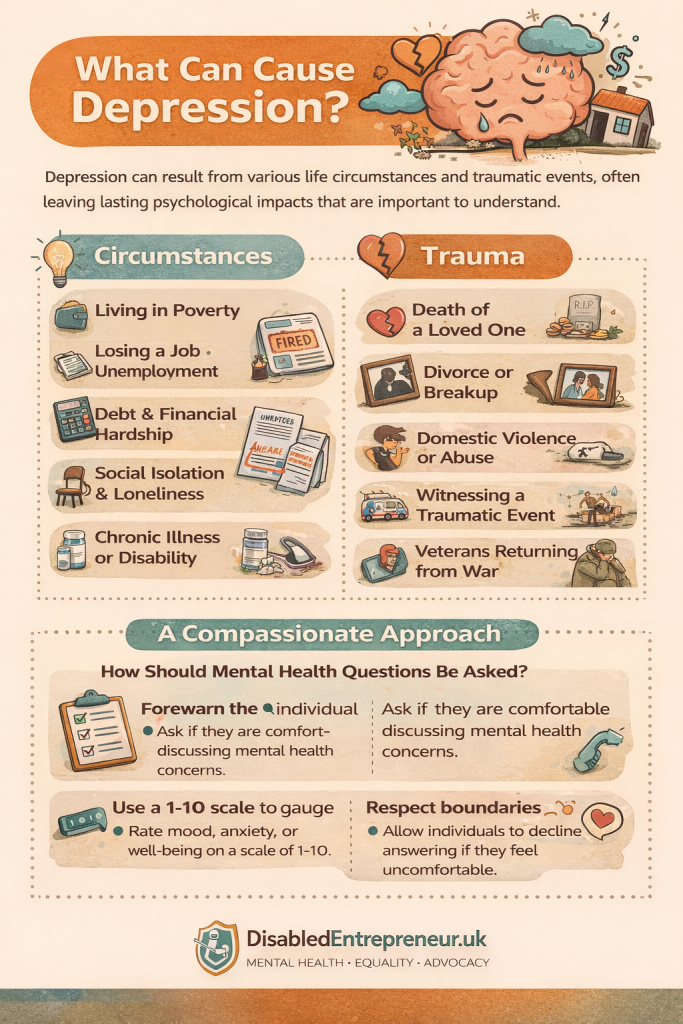
What Can Cause Depression? Understanding the Layers Behind Mental Health
Depression does not exist in isolation. It is often the result of lived experiences, external pressures, and deeply personal events that shape how an individual sees the world and themselves. While some people may experience depression without a clear trigger, many are navigating the emotional aftermath of life events that leave lasting psychological imprints. Understanding why someone may be depressed is essential, particularly for organisations and assessors who are making decisions that impact a person’s livelihood and wellbeing.
Depression can stem from a wide range of circumstances, including but not limited to:
- Living in poverty or financial hardship
- Losing a job or long-term unemployment
- Debt and financial instability
- Housing insecurity or homelessness
- Workplace stress or burnout
- Social isolation or loneliness
Trauma-related causes can be even more profound and long-lasting:
- Death of a loved one (parent, sibling, partner, or child)
- Infant loss or miscarriage
- Divorce or relationship breakdowns
- Domestic abuse (physical, emotional, or psychological)
- Childhood trauma or neglect
- Witnessing a traumatic event (e.g., violence, accidents)
- Being directly involved in a traumatic incident
- Long-term illness or disability diagnosis
- Victim of crime
- Veterans returning from war with PTSD
For many, these experiences do not simply “pass with time.” They can shape thought patterns, trigger intrusive memories, and create an ongoing emotional burden that affects daily functioning.
The editor of Disabled Entrepreneur UK has experienced her fair share of grief and trauma and understands firsthand how these experiences can shape a person’s mental health. Living with Obsessive Compulsive Disorder (OCD), she finds that working remotely provides a safer, more manageable environment, reducing exposure to triggers that can exacerbate anxiety and intrusive thoughts. Through her platform, she not only shares her experiences but actively advocates for change, educating individuals, organisations, and assessors on the importance of trauma-informed approaches to mental health.
One critical issue is how mental health assessments are conducted. There is a right and wrong way to approach sensitive topics. Abruptly asking direct questions about self-harm, without context, warning, or consent, can be harmful and, in some cases, may trigger intrusive thoughts rather than provide clarity.
A more appropriate and safer approach would include:
- Forewarning the individual:
“I would like to ask you a few questions about your mental health and wellbeing. Are you comfortable proceeding?” - Using a scale-based strategy (1–10):
Asking individuals to rate their mood, anxiety, or emotional state can provide insight without immediate intrusion. For example:
“On a scale of 1 to 10, how have you been feeling recently?” - Gradual progression:
Starting with general wellbeing questions before moving into more sensitive areas - Respecting boundaries:
Allowing individuals to decline answering questions they are not comfortable with
This approach fosters trust, reduces distress, and creates a safer environment for honest communication.
Understanding the root causes of depression is not about labelling individuals, it is about recognising the human experiences behind the symptoms. Only by peeling back these layers can professionals, organisations, and society begin to support people in a way that is both effective and compassionate.
The Harmful Impact of Poorly Framed Questions
When professionals, whether assessors, pharmacists, or clinicians, ask abrupt or poorly worded questions such as:
“Have you ever tried to k##l yourself?” (This was asked by a cluster pharmacist not so long ago, without warning, when the editor had her annual medical review). The editor wanted to say, “Have you ever thought of doing just that?” Instead, the editor froze in disbelief at the question being asked. The editor felt she was being judged and wondered what people would have done had they walked in her shoes.
✝️ Matthew 7:1
“Do not judge, or you too will be judged.”
This verse comes from the teachings of Jesus Christ during the Sermon on the Mount. It is often understood as a reminder to show compassion, avoid hypocrisy, and not make unfair or superficial judgments about others
…it can be deeply distressing.
Such questioning:
- Lacks sensitivity
- May trigger harmful thoughts
- Can make individuals feel judged or unsafe
- May discourage honest communication
There is a critical difference between having intrusive thoughts and acting on them. Many people live with such thoughts daily, yet actively resist them.
Medication Is Not Proof of Stability
Medication affects individuals differently:
- One medication may help; another may not
- Some medications manage symptoms rather than resolve underlying trauma
- Stopping medication may not indicate recovery
- Continuing medication does not mean improvement
Assumptions based solely on prescriptions can be misleading and potentially harmful.
Coping Is Not the Same as Healing
Some individuals step away from formal therapy because:
- It forces them to relive trauma
- It worsens their mental state
- They prefer alternative coping mechanisms
Self-help strategies can be powerful and valid forms of managing mental health.
20 Self-Help Therapies You Can Do at Home
Here are accessible, practical approaches individuals may use to cope with depression and trauma:
- Journaling (expressive writing)
- Art therapy (drawing, painting)
- Creative writing or storytelling
- Meditation and mindfulness
- Breathing exercises
- Listening to calming music
- Guided visualisation
- Gratitude journaling
- Reading self-help books
- Gentle exercise (e.g., yoga, stretching)
- Sun therapy (spending time in natural light)
- Gardening or plant care
- Digital detox periods
- Watching uplifting or comforting content
- Crafting (knitting, DIY projects)
- Online support communities
- Affirmation practices
- Routine building (daily structure)
- Pet companionship (if applicable)
- Goal setting with small, manageable steps
These methods may not “cure” depression, but can help individuals navigate daily life.
Small Steps Are Still Progress
Recovery is not always dramatic. It can look like:
- Leaving the house for a short walk
- Sitting in the sunlight
- Writing thoughts instead of suppressing them
- Engaging briefly with the outside world
What may appear minor to others can represent significant progress.
A Personal Perspective: Turning Pain into Purpose
For some, lived experience becomes a catalyst for change.
Building platforms, writing, and advocating for others can serve as a form of therapy, transforming pain into purpose. It allows individuals to:
- Release emotional burden
- Help others facing similar struggles
- Regain a sense of control and identity
Even so, this does not erase the underlying condition. The battle remains ongoing.
The Reality of Living with Trauma and OCD
Living with conditions such as trauma-related depression and Obsessive Compulsive Disorder (OCD) can mean:
- Persistent fear and intrusive thoughts
- Avoidance of environments perceived as unsafe
- Social withdrawal or isolation
- Feelings of guilt or self-judgment
These are not choices; they are symptoms of complex mental health conditions.
Why the DWP Must Do Better
To ensure fair and humane assessments, decision-makers must:
- Look beyond surface behaviour
- Understand trauma-informed care
- Avoid assumptions based on brief interactions
- Use sensitive, considered language
- Recognise self-management strategies as valid
- Consider the full context of a person’s life
PIP assessments should not be about catching people out—they should be about understanding lived reality.
Conclusion
Depression and trauma are deeply personal, complex, and often invisible.
A smile does not negate suffering. A moment of strength does not erase a lifetime of struggle. Every day, individuals push through intrusive thoughts, painful memories, and emotional barriers simply to function. That effort alone deserves recognition, not scepticism. Understanding, empathy, and informed assessment practices are not optional; they are essential.
Individuals living with depression, trauma, grief, or anxiety may not always think clearly or prioritise tasks in the same way as someone who is not experiencing these conditions. Cognitive overload, emotional distress, and intrusive thoughts can impair decision-making, concentration, and the ability to manage everyday responsibilities that others may complete without a second thought. It is therefore important to recognise that what may appear as disorganisation or lack of motivation can, in reality, be a symptom of underlying mental health struggles. Additionally, a change in environment or scenery can sometimes play a positive role in helping individuals manage their symptoms. For some, stepping away from familiar stressors, whether through spending time outdoors, near water, or in sunlight (commonly referred to as heliotherapy or sun therapy), can help reduce anxiety and create a sense of calm. While certain activities, such as extreme sports, may reasonably raise questions about functional ability, more passive activities like resting by a pool or being in natural surroundings can form part of a coping strategy rather than evidence of full recovery. It is also worth noting that environments such as airports can be highly stressful for individuals with anxiety, further demonstrating that participation in isolated activities does not equate to overall well-being or capability.


Andrew Jones is a seasoned journalist renowned for his expertise in current affairs, politics, economics and health reporting. With a career spanning over two decades, he has established himself as a trusted voice in the field, providing insightful analysis and thought-provoking commentary on some of the most pressing issues of our time.