Disclaimer: This article is for educational and informational purposes only and does not constitute legal advice. While real-life scenarios are reflected in a generalised and anonymised manner, readers seeking legal guidance should consult a qualified solicitor or relevant authority.
When Responsibility Exists in Law, But Not Always in Practice
What Is Duty of Care? (Legal Definition)
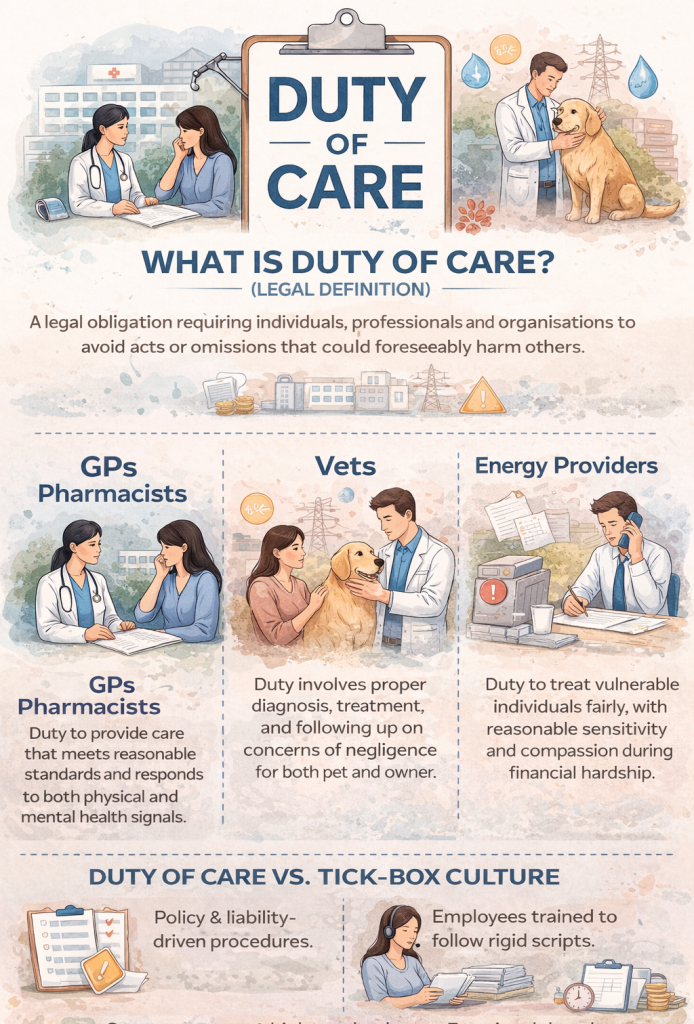
In law, duty of care is a legal obligation requiring individuals, professionals, and organisations to avoid acts or omissions that could reasonably foreseeably harm others.
The modern legal test stems from the landmark case of Donoghue v Stevenson, which established the “neighbour principle”, that one must take reasonable care to avoid acts or omissions likely to injure their “neighbour,” meaning anyone closely and directly affected by their actions.
To establish a duty of care in negligence, courts typically apply the three-stage test from Caparo Industries plc v Dickman:
- Foreseeability of harm
- Proximity between parties
- Whether it is fair, just, and reasonable to impose a duty
If a duty is owed and breached, and that breach causes harm, liability may arise.
Duty of Care Across Key Sectors
Employers
Employers owe a significant duty of care to their employees. Under UK law, including obligations reinforced by the Health and Safety at Work etc. Act 1974, employers must take all reasonably practicable steps to ensure the health, safety, and wellbeing of their staff. This extends beyond physical safety to include mental health, workplace stress, and appropriate support for vulnerable employees. Additionally, under the Equality Act 2010, employers are required to make reasonable adjustments for employees with disabilities and must not discriminate against them. In practice, this means listening to concerns, implementing adjustments such as seating or flexible working where appropriate, and regularly reviewing employee wellbeing. A failure to do so may not only breach legal obligations but also undermine trust, dignity, and long-term employee welfare.
Healthcare (GPs, Pharmacists, NHS Services)
Healthcare professionals, including GPs and pharmacists, owe patients a duty to provide care that meets reasonable professional standards. This includes both physical and mental health considerations. Failing to act on distress signals, dismissing concerns, or inadequately responding to complaints may raise questions about whether that duty has been fulfilled.
Veterinary Services
Veterinary professionals owe a duty of care not only to the animal but also to the owner. This includes proper diagnosis, treatment, and appropriate follow-up where concerns of negligence arise. A failure to invite reassessment or second opinions after a complaint may undermine confidence in that duty.
Energy Providers and Utility Companies
Energy providers have both contractual obligations and wider responsibilities under consumer protection frameworks. When dealing with vulnerable customers—particularly those experiencing financial hardshi, there is an expectation of sensitivity, fairness, and proportionate action. Escalating matters to authorities under the guise of “duty of care” raises complex questions about reasonable conduct vs. procedural compliance.
The Reality: Duty of Care vs. “Tick-Box” Culture
While the law sets out a clear framework, the lived experience of many individuals can feel very different.
In practice, the duty of care can become:
- Procedural rather than personal
- Driven by policy rather than compassion
- Focused on liability avoidance rather than genuine wellbeing
Illustrative Scenarios (Generalised)
- A patient expresses emotional distress during a consultation. Trigger questions are asked, concerns are logged, but no meaningful follow-up occurs. The system records compliance, but the individual feels unheard and unsupported.
- A pet owner raises concerns about possible negligence. A complaint is acknowledged, yet no proactive effort is made to reassess the animal or provide reassurance through a second opinion.
- A vulnerable customer under financial strain is warned that authorities may be contacted. A welfare check is initiated, causing embarrassment and distress, raising questions about whether the response was proportionate—or simply policy-driven.
- An employee discloses a disability but is not provided with reasonable workplace adjustments, such as seating support, nor are they regularly asked about their well-being, despite clear obligations under equality legislation.
Why Does This Gap Exist?
There are several reasons why the duty of care in reality may feel absent, despite existing in law:
1. Institutional Conditioning
Employees are often trained to follow strict protocols. Their role becomes one of compliance rather than critical thinking or empathy.
2. Fear of Liability
Organisations may act defensively—logging actions, escalating cases, or reporting concerns—not necessarily out of care, but to protect themselves from legal repercussions.
3. Workload and System Pressure
High caseloads, understaffing, and time constraints can reduce meaningful engagement to box-ticking exercises.
4. Emotional Detachment
To cope with difficult situations, some professionals may develop a level of detachment, which can be perceived as indifference.
5. Fragmented Responsibility
In large organisations, responsibility is often spread across departments, leading to situations where no one takes ownership of an individual’s well-being.
Legal Duty vs. Moral Responsibility
A key distinction must be made:
- Legal Duty of Care → What the law requires
- Moral Duty of Care → What humanity expects
It is entirely possible for an organisation to meet its legal obligations on paper while failing to meet the spirit of care in practice.
For example, initiating a welfare check may technically satisfy a safeguarding protocol, but if it causes avoidable distress, humiliation, or escalation, questions arise about whether the response was reasonable and proportionate.
Does Duty of Care Always Mean “Caring”?
Not necessarily.
Many frontline workers operate within systems where:
- Decisions are scripted
- Responses are standardised
- Outcomes are pre-determined by policy
This can create the perception—and sometimes the reality—that individuals are treated as cases rather than people.
Outside of their professional role, those same individuals may not have any connection to the outcome. However, within their role, they are expected to act in accordance with institutional rules, regardless of personal feelings.
Where Do Individuals Stand Legally?
If a duty of care is breached, individuals may have recourse through:
- Negligence claims (if harm can be proven)
- Complaints procedures (internal and external regulators)
- Ombudsman services (e.g., health, energy, or financial)
- Equality legislation (for disability-related failures)
However, proving a breach is often complex and requires:
- Evidence of harm
- Proof of causation
- Demonstration that the standard of care fell below what is reasonable
Closing Thoughts
Duty of care is one of the cornerstones of modern law, designed to protect individuals from harm. Yet, the gap between legal theory and lived reality can be significant.
Where systems prioritise process over people, the duty of care risks becoming a checkbox rather than a commitment.
Bridging this gap requires more than legal compliance; it demands accountability, empathy, and a willingness to see beyond procedure to the human being at the centre of it all.


Renata The Editor of DisabledEntrepreneur.uk - DisabilityUK.co.uk - DisabilityUK.org - CMJUK.com Online Journals, suffers From OCD, Cerebellar Atrophy & Rheumatoid Arthritis. She is an Entrepreneur & Published Author, she writes content on a range of topics, including politics, current affairs, health and business. She is an advocate for Mental Health, Human Rights & Disability Discrimination.
She has embarked on studying a Bachelor of Law Degree with the goal of being a human rights lawyer.
Whilst her disabilities can be challenging she has adapted her life around her health and documents her journey online.
Disabled Entrepreneur - Disability UK Online Journal Working in Conjunction With CMJUK.com Offers Digital Marketing, Content Writing, Website Creation, SEO, and Domain Brokering.
Disabled Entrepreneur - Disability UK is an open platform that invites contributors to write articles and serves as a dynamic marketplace where a diverse range of talents and offerings can converge. This platform acts as a collaborative space where individuals or businesses can share their expertise, creativity, and products with a broader audience.