
Disclaimer: This article is for informational purposes only and does not constitute financial or legal advice. Funding options, tax relief schemes, and eligibility criteria may change. Readers are advised to seek independent professional advice and consult official HMRC and financial guidance before making decisions.
A Practical Guide for Sole Traders, Start-Ups & Early-Stage Businesses
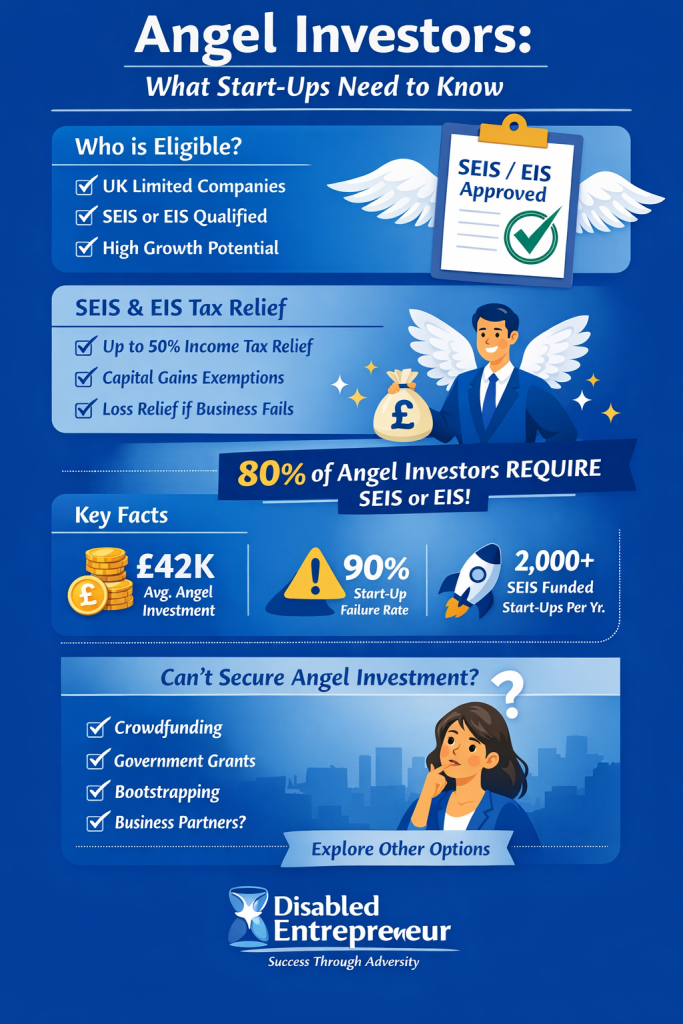
Securing funding is one of the biggest hurdles for any start-up. While angel investors are often seen as an attractive option, the reality is more nuanced, especially for sole traders and unincorporated businesses.
This guide explains how angel investment works, success rates, tax schemes (SEIS/EIS), eligibility issues, and alternative funding routes so that you can make informed decisions.
What Is an Angel Investor?
An angel investor is typically a high-net-worth individual who invests personal funds into early-stage businesses in exchange for equity (ownership shares).
- Average UK angel investment: ~£42,000 for around 8% equity
- Expected returns: often 2–3x investment within 3–5 years
- Investors expect high growth and clear exit strategies
👉 This is critical: angel investors are not lenders, they are equity partners.
The Reality: Success Rates & Risk
- Up to 90% of start-ups fail, which makes angel investing high-risk
- Only a small percentage of businesses actually secure funding
- Investors typically review hundreds of pitches before investing in a handful
Even where funding exists:
- Around 2,000 UK businesses per year secure SEIS funding
👉 This highlights a key truth: competition is extremely high.
Why Most Angel Investors Prefer Limited Companies
Here is where many founders get caught:
👉 Angel investors almost always invest in LIMITED COMPANIES, not sole traders.
Why?
Because:
- Investors receive shares (equity)
- Sole traders cannot issue shares
- Legal liability is higher in sole trader structures
- Tax incentives (SEIS/EIS) require a company structure
What is SEIS & EIS: The Tax Incentives Investors Expect
SEIS and EIS sit at the heart of the UK’s early‑stage investments, giving startups a powerful way to attract capital while reducing the financial risk for investors. Both schemes are designed to stimulate innovation by making it more appealing for individuals to back young, unlisted companies. SEIS (Seed Enterprise Investment Scheme) supports the earliest, most fragile stage of a business, offering investors income tax relief of 50% on investments up to £200,000 per year, along with capital gains tax exemptions and loss relief if the company fails. EIS (Enterprise Investment Scheme) steps in once a company has grown beyond the seed phase, providing 30% income tax relief on investments up to £1 million per year, or £2 million for knowledge‑intensive companies, plus capital gains deferral and tax‑free gains after three years. These incentives significantly reduce downside risk and enhance potential returns, which is why they are so central to UK startup fundraising.
Investors participating in SEIS and EIS typically expect a few key things from startups. They look for a clear qualifying status under the schemes, meaning the company must be early‑stage, unlisted, UK‑based, and engaged in a genuine growth‑oriented trade. They also expect a compelling business model, evidence of market demand, and a credible plan for how the investment will be used, since funds must be deployed within three years under SEIS rules. Above all, investors want confidence that the startup meets the “risk‑to‑capital” condition: the business must be genuinely entrepreneurial, not structured primarily for tax benefits. When these elements align, SEIS and EIS become powerful tools for founders to secure early backing while giving investors a structured, tax‑efficient path into high‑risk, high‑potential ventures.
1. SEIS (Seed Enterprise Investment Scheme)
2. EIS (Enterprise Investment Scheme)
These are government-backed tax relief schemes designed to encourage investment.
Why They Matter:
- 80% of angel investments use SEIS/EIS
- Around 90% of angel investors rely on these schemes
- 2/3 of investors only invest in SEIS/EIS eligible businesses
Investor Benefits:
- Up to 50% income tax relief (SEIS)
- 30% tax relief (EIS)
- Capital gains tax exemptions
- Loss relief if the business fails
In simple terms:
These schemes reduce investor risk, which is why they are almost essential.
Important: Sole Traders Are NOT Eligible for SEIS/EIS
To qualify, your business must:
- Be a UK limited company
- Issue new shares
- Meet size and trading criteria
Therefore:
A sole trader will not qualify for angel investment in most cases.
Why Angel Networks Must Be Transparent
Many founders waste time applying for funding they are not eligible for.
Angel investment platforms should clearly state on their homepage:
- Whether they fund sole traders or only limited companies
- SEIS/EIS requirements
- Minimum growth expectations
- Sector preferences
Failure to do so:
- Wastes entrepreneurs’ time
- Creates false hope
- Disproportionately affects vulnerable founders and small businesses
What If You Are a Sole Trader?
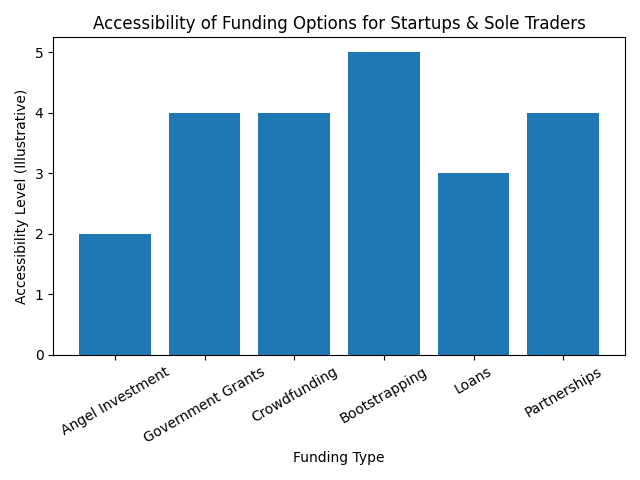
If you are not ready to incorporate, angel investment may not be suitable.
Alternatives include:
1. Bootstrapping (Self-Funding)
- Retain full control
- Lower risk
- Slower growth
2. Government Grants & Support
- UK Start-Up Loans
- Innovate UK grants
- Local authority funding (e.g., Business Wales)
3. Crowdfunding
- Platforms like equity crowdfunding or reward-based models
- No need for traditional investors
4. Friends & Family Investment
- Informal but common
- Must be legally documented
5. Revenue-Based Financing
- Repay funding as a percentage of income
- No equity required
6. Partnerships or Joint Ventures
- Bring in someone with:
- Skills
- Capital
- Industry connections
What If You Just Need Help Running the Business?
Not every business needs funding; sometimes, you need support.
Options:
✔️ Business Partner
Someone who shares responsibility and decision-making
✔️ Consultant or Mentor
- Strategy
- Growth advice
- Operational support
✔️ Virtual Assistant / Operations Manager
- Helps manage daily workload
✔️ Accelerator or Incubator
- Structured programmes
- Mentorship + networking
✔️ Non-Executive Director (NED)
- Strategic oversight
- Often used in scaling businesses
Sometimes support is more valuable than funding.
What Angel Investors Actually Look For
To secure funding, your business typically needs:
- Scalable model (not just self-employment)
- High growth potential
- Clear revenue model
- Exit strategy (sale, IPO, acquisition)
- Strong founder story and resilience
Investors are not just backing a business; they are backing you.
Key Takeaways
- Angel investment is highly competitive and high-risk
- Most investors require SEIS/EIS eligibility
- Sole traders are rarely suitable for angel funding
- Converting to a limited company may be necessary
- There are many alternative funding routes
- Sometimes the best investment is support, not capital
Final Thoughts
There is a growing need for greater transparency in the funding ecosystem. Too many entrepreneurs, especially sole traders and disabled founders, are encouraged to pursue routes that are structurally inaccessible to them.
Angel investment can be powerful, but it is not the only path to success.
The key is understanding:
👉 what stage you are at
👉 what structure you operate under
👉 and what kind of support you truly need
For our planned charity www.disabilityuk.org, we are now looking for trusted partners and trustees. We welcome any discussion and look forward to seeing how you can join our movement. We are particularly interested in people who want to turn their lives around, be part of a large ecosystem, and, at the same time, help the wider community. If you have skills such as mentorship, coaching, website development, or lead generation, we would love to hear from you. Please contact us using the contact us page.
Further Reading & Resources
- A Complete Guide to UK Government Startup Incentives: SEIS and EIS Explained | Oriel IPO
- EIS, SEIS and VCT – tax efficient investments – a guide for investors – BDO
- Understanding SEIS & EIS Tax Incentives – StartUp UK
- VCM30100 – Seed Enterprise Investment Scheme : Overview of SEIS reliefs – HMRC internal manual – GOV.UK
- EIS and SEIS Explained: Tax Relief for Income Tax and Capital Gains in the UK — Tax Matters
- What is EIS, VCT or SEIS? | M&G Wealth Adviser
- SEIS & EIS Explained: Essential Guide To Tax Relief For UK Startups
- SEIS vs EIS (2025): Which Tax Relief Fits Your Startup? | Undo Capital
- SEIS and EIS Explained: A Comprehensive Guide for UK Startups in 2024
- What are the SEIS/EIS tax benefits for investors?


Renata The Editor of DisabledEntrepreneur.uk - DisabilityUK.co.uk - DisabilityUK.org - CMJUK.com Online Journals, suffers From OCD, Cerebellar Atrophy & Rheumatoid Arthritis. She is an Entrepreneur & Published Author, she writes content on a range of topics, including politics, current affairs, health and business. She is an advocate for Mental Health, Human Rights & Disability Discrimination.
She has embarked on studying a Bachelor of Law Degree with the goal of being a human rights lawyer.
Whilst her disabilities can be challenging she has adapted her life around her health and documents her journey online.
Disabled Entrepreneur - Disability UK Online Journal Working in Conjunction With CMJUK.com Offers Digital Marketing, Content Writing, Website Creation, SEO, and Domain Brokering.
Disabled Entrepreneur - Disability UK is an open platform that invites contributors to write articles and serves as a dynamic marketplace where a diverse range of talents and offerings can converge. This platform acts as a collaborative space where individuals or businesses can share their expertise, creativity, and products with a broader audience.