Disclaimer: This article is for informational and educational purposes only and does not constitute legal or professional advice. Behavioural indicators of deception are not definitive proof of dishonesty and should always be considered alongside evidence and context.
Understanding Deception in Everyday and Legal Contexts
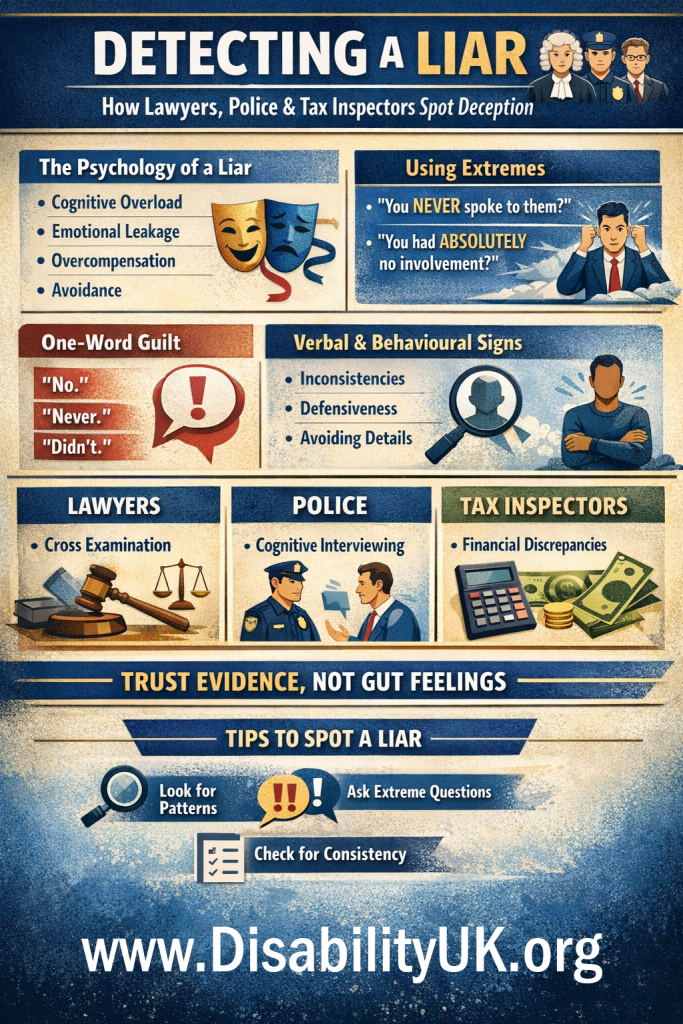
Detecting deception is not just the domain of police interrogations or courtroom drama; it plays a role in everyday interactions, business dealings, and legal proceedings. For professionals such as lawyers, police officers, and tax inspectors, identifying dishonesty can be critical in uncovering the truth.
However, contrary to popular belief, there is no single “tell” that proves someone is lying. Instead, deception detection relies on patterns, inconsistencies, psychological cues, and behavioural shifts.
The Psychology of a Liar
At its core, lying is cognitively demanding. When a person lies, they must:
- Suppress the truth
- Construct a believable alternative
- Monitor your reaction
- Maintain consistency in their story
This creates mental strain, which often leaks through behaviour.
Common Psychological Traits of Deception
- Cognitive overload: hesitation, overthinking, or slowed responses
- Emotional leakage: flashes of anxiety, defensiveness, or irritation
- Overcompensation: trying too hard to appear honest
- Avoidance behaviours: evading direct answers or changing topics
Liars are not always nervous; in fact, experienced liars may appear calm, but their story often cannot withstand scrutiny over time.
Using Extremes to Detect a Liar
One effective technique used in investigative interviewing is the use of extremes, pushing a narrative to its limits to observe reactions.
What Are “Extremes”?
This involves presenting exaggerated or absolute statements such as:
- “So you never spoke to them at all?”
- “You’re saying this has never happened before?”
- “You had absolutely no involvement whatsoever?”
Why It Works
Truthful individuals are usually comfortable qualifying their answers, for example:
- “Well, not never… I may have spoken once.”
Liars, however, may:
- Commit too strongly (“Absolutely never!”)
- Later contradict themselves
- Become defensive when challenged
This technique exposes rigidity vs flexibility in responses, a key indicator of deception.
One-Word Guilt: The Power of Minimal Responses
Another subtle indicator is what is sometimes referred to as “one-word guilt.”
What Is It?
When asked a direct question, a deceptive person may respond with short, abrupt answers, such as:
- “No.”
- “Never.”
- “Didn’t.”
Why This Can Signal Deception
While not definitive, this behaviour may suggest:
- Avoidance of elaboration (to reduce the risk of contradiction)
- Psychological distancing from the lie
- An attempt to shut down further questioning
By contrast, truthful individuals often provide context and detail naturally, even when not asked.
Verbal and Behavioural Indicators of Lying
Professionals are trained to look for clusters of behaviour, not isolated signs.
Verbal Indicators
- Inconsistencies in the timeline
- Overly detailed or rehearsed answers
- Vagueness when specifics are required
- Repeating the question before answering
Behavioural Indicators
- Changes in tone or speech pace
- Unnatural pauses
- Defensive body language
- Sudden shifts in confidence
How Lawyers Detect Lies
Lawyers are less concerned with body language and more focused on evidence and consistency.
Key Techniques
- Cross-examination: exposing contradictions
- Leading questions: controlling the narrative
- Timeline testing: checking if events align logically
- Document comparison: matching statements with records
A skilled lawyer understands that truth remains consistent, but lies unravel under pressure.
How Police Officers Detect Lies
Police rely on structured interview methods rather than intuition.
Common Methods
- Cognitive interviewing: asking suspects to recall events in reverse order
- Strategic questioning: withholding evidence to test reactions
- Baseline behaviour analysis: comparing normal vs stressed responses
- Statement analysis: examining language patterns
Importantly, modern policing avoids relying solely on “gut instinct” due to the risk of false positives.
How Tax Inspectors Detect Lies
Tax inspectors (e.g., HMRC investigators) focus heavily on financial inconsistencies.
Key Indicators
- Income that does not match lifestyle
- Unexplained deposits or transfers
- Discrepancies between declared and actual earnings
- Evasive or incomplete financial explanations
Their approach is data-driven:
Numbers rarely lie, but people sometimes do.
The Danger of Assumptions
It is crucial to stress:
- Nervousness ≠ lying
- Confidence ≠ truthfulness
Factors such as anxiety, disability, trauma, or stress (which you often highlight in your work) can mimic deceptive behaviours.
Misinterpreting these signals can lead to:
- Wrongful accusations
- Discrimination
- Unfair legal outcomes
This is why professionals are trained to rely on evidence over intuition.
Practical Tips: How to Assess Truth More Accurately
- Look for patterns, not single behaviours
- Ask open-ended questions
- Revisit the same topic later
- Introduce extreme statements to test consistency
- Pay attention to changes, not absolutes
Conclusion
Detecting deception is not about spotting a single sign; it is about understanding human psychology, analysing consistency, and applying structured questioning techniques.
Whether through:
- The use of extremes
- Observing one-word responses
- Identifying inconsistencies over time
…the truth often reveals itself gradually.
For legal professionals, investigators, and even everyday individuals, the key is simple:
“Do not look for lies, look for what does not make sense”.
Further Reading & Resources
- Lawyer shares 1 word liars always use that’s a ‘dead giveaway’
- How to Spot a Liar: 35 Clever Clues to Catch Them
- The only real way to catch a liar, according to psychologists | BBC Science Focus Magazine
- How to Spot a Liar: 12 Powerful Signs to Detect Deception – LIE DETECTOR TEST U.K. SERVICES
- Think You Can Spot A Liar At Work? You Likely Can’t—But Here’s How
- How to spot a liar with body language and words – PsychMechanics
- How to spot a liar: Look less and listen more – Bloomsbury
- 10 Signs of Deception: How to Detect Lies Like a Polygraph Expert – Lie Detector Test
- sciencesensei.com/15-science-backed-tricks-to-spot-a-liar-instantly/
- 10 Ways to Catch a Liar
- How to Detect Lies | Psychology Today


Renata The Editor of DisabledEntrepreneur.uk - DisabilityUK.co.uk - DisabilityUK.org - CMJUK.com Online Journals, suffers From OCD, Cerebellar Atrophy & Rheumatoid Arthritis. She is an Entrepreneur & Published Author, she writes content on a range of topics, including politics, current affairs, health and business. She is an advocate for Mental Health, Human Rights & Disability Discrimination.
She has embarked on studying a Bachelor of Law Degree with the goal of being a human rights lawyer.
Whilst her disabilities can be challenging she has adapted her life around her health and documents her journey online.
Disabled Entrepreneur - Disability UK Online Journal Working in Conjunction With CMJUK.com Offers Digital Marketing, Content Writing, Website Creation, SEO, and Domain Brokering.
Disabled Entrepreneur - Disability UK is an open platform that invites contributors to write articles and serves as a dynamic marketplace where a diverse range of talents and offerings can converge. This platform acts as a collaborative space where individuals or businesses can share their expertise, creativity, and products with a broader audience.