
Disclaimer: This article is for informational purposes only and does not constitute legal advice. Readers are encouraged to seek professional legal guidance or contact their local authority for advice specific to their circumstances.
🐾 The Hidden Impact of Constant Barking on Mental Health and Productivity
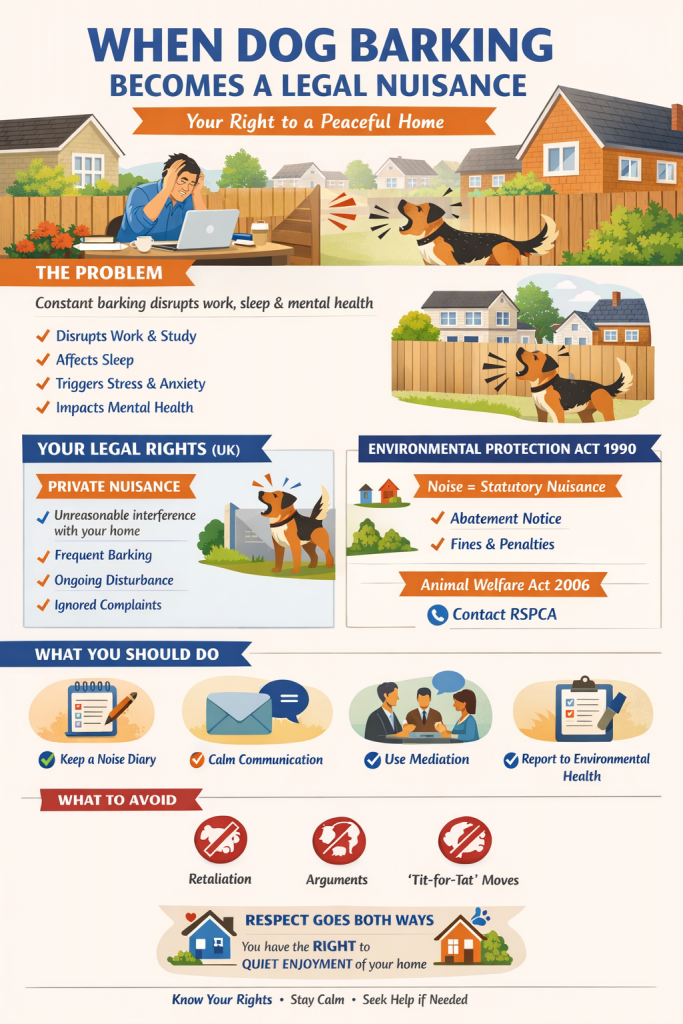
For many people working remotely or studying from home, peace and quiet are not luxuries, they are necessities. However, persistent dog barking from neighbouring properties can quickly turn a home environment into a source of stress, anxiety, and disruption.
While occasional barking is normal animal behaviour, constant, excessive barking may cross the line into what the law recognises as a private nuisance.
This issue is particularly concerning for individuals already managing mental health conditions, neurodivergence, or high cognitive workloads, such as students, carers, and professionals working from home.
🧠 The Psychological Toll of Noise Disturbance
Ongoing noise disturbance, especially unpredictable sounds like barking, can:
- Disrupt concentration and reduce productivity
- Increase stress and anxiety levels
- Trigger sensory overload (particularly for those with OCD, PTSD, or neurodivergence)
- Interfere with sleep patterns
- Lead to emotional fatigue and burnout
Over time, what may seem like a minor inconvenience can escalate into a serious wellbeing issue.
⚖️ Legal Position: Your Right to Quiet Enjoyment
Under UK law, individuals have a right to the “quiet enjoyment” of their property. This does not mean absolute silence, but it does protect against unreasonable interference.
🏛️ Private Nuisance
In your law studies, you will recognise that private nuisance is concerned with:
- Unreasonable interference with the use or enjoyment of land
Excessive dog barking may qualify as amenity nuisance, particularly where it:
- Is frequent, prolonged, or at unsociable hours
- Interferes with work, study, or rest
- Continues despite reasonable complaints
The courts assess nuisance using factors such as:
- Duration and frequency
- Locality (urban vs rural expectations)
- Sensitivity (though ordinary standards apply)
- Malice or failure to act
📜 Statutory Protection
Beyond common law, there are statutory remedies:
Environmental Protection Act 1990
Local authorities can investigate complaints of statutory nuisance, including noise.
If deemed a nuisance, they can issue an:
- Abatement Notice requiring the noise to stop
Failure to comply can result in:
- Fines
- Seizure of equipment (in severe cases)
🐕 What If the Dog Is Distressed?
Constant barking may also indicate animal welfare concerns.
Under the Animal Welfare Act 2006, owners have a duty to ensure the welfare of their pets.
Excessive barking may signal:
- Separation anxiety
- Neglect or lack of stimulation
- Poor living conditions
If you suspect distress, you may consider contacting:
- The RSPCA
- Local animal welfare officers
This shifts the issue from “annoyance” to safeguarding an animal’s wellbeing.
🧭 When Neighbours Ignore the Problem
One of the most frustrating aspects is when neighbours are notified, sometimes repeatedly, and choose not to act.
This reflects a broader social issue:
👉 People often do not recognise the impact of their actions until they are directly confronted.
However, escalation can quickly damage relationships and create hostility, something best avoided where possible.
🤝 Practical Steps to Resolve the Issue (Without WWIII)
Here are balanced, constructive approaches:
1. Keep a Noise Diary
Document:
- Dates and times of barking
- Duration
- Impact on your work/study
This creates evidence without confrontation.
2. Polite Written Communication
If verbal discussions have failed, send a calm, non-accusatory message:
- Focus on the impact, not blame
- Suggest solutions (training, supervision, anti-bark devices)
3. Use Mediation Services
Local councils often offer neighbour mediation, which can:
- De-escalate tensions
- Provide a neutral third party
- Avoid legal escalation
4. Contact Environmental Health
If the issue persists:
- Submit a formal complaint to your local council
- Provide your noise diary
This introduces authority without personal conflict.
5. Consider Sound Mitigation (Short-Term)
While not a solution to the root problem, you may use:
- Noise-cancelling headphones
- White noise machines
This protects your wellbeing while the issue is being resolved.
⚠️ What to Avoid
To prevent escalation:
- Do not retaliate (e.g., making noise back)
- Avoid aggressive confrontation
- Do not engage in ongoing disputes or “tit-for-tat” behaviour
These approaches often worsen the situation and undermine your position if legal action becomes necessary.
🧩 A Balanced Perspective
Neighbour disputes are rarely just about noise; they are about respect, awareness, and shared living spaces.
Responsible pet ownership includes:
- Recognising the impact on others
- Taking reasonable steps to prevent disturbance
- Acting when concerns are raised
Equally, those affected should approach the situation with:
- Calmness
- Documentation
- Proportional escalation
📝 Conclusion
No one should feel distressed in their own home.
The law recognises that persistent noise, such as constant dog barking, can amount to a private nuisance, particularly when it interferes with daily life, work, and mental wellbeing.
While it is always preferable to resolve issues amicably, there are clear legal protections in place when cooperation fails.
Striking the right balance between asserting your rights and maintaining neighbourly relations is key, but silence should never come at the cost of your health or peace of mind.
Further Reading & Resources
- RSPCA’s advice on what to do if your neighbour’s dog won’t stop barking – The Mirror
- Dealing with Barking Dogs
- How To Stop Your Dog Barking Too Much – RSPCA – rspca.org.uk
- What To Do If Neighbors Dog Keeps Barking – [Vet Explains Pets]
- What Can I Do if My Neighbor’s Dog Barks All Day? – LegalClarity
- My neighbour’s dog is constantly barking and disturbing me, what should I do? – RSPCA Knowledgebase
- Dog Barking, Noise Nuisance & Neighbour Complaints | Dog Law
- 3 Ways to Deal With a Neighbor’s Barking Dog – wikiHow
- 8 Things to Do When a Neighbor’s Dog Won’t Stop Barking – Dogster
- Noise, neighbours, pets and pests – GOV.UK


Renata The Editor of DisabledEntrepreneur.uk - DisabilityUK.co.uk - DisabilityUK.org - CMJUK.com Online Journals, suffers From OCD, Cerebellar Atrophy & Rheumatoid Arthritis. She is an Entrepreneur & Published Author, she writes content on a range of topics, including politics, current affairs, health and business. She is an advocate for Mental Health, Human Rights & Disability Discrimination.
She has embarked on studying a Bachelor of Law Degree with the goal of being a human rights lawyer.
Whilst her disabilities can be challenging she has adapted her life around her health and documents her journey online.
Disabled Entrepreneur - Disability UK Online Journal Working in Conjunction With CMJUK.com Offers Digital Marketing, Content Writing, Website Creation, SEO, and Domain Brokering.
Disabled Entrepreneur - Disability UK is an open platform that invites contributors to write articles and serves as a dynamic marketplace where a diverse range of talents and offerings can converge. This platform acts as a collaborative space where individuals or businesses can share their expertise, creativity, and products with a broader audience.