Disclaimer: This article is for educational and awareness purposes only and should not be interpreted as legal advice. Statistics referenced are based on publicly available data and general trends reported by the Office for National Statistics and other public sources. Readers should conduct their own research when relying on statistical information.
The Growing Concern of Youth Crime
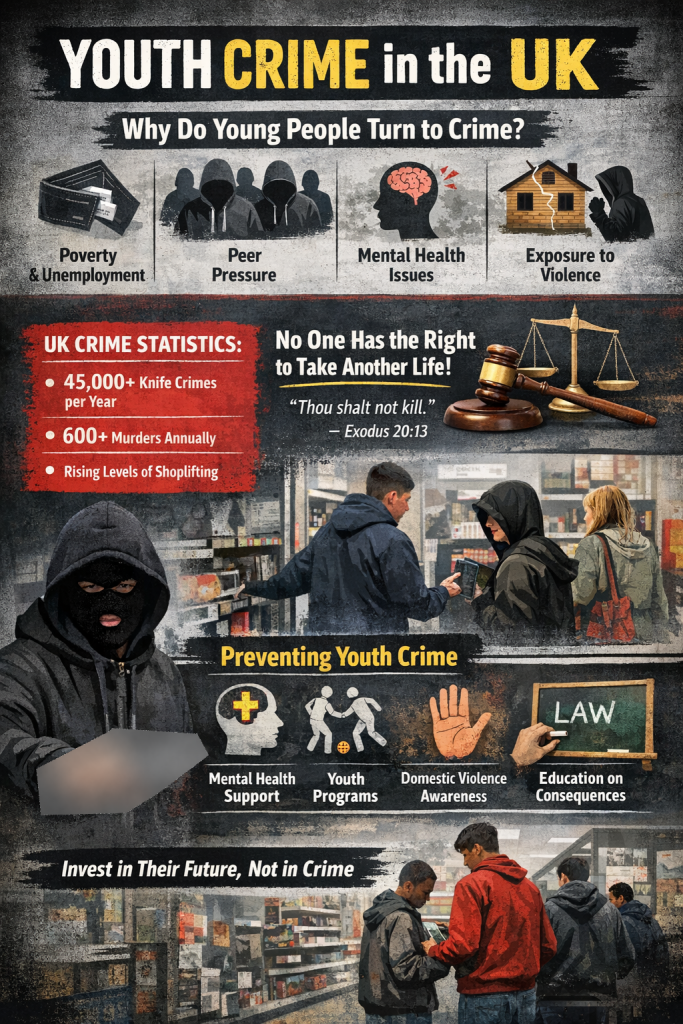
Youth crime remains a significant social issue across the United Kingdom. While the majority of young people do not engage in criminal activity, rising incidents of shoplifting, knife crime, and violent offences have raised serious concerns among communities, educators, and policymakers.
Crime is rarely the result of a single factor. Instead, it is often influenced by a complex mixture of psychology, environment, opportunity, and socio-economic pressures.
Understanding why young people turn to crime is essential if society wishes to prevent it.

Crime in the UK: What the Statistics Show
According to recent data from the Office for National Statistics:
- Police recorded over 6 million crimes in England and Wales annually in recent years.
- Knife-related offences exceed 45,000 cases per year, with a significant proportion involving young offenders.
- Shoplifting offences have risen sharply, particularly during periods of economic hardship.
- The UK typically records around 600–700 homicides per year, though the number fluctuates.
Although homicide rates remain lower than in many countries, the increase in youth involvement in violent incidents has become a major concern.
The Psychology of Youth Crime
Young people rarely wake up one day deciding to become criminals. Several psychological and environmental factors can push them toward unlawful behaviour.
1. Lack of Opportunity and Hopelessness
When young people feel they have no realistic future, crime may appear to be the only option.
Long-term unemployment, family poverty, or being sanctioned from financial support systems can create feelings of desperation and exclusion. Some individuals begin to believe that legitimate paths to success are closed to them.
For some, crime becomes a perceived survival strategy rather than a moral choice.
2. Peer Pressure and Identity
Adolescence is a stage where young people search for identity and belonging.
When peer groups normalise crime, whether shoplifting, drug dealing, or carrying knives for protection, individuals may follow suit to gain acceptance.
In many cases, young offenders report that they carried weapons not to attack someone but because they feared others who might be armed.
3. Exposure to Violence and Trauma
Children raised in environments where violence is common may begin to see aggression as normal behaviour.
Domestic abuse, unstable households, or exposure to crime in their neighbourhood can shape psychological responses where violence becomes a learned behaviour.
4. Mental Health and Poverty
Poverty is closely linked with mental health deterioration.
Financial instability can create stress within families, and young people living in disadvantaged environments often experience:
- Anxiety
- Depression
- Feelings of abandonment
- Lack of guidance
Without support systems, frustration can turn into anger directed toward society.
Should Crime Education Be Taught in Schools?
One argument gaining attention is that schools should teach the real consequences of crime.
Many young people do not fully understand what prison life is like or how a criminal record can permanently affect their future.
Young people should be taught early about the real consequences of their actions so they understand that decisions made in a moment can have lifelong effects. Education about crime prevention should not be limited to the classroom alone but reinforced in the wider community, including youth clubs, after-school meeting places, and other social environments where young people gather. Local businesses such as pubs, clubs, shops, and restaurants can also play a role by displaying visible signage promoting messages such as “Respect Your Community” or “Say No to Crime and Violence.” These reminders help create a culture where responsible behaviour is expected and supported by the whole community. In addition, some communities have begun discussing stronger safety measures, such as security checks or metal detectors in certain high-risk environments, particularly where large numbers of people gather. While such measures require careful consideration, appropriate policies, and community agreement, the overall aim is to prioritise safety and reinforce the message that protecting lives and preventing violence is a shared responsibility.
The consequences of crime rarely affect only the individual who commits it. When a young person becomes involved in criminal activity, the repercussions can ripple outward like a snowball rolling downhill, growing larger as it gathers momentum. Communities often form perceptions based on the actions of one individual, and unfairly, families and close associates can become subject to judgment or suspicion. The old saying that “the apple does not fall far from the tree” can lead people to assume that a youth’s behaviour reflects their upbringing or the values of their family, even when this is far from the truth. As a result, parents, siblings, and friends may find themselves labelled or stigmatised because of a single decision made by one person. This illustrates how crime can damage not only the offender’s future but also the reputation, relationships, and social standing of those around them, reinforcing the importance of understanding that individual choices can carry wider consequences for entire communities.
Crime can also affect the wider perception of a neighbourhood and the people who live there. When an area becomes associated with criminal activity, residents may begin to feel unsafe in their own community, particularly if incidents involve violence, theft, or antisocial behaviour. This fear can gradually erode trust between neighbours and reduce the sense of security that communities depend upon. Over time, such reputational damage can also influence property values. Prospective buyers or renters may hesitate to move into an area known for crime, which can lead to reduced demand and falling housing prices. As a result, the impact of crime extends beyond the individuals directly involved, affecting the economic stability of the neighbourhood and the well-being of the law-abiding residents who call it home.
Education programs could include:
- Visits from former offenders describing prison reality
- Lessons on the legal system and criminal consequences
- Victim impact statements
- Discussions about ethics, responsibility, and empathy
Education and community engagement can play a powerful role in amplifying the message to say no to crime. Schools, youth groups, and local community organisations can help shape attitudes by teaching young people about the real consequences of criminal behaviour, not only the legal penalties, but also the long-term impact on families, communities, and future opportunities. Workshops, guest talks from community leaders, police officers, or people who have turned their lives around after crime can help bring these lessons to life. At the same time, modern communication tools allow communities to spread positive messages widely through online awareness campaigns, social media, and community websites. Simple but visible initiatives can also help reinforce the message, such as creating “Say No to Crime” T-shirts, hoodies, wristbands, badges, posters, and stickers that young people can wear or share proudly. Community events, school competitions for designing anti-crime posters, and digital campaigns using short videos or hashtags can further engage young people and encourage them to become ambassadors for positive change. When education, community support, and creative awareness campaigns work together, they can help build a culture where respect for the law and responsibility toward others becomes the norm rather than the exception.
Such education could help students realise that criminal behaviour can destroy both their lives and the lives of others.
The Reality of Prison
The reality of prison life is often very different from what some people may imagine. While prisons provide basic necessities such as food and shelter, they are highly restrictive environments where individuals lose their freedom, privacy, and many of the opportunities available in everyday life. More importantly, once a person leaves prison, the consequences often continue. Having a criminal record can make it much harder to find employment, secure housing, or rebuild trust within society. This can create significant barriers to reintegration, and unfortunately, some individuals fall into a cycle where the lack of opportunity leads them back into criminal behaviour. For those who are homeless, particularly during harsh winter months, the desperation for warmth, food, and a roof over their heads can sometimes push them toward crime as a perceived means of survival. This highlights the importance of addressing not only crime itself but also the underlying social issues, such as homelessness, poverty, and lack of support, that can contribute to reoffending.
Prison often involves:
- Loss of freedom and family contact
- Limited employment prospects after release
- Psychological stress and institutionalisation
- A stigma that can follow someone for life
While rehabilitation programs exist, incarceration is not a solution to social inequality.
Preventing Youth Crime: What Needs to Change
Preventing youth crime requires long-term investment in communities.
Key areas include:
Better Mental Health Support
Young people struggling with trauma, anxiety, or depression must have access to counselling and psychological support.
Opportunities for Young People
Sports, arts programs, apprenticeships, and mentorship initiatives provide positive alternatives to crime.
Domestic Violence Awareness
Many young offenders come from homes affected by abuse. Early intervention can prevent cycles of violence from repeating.
Responsible Media Representation
Media outlets must avoid glorifying violence or presenting crime as glamorous.
Community Role Models
Teachers, parents, community leaders, and mentors must demonstrate that success through honest work is possible.
Conclusion
Youth crime cannot be solved simply through punishment.
It requires understanding why young people feel pushed toward crime in the first place.
When poverty, trauma, lack of opportunity, and social inequality combine, some individuals begin to believe that society has abandoned them.
If communities wish to reduce crime, they must invest in:
- Education
- Mental health
- Opportunity
- Moral responsibility
Most importantly, society must reinforce a fundamental truth:
Every human life has value, and no one has the right to take it away.
Only by addressing both social causes and moral responsibility can we create safer communities for future generations.
Further Reading & Resources
- Two Cardiff schools closed: Explosive devices, firearms, and knife attacks threatened | Wales Online
- Update issued on Cardiff school closures after threats made | Wales Online
- Knife crime statistics England and Wales – House of Commons Library
- Knife and Offensive Weapon Sentencing Statistics: January to March 2025 – GOV.UK
- Youth Justice Board annual statistics 2024-2025
- Crime statistics on young adults and youths – Office for National Statistics
- Sexual offences in England and Wales overview – Office for National Statistics
- (PDF) The ‘Knife Crime’ phenomenon – A psychological perspective on youth knife culture
- https://www.coram.org.uk/wp-content/uploads/migrated/Dr-Jasmine-Chin-Knife-Crime-20-APR-202019.pdf
- https://researchbriefings.files.parliament.uk/documents/SN04304/SN04304.pdf
- https://www.ons.gov.uk/crimeandjustice/yearendingseptember2025


Renata The Editor of DisabledEntrepreneur.uk - DisabilityUK.co.uk - DisabilityUK.org - CMJUK.com Online Journals, suffers From OCD, Cerebellar Atrophy & Rheumatoid Arthritis. She is an Entrepreneur & Published Author, she writes content on a range of topics, including politics, current affairs, health and business. She is an advocate for Mental Health, Human Rights & Disability Discrimination.
She has embarked on studying a Bachelor of Law Degree with the goal of being a human rights lawyer.
Whilst her disabilities can be challenging she has adapted her life around her health and documents her journey online.
Disabled Entrepreneur - Disability UK Online Journal Working in Conjunction With CMJUK.com Offers Digital Marketing, Content Writing, Website Creation, SEO, and Domain Brokering.
Disabled Entrepreneur - Disability UK is an open platform that invites contributors to write articles and serves as a dynamic marketplace where a diverse range of talents and offerings can converge. This platform acts as a collaborative space where individuals or businesses can share their expertise, creativity, and products with a broader audience.