Disclaimer: This article is for educational and informational purposes only and does not constitute legal advice. For specific legal concerns regarding defamation, you should consult a qualified legal professional or refer to official guidance, such as Citizens Advice or seek legal representation.
Understanding Libel, Slander, and the Legal Threshold for Harm
What is Defamation?
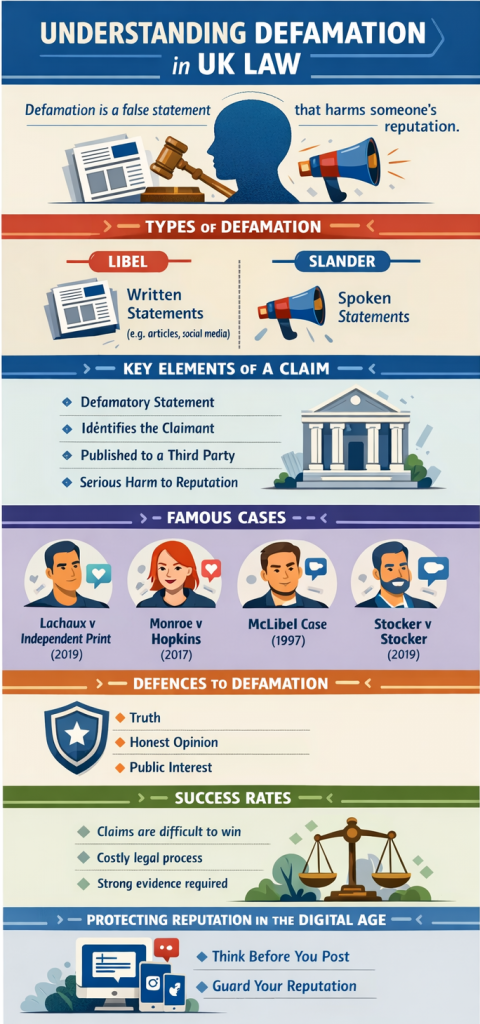
Defamation is a legal concept in tort law that protects an individual’s reputation from unjust harm caused by false statements. In simple terms, defamation occurs when someone makes or publishes a statement about another person that lowers them in the estimation of right-thinking members of society.
Under UK law, defamation is primarily governed by the Defamation Act 2013, which modernised the law to reflect online communication and introduced stricter thresholds for claims.
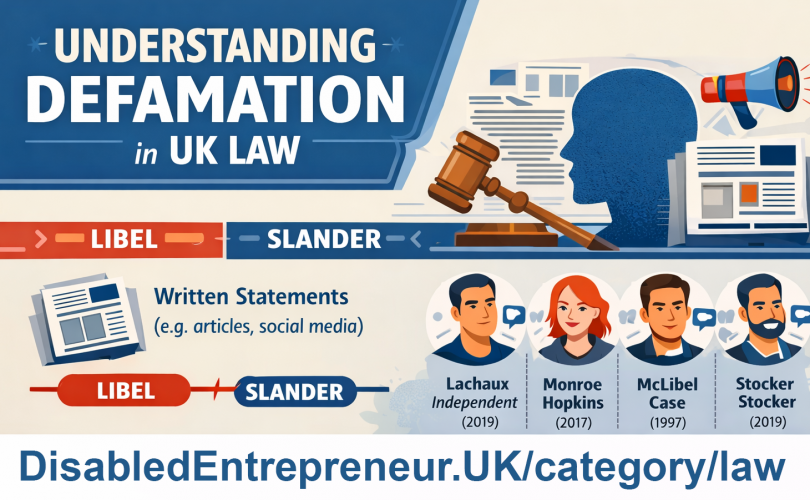
Types of Defamation: Libel vs Slander
There are two main forms of defamation:
- Libel:
Written or published defamatory statements (e.g., newspapers, websites, social media).
✔ Considered more serious because it has a permanent record - Slander:
Spoken defamatory statements
✔ Typically requires proof of actual damage, unless it falls into specific exceptions (e.g., allegations of criminal conduct)
Key Elements of a Defamation Claim
To succeed in a defamation claim, a claimant must prove:
- The statement is defamatory
It harms the reputation or exposes the claimant to ridicule or contempt. - The statement refers to the claimant
Even if not named directly, they must be identifiable. - The statement has been published
Communicated to at least one third party. - Serious harm requirement
Introduced under the Defamation Act 2013, the claimant must show that the statement caused or is likely to cause serious harm to their reputation.- For businesses: serious financial loss must be demonstrated.
The Importance of Reputation Protection
Reputation is a valuable personal and professional asset. The law recognises that false allegations can:
- Damage careers and businesses
- Impact on mental health and wellbeing
- Undermine trust and credibility
- Cause financial loss
Defamation law, therefore, aims to strike a balance between freedom of expression and protection of reputation, a principle also influenced by the Human Rights Act 1998, particularly:
- Article 8 (right to private life and reputation)
- Article 10 (freedom of expression)
Defences to Defamation
A defendant may avoid liability if they can rely on one of the following defences:
- Truth (Justification)
If the statement is substantially true, it is not defamatory. - Honest Opinion
Applies to opinions rather than statements of fact. - Publication on a Matter of Public Interest
Protects responsible journalism and public debate. - Privilege (Absolute or Qualified)
Statements made in Parliament or court proceedings may be protected.
Famous Defamation Cases
Here are some notable cases that illustrate how defamation law operates:
Lachaux v Independent Print Ltd (2019)
- Established the “serious harm” threshold
- The court confirmed that claimants must prove actual or probable harm, not just assume it
Monroe v Hopkins (2017)
- Involved in social media defamation on Twitter
- Political commentator Katie Hopkins falsely accused Jack Monroe
- Result: Damages awarded to Monroe
✔ Highlighted risks of online statements
McDonald’s Corporation v Steel & Morris [1997]. Known as “the McLibel Case (1997)
- One of the longest trials in UK history
- Demonstrated imbalance between corporations and individuals
✔ Raised concerns about access to justice
Stocker v Stocker (2019)
- Focused on the meaning of words in Facebook posts
✔ Courts consider how ordinary readers interpret online language
Success Rates and Practical Reality
Defamation claims in the UK can be complex and costly, and success is not guaranteed.
Key considerations:
- The serious harm threshold has made claims harder to win
- Legal costs can be significant, often limiting access to justice
- Many cases settle out of court
- Claimants must provide strong evidence of reputational damage
✔ In practice, only well-evidenced claims tend to succeed
Remedies for Defamation
If a claim is successful, the court may award:
- Damages (compensation)
- Injunctions (to stop further publication)
- Apologies or retractions
Defamation in the Digital Age
With the rise of social media and online publishing:
- Statements spread rapidly and globally
- Even a single post can cause significant harm
- Individuals and businesses must be cautious when posting opinions
Online platforms have also introduced procedures to remove defamatory content, though enforcement can vary.
Conclusion
Defamation law plays a crucial role in protecting reputation, ensuring individuals and businesses are not unfairly harmed by false statements. However, the law also recognises the importance of free speech, creating a careful legal balance.
For students of law, understanding defamation is essential, not only as a legal concept but as a reflection of wider societal values around truth, accountability, and communication in the modern world.
References:
- Defamation Act 2013
- Human Rights Act 1998
- The Human Rights Act | EHRC
- Human rights in Wales | GOV.WALES
- What are human rights? | OHCHR
- Human Rights: The UK’s international human rights obligations – GOV.UK
- Lachaux (Respondent) v Independent Print Ltd and another (Appellants) – UK Supreme Court
- Jack Monroe v Katie Hopkins [2017] EWHC 433 (QB)
- McDonald’s Corporation, McDonald’s Restaurants Limited v. Helen Marie Steel and David Morris [1997] EWHC QB 366 (19th June, 1997)
- Stocker (Appellant) v Stocker (Respondent) – UK Supreme Court
- Article 8: Respect for your private and family life | EHRC
- Article 10: Freedom of expression | EHRC

www.First4Lawyers.com

Renata The Editor of DisabledEntrepreneur.uk - DisabilityUK.co.uk - DisabilityUK.org - CMJUK.com Online Journals, suffers From OCD, Cerebellar Atrophy & Rheumatoid Arthritis. She is an Entrepreneur & Published Author, she writes content on a range of topics, including politics, current affairs, health and business. She is an advocate for Mental Health, Human Rights & Disability Discrimination.
She has embarked on studying a Bachelor of Law Degree with the goal of being a human rights lawyer.
Whilst her disabilities can be challenging she has adapted her life around her health and documents her journey online.
Disabled Entrepreneur - Disability UK Online Journal Working in Conjunction With CMJUK.com Offers Digital Marketing, Content Writing, Website Creation, SEO, and Domain Brokering.
Disabled Entrepreneur - Disability UK is an open platform that invites contributors to write articles and serves as a dynamic marketplace where a diverse range of talents and offerings can converge. This platform acts as a collaborative space where individuals or businesses can share their expertise, creativity, and products with a broader audience.