Disclaimer: This article is for informational and educational purposes only and does not constitute medical or psychological advice. If you are experiencing severe anxiety or mental distress, please seek support from a qualified healthcare professional or your university’s wellbeing services.
When Waiting Becomes the Hardest Part of Learning
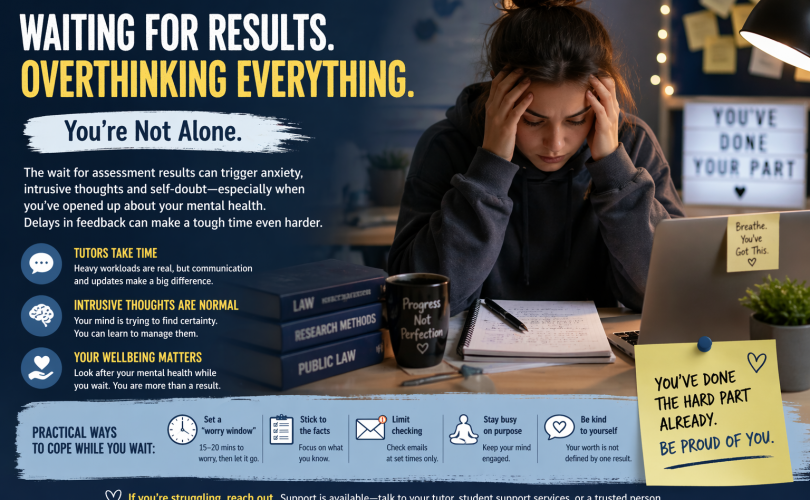
For many university students, the period between submitting an assessment and receiving results can feel more stressful than the work itself. This waiting phase often amplifies anxiety, especially for students who have already disclosed mental health conditions such as anxiety disorders, depression, or OCD.
Despite increased awareness around student wellbeing, delays in marking and feedback can unintentionally contribute to emotional distress. When students have been open about their vulnerabilities, prolonged silence or slow responses from tutors can feel dismissive, even if that is not the intention.
Why Waiting for Results Triggers Anxiety
Waiting removes control. Once an assessment is submitted, students are left with uncertainty:
- “Did I do enough?”
- “What if I fail?”
- “Will this affect my future?”
For students with pre-existing mental health conditions, this uncertainty can escalate into:
- Intrusive thoughts and overthinking
- Sleep disruption
- Difficulty concentrating on new tasks
- Emotional exhaustion
- Physical symptoms (e.g. headaches, tension)
The brain naturally seeks closure. Without it, it often fills the gap with worst-case scenarios.
The Impact of Delayed Feedback from Tutors
While tutors often manage heavy workloads, delays can have unintended consequences:
- Perceived lack of support: Students who have opened up may feel overlooked
- Increased rumination: The longer the wait, the more time for negative thought cycles
- Academic paralysis: Students may struggle to move on to the next task
- Trust breakdown: Particularly when expectations or timelines are unclear
For vulnerable students, communication matters just as much as the outcome.
Intrusive Thoughts: Why They Happen
Intrusive thoughts are unwanted, repetitive thoughts that can feel overwhelming and difficult to control. They often:
- Focus on fear of failure
- Replay perceived mistakes
- Predict negative outcomes without evidence
This is especially common in individuals with anxiety or OCD, where the mind attempts to “solve” uncertainty by overthinking it.
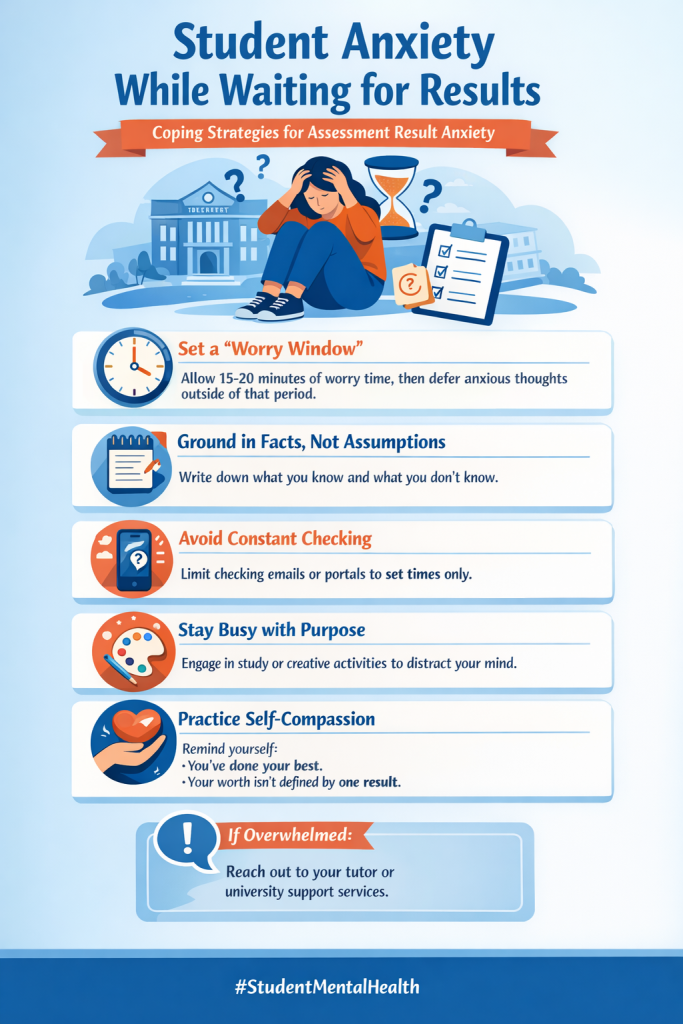
Practical Strategies to Manage Anxiety While Waiting
1. Set a “Worry Window.”
Instead of battling thoughts all day, allocate a fixed 15–20 minute period to think about your concerns.
- When thoughts arise outside this time, gently defer them
- This trains your brain to contain anxiety rather than let it spread
2. Ground Yourself in Facts, Not Assumptions
Write down:
- What you know (e.g., you completed and submitted the work)
- What you don’t know (e.g., the grade)
Challenge assumptions with evidence. Most anxious thoughts are not facts; they are predictions.
3. Avoid “Result Checking” Behaviour
Constantly refreshing emails or portals reinforces anxiety.
- Set specific times to check (e.g., once in the morning, once in the evening)
- Outside those times, redirect your focus
4. Use Cognitive Defusion Techniques
Instead of engaging with intrusive thoughts, observe them:
- “I am having the thought that I failed.”
- This creates distance between you and the thought
It reduces its emotional power.
5. Stay Occupied with Purposeful Activity
Idle time fuels overthinking. Try:
- Light studying or revision
- Creative work (writing, art)
- Structured routines
Even small tasks restore a sense of control.
6. Communicate When Needed
If delays are affecting your mental health:
- Send a polite follow-up email
- Reference any previously disclosed conditions
- Ask for a timeframe or reassurance
Clear communication can reduce uncertainty.
7. Practice Self-Compassion
Remind yourself:
- You have done your part
- Waiting is not a reflection of your ability
- Your worth is not defined by one result
What Universities and Tutors Can Do Better
To support student wellbeing, institutions could:
- Provide clear marking timelines and stick to them
- Acknowledge delays proactively
- Offer interim updates where possible
- Recognise disclosures of mental health conditions as ongoing needs, not one-off statements
Small changes in communication can significantly reduce student distress.
Final Thoughts
I wrote this article as a way to support myself in the future. I received my assessment results at 10 p.m., with the online feedback session scheduled for 10 a.m. the following morning. With only twelve hours between the two, and no realistic opportunity to rest, process the feedback, or review my tutor’s comments in detail, I simply did not have the capacity to prepare. As a result, I decided to cancel the session; attending without being able to engage meaningfully would not have been productive. The waiting period and the final assessment triggered significant anxiety to the point that I struggled to function. My heart rate was elevated, I felt tearful, and intrusive thoughts about the possibility of failing became overwhelming. This created a domino effect that began to interfere with the other responsibilities I manage, including running a business and providing care.
No apology can undo the impact this experience had on me. That is why I chose to reflect on it and write this article, to understand how to prevent a similar situation in the future. Waiting for results is more than an administrative delay; it is an emotional experience. For students managing mental health challenges, this period can feel overwhelming and isolating. I hope it resonates with other students who may be facing the same challenges. Understanding this reality is the first step toward change, both for students learning to cope and for institutions striving to support them better.
Further Reading & Resources
- Academic Stress and Mental Well-Being in College Students: Correlations, Affected Groups, and COVID-19 – PMC
- Longitudinal effects of stress in an academic context on psychological well-being, physiological markers, health behaviors, and academic performance in university students – PMC
- (PDF) The Psychological Consequences Of Exam Stress On University Students
- Managing stress when waiting for results
- A Qualitative Inquiry of University Students’ Experiences of Exam Stress and Its Effect on Their Academic Performance | Human Arenas | Springer Nature Link
- Waiting for exam results can be awful. Our research shows how best to manage the stress
- Predicting University Students’ Stress Responses: The Role of Academic Stressors and Sociodemographic Variables
- Full article: Academic stress as a predictor of mental health in university students
- Waiting for exam results can be awful. Our research shows how best to manage the stress – Medicine.net
- Continued deterioration in university student mental health: Inevitable decline or skirting around the deeper problems? – ScienceDirect


Renata The Editor of DisabledEntrepreneur.uk - DisabilityUK.co.uk - DisabilityUK.org - CMJUK.com Online Journals, suffers From OCD, Cerebellar Atrophy & Rheumatoid Arthritis. She is an Entrepreneur & Published Author, she writes content on a range of topics, including politics, current affairs, health and business. She is an advocate for Mental Health, Human Rights & Disability Discrimination.
She has embarked on studying a Bachelor of Law Degree with the goal of being a human rights lawyer.
Whilst her disabilities can be challenging she has adapted her life around her health and documents her journey online.
Disabled Entrepreneur - Disability UK Online Journal Working in Conjunction With CMJUK.com Offers Digital Marketing, Content Writing, Website Creation, SEO, and Domain Brokering.
Disabled Entrepreneur - Disability UK is an open platform that invites contributors to write articles and serves as a dynamic marketplace where a diverse range of talents and offerings can converge. This platform acts as a collaborative space where individuals or businesses can share their expertise, creativity, and products with a broader audience.