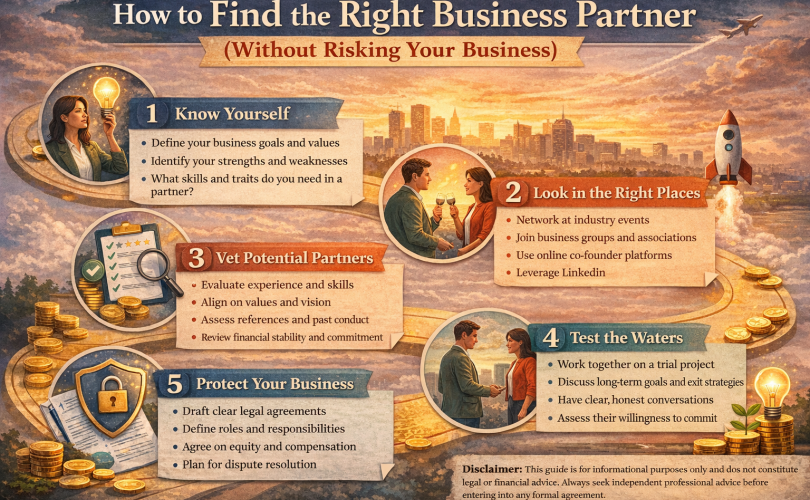
Disclaimer: This article is for informational purposes only and does not constitute legal, financial, or business advice. Entering into a business partnership carries legal and financial risks, and readers are advised to seek independent professional advice before entering into any formal agreement. The author and publisher accept no liability for any decisions made based on the information provided in this article.
Choosing the Right Partner Could Be Your Greatest Asset, or Your Biggest Risk
Finding the right business partner can be one of the most important decisions you make as an entrepreneur. While the right partnership can accelerate growth, bring new opportunities, and strengthen your business, the wrong one can lead to conflict, financial strain, and long-term setbacks. In an increasingly competitive and fast-paced business environment, it is essential to approach partnerships with clarity, caution, and strategy. This guide explores how to identify, evaluate, and secure the right business partner, without putting your business, vision, or peace of mind at risk.
1. Be Clear on What You Actually Need First
Before looking for anyone, define:
- Do you need skills (e.g. sales, tech, legal)?
- Do you need time support (operations, admin)?
- Do you need growth expertise (marketing, scaling)?
- Or do you need financial backing + involvement?
For you specifically, based on your ecosystem:
- Sales / lead generation
- Operations support
- Possibly legal collaboration (future law expansion)
2. Start With Your Existing Network (Most Underrated Strategy)
You already have:
- 12,000+ LinkedIn connections
- MSN audience
- Website traffic
- Industry visibility
That’s gold.
What to do:
- Post: “Looking for a strategic partner in [area]”
- Be specific: skills, expectations, time commitment
- Invite conversation, not commitment
Tip: The best partners often come from people already watching your work.
3. Use LinkedIn Properly (Not Passively)
Instead of waiting:
Search for:
- “Co-founder”
- “Business development”
- “Startup partner”
- “Sales director”
- “Non-executive director”
Then:
- Connect with a short, warm message
- Mention shared vision, not just opportunity
Example:
“Hi, I’m building a platform supporting disabled entrepreneurs across the UK and expanding into legal services. I’m looking to connect with people who align with this vision, no pressure, just a conversation.”
4. Look for Alignment, Not Just Skills
This is where many go wrong.
Red flags:
- Only interested in money
- No understanding of your mission
- Pushy or transactional
- No long-term vision
Green flags:
- Shares your values
- Understands your audience
- Patient and collaborative
- Brings ideas, not just demands
5. Consider a “Trial Phase” First
Never jump straight into partnership.
Start with:
- Freelance work
- Small project collaboration
- Revenue share on one service
- 30–90 day trial
This protects you from:
- Conflict
- Misalignment
- Loss of control
6. Use Formal Structures (Even Informally)
Even if you’re testing:
- Write a simple agreement
- Define:
- Roles
- Expectations
- Payment / equity (if any)
- Exit terms
7. Platforms to Find Partners
Professional Platforms:
- CoFoundersLab
- AngelList (now Wellfound)
UK-Specific:
- Business Wales networking
- Local enterprise hubs
- University entrepreneurship groups
8. Consider Alternative “Partners” (Lower Risk Options)
Not all partners need equity.
✔ Strategic Collaborators
- Work together on projects
- No ownership involved
✔ Affiliates
- Earn commission on referrals
✔ Consultants
- Paid expertise without commitment
✔ Non-Executive Directors (NEDs)
- Advisory role
- No day-to-day involvement
These options give you:
✔ Support
✔ Growth
✔ Without losing control
9. If You Do Want a Partner – Protect Yourself
- Never give away large equity early
- Avoid 50/50 splits initially
- Keep decision-making control
- Use staged equity (earned over time)
10. A Simple Strategy Tailored to You
Here are some recommendations:
Step 1:
Post on LinkedIn:
“Looking for a strategic collaborator in sales/lead generation to help scale a growing platform supporting disabled entrepreneurs and UK businesses.”
Step 2:
Offer:
- Commission-based role initially
- No equity upfront
Step 3:
Evaluate over 60–90 days
Step 4:
Then decide:
- Keep as a contractor
- Upgrade to partner
- Or walk away
Final Thoughts
Finding the right business partner is not about filling a gap quickly; it is about building a relationship rooted in trust, shared values, and long-term vision. The wrong partnership can create conflict, financial loss, and unnecessary stress, while the right one can accelerate growth, bring stability, and open doors you could not access alone. Take your time, protect your interests, and never feel pressured to commit before you are ready. In business, as in life, who you choose to stand beside you matters just as much as the direction you are heading.
Further Reading & Resources
How To Find Business Partners:
- https://disabledentrepreneur.uk/everything-start-ups-need-to-know-about-securing-angel-investment-in-the-uk/
- Finding A Business Partner For 2025 | Startups.co.uk
- How to find and choose the right business partner | UK Business Forums
- How to Find a Business Partner | Tips for Successful Partnerships | LinkedIn
- How to Find Investors | Financing Your Business | Xero UK
- 8 Strategies To Find The Perfect Business Partner
- 12 Tips for Finding a Business Partner and Maintaining a Successful Partnership | Indeed.com
- How To Choose A Business Partner You Won’t Regret
- How to Find a Business Partner Online – NerdWallet
- How to Identify and Evaluate Potential Strategic Partners for Business Success — Brick Shore Consulting
Guide To Angel Investors:
- A Complete Guide to UK Government Startup Incentives: SEIS and EIS Explained | Oriel IPO
- EIS, SEIS and VCT – tax efficient investments – a guide for investors – BDO
- Understanding SEIS & EIS Tax Incentives – StartUp UK
- VCM30100 – Seed Enterprise Investment Scheme : Overview of SEIS reliefs – HMRC internal manual – GOV.UK
- EIS and SEIS Explained: Tax Relief for Income Tax and Capital Gains in the UK — Tax Matters
- What is EIS, VCT or SEIS? | M&G Wealth Adviser
- SEIS & EIS Explained: Essential Guide To Tax Relief For UK Startups
- SEIS vs EIS (2025): Which Tax Relief Fits Your Startup? | Undo Capital
- SEIS and EIS Explained: A Comprehensive Guide for UK Startups in 2024
- What are the SEIS/EIS tax benefits for investors?

Renata is the Founder and Editor of DisabledEntrepreneur.UK and is currently developing a charity through DisabilityUK.org to support Disabled Start‑Ups and vulnerable individuals. She is also working toward establishing a Pro Bono Law Department to assist people across Wales.
An entrepreneur and published author, Renata leads a team producing content on politics, current affairs, health, disabilities, and business. She is a dedicated advocate for Mental Health, Human Rights, and Disability Discrimination.
Renata lives with OCD, Cerebellar Atrophy, and Rheumatoid Arthritis, and openly documents her journey to empower others navigating similar challenges.
Through the Disabled Entrepreneur Online Journal in collaboration with The UK Website Designers Group, she provides Digital Marketing, Content Writing, SEO, Website Creation, and Domain Brokering. The wider Disabled Entrepreneur – Disability UK platform is an open, collaborative space where contributors, creators, and domain sellers can share their expertise and connect with a broader audience.