Disclaimer: This article is for educational and informational purposes only and does not constitute legal, financial, or tax advice. Regulations may change, and individual circumstances vary. Always seek advice from a qualified accountant, solicitor, or financial adviser before making business decisions.
From Sole Trader to Limited Company: Structures, Responsibilities, and Strategic Growth
Choosing the right business structure is one of the most important decisions you will make as an entrepreneur. Whether you are starting small or planning to scale and attract investors, your structure affects your taxes, liability, credibility, and growth potential.
In the UK, the most common business structures are:
- Sole Trader
- Partnership
- Limited Company (Ltd)
- Public Limited Company (PLC)
- Limited Liability Partnership (LLP)
Each has its own advantages, obligations, and risks.
1. Sole Trader
✔️ What It Is
A sole trader is an individual who runs their business personally and keeps all profits after tax.
✅ Pros
- Simple and quick to set up (register with HM Revenue and Customs)
- Full control of business decisions
- Minimal reporting requirements
- Lower administrative costs
❌ Cons
- Unlimited personal liability (you are personally responsible for debts)
- Less credibility with investors and larger clients
- Harder to raise finance
📌 Obligations
- Register for Self Assessment
- Submit annual tax return
- Keep accurate financial records
2. Partnership
✔️ What It Is
A partnership involves two or more people sharing responsibility, profits, and liabilities.
✅ Pros
- Shared workload and expertise
- Simple structure
- Flexible profit sharing
❌ Cons
- Joint liability (partners can be responsible for each other’s actions)
- Potential disputes
- Still limited access to investment
📌 Obligations
- Register a partnership with HM Revenue and Customs
- Submit the partnership tax return
- Each partner submits individual returns
3. Limited Liability Partnership (LLP)
✔️ What It Is
A hybrid between a partnership and a limited company where partners have limited liability.
✅ Pros
- Limited liability protection
- Flexible internal structure
- Separate legal identity
❌ Cons
- More administrative requirements
- Public disclosure of accounts
📌 Obligations
- Register with Companies House
- File annual accounts and confirmation statement
4. Limited Company (Ltd)
✔️ What It Is
A limited company is a separate legal entity from its owners (shareholders) and directors.
✅ Pros
- Limited liability (your personal assets are protected)
- More tax-efficient in many cases
- Increased credibility
- Easier to attract investors and funding
- Preferred structure for angel investors
❌ Cons
- More complex administration
- Public financial records
- Directors’ legal responsibilities
📌 Obligations
- File annual accounts with Companies House
- Submit Corporation Tax returns to HM Revenue and Customs
- Maintain statutory registers
- File a confirmation statement annually
5. Public Limited Company (PLC)
✔️ What It Is
A PLC can sell shares to the public and is typically used by large organisations.
✅ Pros
- Ability to raise large amounts of capital
- Enhanced credibility
- Shares can be publicly traded
❌ Cons
- High regulatory burden
- Minimum share capital requirement (£50,000)
- Greater scrutiny
📌 Obligations
- Strict reporting and governance requirements
- Must comply with additional regulations
How to Set Up a Limited Company in the UK
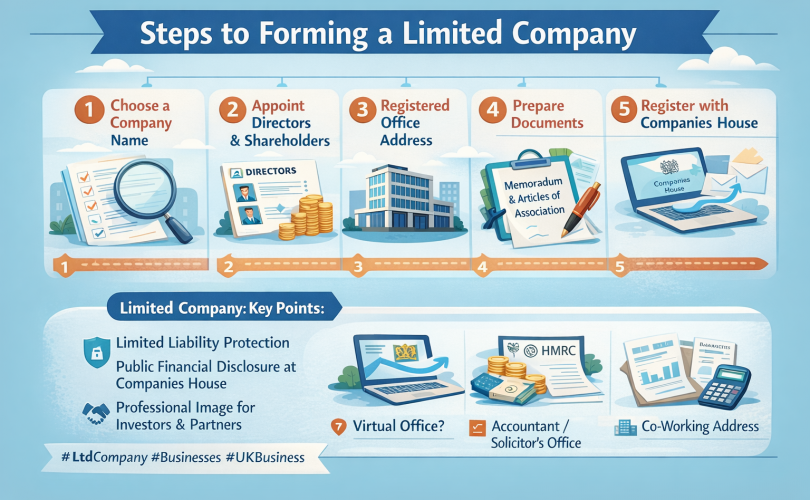
Step 1: Choose a Company Name
- Must be unique
- Cannot be misleading or offensive
- Must comply with naming rules
Step 2: Register with Companies House
You can:
- Register yourself directly via Companies House
- Or use an accountant or formation agent
👉 Yes, you can set up a limited company yourself.
You do not need an organisation, although many people choose one for convenience.
Step 3: Provide Key Information
You will need:
- Company name
- Registered office address
- Director(s) details
- Shareholder(s) details
- Memorandum and Articles of Association
Step 4: Registered Address Requirements
Your company must have a registered office address:
- This is publicly visible
- Used for official correspondence
⚠️ Important Note on Virtual Addresses & SEO
Using a virtual address (especially for marketing purposes) can be problematic:
- Search engines like Google prioritise genuine, physical business locations
- Virtual offices used purely for ranking manipulation may:
- Be flagged as misleading
- Harm local SEO rankings
- Reduce trust signals
👉 For credibility and SEO:
- Use a legitimate, consistent business address
- Avoid “ghost offices” or mass virtual address listings
Step 5: Register for Corporation Tax
You must register with HM Revenue and Customs within 3 months of starting business activity.
Step 6: Open a Business Bank Account
Essential for separating personal and company finances.
Step 7: Understand Public Disclosure
When you form a limited company:
- Your accounts are filed with Companies House
- These are publicly accessible
- Anyone can view basic financial data
Where to Register Your Business Address: Office, Home, or Virtual?
When forming a company, one of the most common questions is: “Where do I register my business if I work remotely or don’t have an office?” The answer depends on your business model, personal circumstances, and legal requirements.
Do You Need a Physical Office?
You do not need a traditional office to start or register a company in the UK. Many successful companies are fully remote. However, you must provide a registered office address when forming a company with Companies House.
This address:
- Appears on the public register
- Is used for official legal and tax correspondence
- Must be a real physical address in the UK
Your options include:
- Your home address
- A rented office
- A registered office service provider
- Your accountant’s or solicitor’s office (if permitted)
Using Your Home Address (Owner-Occupiers vs Renters)
Many sole directors register their company at home, especially when working online. But there are key considerations:
If you own your home
- Usually permitted, but check mortgage terms and home insurance
- Inform your insurer if you operate a business from home
If you are renting
You must check your tenancy agreement, because:
- Many residential tenancies prohibit business use
- Your landlord may need to give written permission
- Some landlords refuse business registration due to:
- Mortgage conditions
- Insurance restrictions
- Council or building rules
Failure to obtain permission could:
- Breach your tenancy agreement
- Lead to eviction
- Cause disputes with your landlord
Privacy Concerns When Using Your Home Address
When you use your home address:
- Your address becomes publicly visible on the Companies House register
- Search engines like Google index it
- Anyone (clients, competitors, scammers) can see it
For some business owners, especially those working from home due to disability or caring responsibilities, this can be a significant privacy concern.
What If Your Business Is 100% Online?
If you operate fully online, you still need a physical registered office address. Options include:
✔️ Registered Office Service Providers
- Provide a legal address for Companies House correspondence
- Help protect your privacy
- Commonly used by remote founders and freelancers
✔️ Accountant or Solicitor Address
- Some professional firms allow their clients to use their office as the registered address
✔️ Co-Working Spaces
- Some offer business address services even if you don’t use the workspace daily
Virtual Offices and SEO Implications
Virtual offices are legal and commonly used for company formation. However, using a virtual office purely to appear local or to manipulate local search rankings can create issues.
Search engines such as Google prioritise:
- Authentic physical business locations
- Businesses that demonstrate real-world presence
Using a virtual office for SEO manipulation can:
- Harm local search visibility
- Lead to penalties if deemed misleading
If your business is online-only, it’s usually better to be transparent rather than appear to operate from a location where you have no presence.
You do not need a traditional office to register or run a company in the UK, but you must have a legitimate registered address. The right choice depends on your business model, privacy needs, tenancy agreements, and long-term growth plans.
For online-only businesses, registered office services offer a practical solution, but transparency, legal compliance, and credibility should always come first.
Why Investors Prefer Limited Companies
Angel investors and institutional investors typically prefer limited companies because:
- Clear share structure
- Limited liability
- Easier equity distribution
- Legal protections
- Scalable business model
👉 Sole traders and partnerships:
- Cannot easily issue shares
- Carry a higher risk for investors
Key Comparison Table
| Structure | Liability | Complexity | Investment Potential | Public Disclosure |
|---|---|---|---|---|
| Sole Trader | Unlimited | Low | Low | No |
| Partnership | Unlimited | Low | Low | No |
| LLP | Limited | Medium | Moderate | Yes |
| Ltd | Limited | Medium-High | High | Yes |
| PLC | Limited | High | Very High | Yes |
Final Thoughts
If you are starting small, a sole trader structure may be sufficient. However, if you are planning to grow, attract investors, and build a scalable business, forming a limited company is often the most strategic move.
For entrepreneurs like yourself who are building multi-layered businesses, seeking investment, and establishing credibility, transitioning to a limited company is not just a legal step, it is a strategic milestone.
Further Reading & Resources
- Sign in to WebFiling – Companies House – GOV.UK
- Search the register – Find and update company information – GOV.UK
- Companies House – GOV.UK
- Set up a limited company: step by step – GOV.UK
- Self Assessment – GOV.UK
- How to fill in your tax return
- Making Tax Digital for Income Tax – HMRC guide
- HMRC online services: sign in or set up an account: Sign in or set up an account – GOV.UK
- What does it mean to be a ‘limited’ company? – Companies House
- What is a Limited Company | Business Wales


Renata The Editor of DisabledEntrepreneur.uk - DisabilityUK.co.uk - DisabilityUK.org - CMJUK.com Online Journals, suffers From OCD, Cerebellar Atrophy & Rheumatoid Arthritis. She is an Entrepreneur & Published Author, she writes content on a range of topics, including politics, current affairs, health and business. She is an advocate for Mental Health, Human Rights & Disability Discrimination.
She has embarked on studying a Bachelor of Law Degree with the goal of being a human rights lawyer.
Whilst her disabilities can be challenging she has adapted her life around her health and documents her journey online.
Disabled Entrepreneur - Disability UK Online Journal Working in Conjunction With CMJUK.com Offers Digital Marketing, Content Writing, Website Creation, SEO, and Domain Brokering.
Disabled Entrepreneur - Disability UK is an open platform that invites contributors to write articles and serves as a dynamic marketplace where a diverse range of talents and offerings can converge. This platform acts as a collaborative space where individuals or businesses can share their expertise, creativity, and products with a broader audience.