Disclaimer: This article is for educational and informational purposes only and does not constitute legal or medical advice. Readers should consult qualified professionals for specific concerns regarding health, safety, or legal compliance.
Protecting Consumers, Preserving Trust, and Preventing Harm in the Beauty Industry
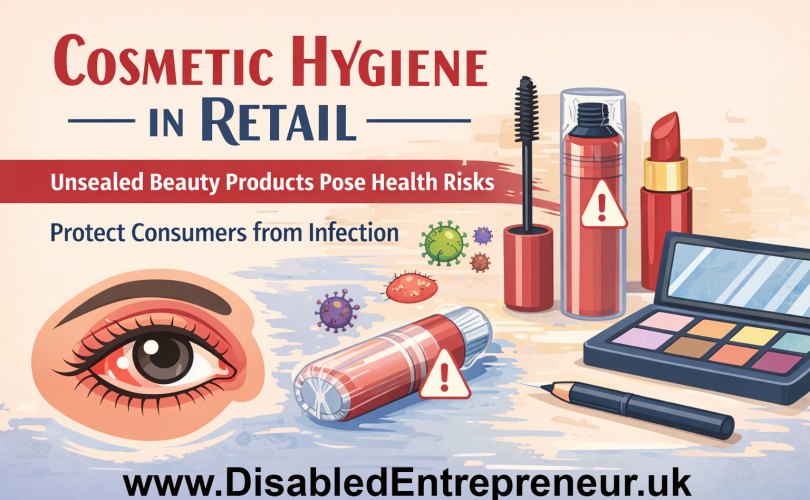
In today’s beauty retail environment, hygiene is no longer optional; it is a fundamental consumer expectation. With increasing awareness of health risks, many shoppers are becoming cautious about purchasing cosmetic products that appear tampered with, unsealed, or previously opened.
The issue is particularly concerning in high-risk categories such as eye cosmetics, including mascaras, eyeliners, and eyeshadows, where contamination can lead to serious infections and, in extreme cases, vision impairment or loss.
The Hidden Risk of Unsealed Cosmetics
When products are not sealed or tamper-proof, they are vulnerable to germ contamination and cross-contamination. This can occur when:
- Customers open fresh stock out of curiosity
- Individuals test products directly on their skin or eyes
- Retail environments lack supervision or hygiene protocols
A product that appears “new” may, in fact, have already been exposed to bacteria, viruses, or fungi.
High-Risk Products: The Eye Area
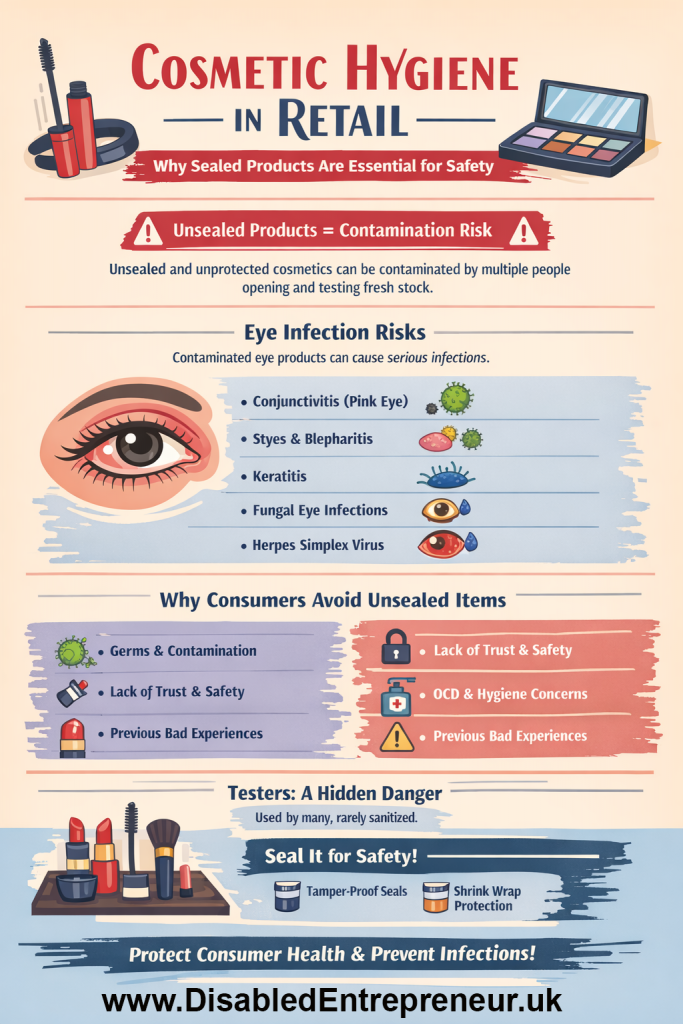
The eye area is susceptible to infection. Using contaminated products such as mascara or eyeliner can introduce harmful microorganisms directly into the eye.
Common Infections Linked to Contaminated Cosmetics
- Conjunctivitis (Pink Eye)
A highly contagious infection causing redness, discharge, and irritation. Can spread rapidly through shared or contaminated products. - Styes (Hordeolum)
Painful lumps on the eyelid caused by bacterial infection, often linked to contaminated mascara or eyeliner. - Blepharitis
Chronic inflammation of the eyelids, leading to irritation, crusting, and discomfort. - Keratitis
A serious infection of the cornea that can lead to vision impairment or permanent damage if untreated. - Fungal Eye Infections
Less common but potentially severe, particularly in immunocompromised individuals. - Herpes Simplex Virus (HSV-1)
Can be transmitted via contaminated products, leading to recurrent eye infections and potential corneal scarring.
Germ Contamination and Cross-Contamination Explained
- Germ contamination occurs when harmful microorganisms are introduced into a product.
- Cross-contamination happens when bacteria or viruses are transferred from one person to another via shared surfaces or items.
In retail settings, this can happen through:
- Multiple people touching the same product
- Lack of hygiene controls for testers
- Staff handling products without sanitation protocols
Why Consumers Avoid Unsealed Products
Many consumers are now actively avoiding unsealed cosmetics for several reasons:
- Health concerns and fear of infection
- Lack of trust in product integrity
- Visible signs of tampering or prior use
- Poor retail hygiene standards
- Previous negative experiences
For individuals living with Obsessive-Compulsive Disorder (OCD), the issue is even more pronounced. Unsealed items, even when gifted, may be completely unusable due to contamination fears, leading to distress and financial waste.
The Problem with Testers
Testers, while useful for product sampling, present a significant hygiene challenge:
- Used by multiple people without sanitisation
- Often applied directly to skin, lips, or eyes
- Rarely replaced, frequently enough
- May be mistaken for new stock
As a result, many consumers refuse to use testers altogether, particularly for products applied near sensitive areas.
Retail Responsibility: Safety Over Cost-Cutting
There is growing concern that some brands and retailers avoid sealing products to reduce packaging costs or improve accessibility in-store. However, this approach may ultimately gamble with both consumer health and company profits.
- Health risks can lead to customer harm and legal claims
- Reputational damage can erode brand trust
- Loss of sales as consumers avoid unsealed products
In reality, failing to seal cosmetics may cost far more in the long term than the savings achieved.
Should All Cosmetics Be Sealed?
Yes, regardless of price point.
Even low-end or budget products should be tamper-evident. Hygiene is not a premium feature; it is a basic safety requirement.
Sealing methods may include:
- Shrink wrap
- Tamper-proof stickers
- Safety seals under caps
- Boxed packaging with security tabs
Legal and Regulatory Framework (UK & EU)
While there is no specific UK law mandating that all cosmetics must be sealed, several regulations impose strict safety obligations:
1. UK Cosmetics Regulation (EC) No 1223/2009
Requires that cosmetic products placed on the market must be safe for human health under normal or reasonably foreseeable conditions of use.
2. General Product Safety Regulations 2005
Obliges manufacturers and retailers to ensure products are safe and free from risks to consumers.
3. Consumer Protection Act 1987
Allows consumers to seek compensation if a defective product causes harm, including infections resulting from contamination.
4. Health and Safety Executive (HSE)
Provides guidance on consumer safety and risk prevention in retail environments.
The Legal Risk for Businesses
If a consumer develops an infection from an unsealed product, businesses may face:
- Product liability claims
- Negligence claims
- Regulatory investigations
- Financial compensation payouts
All it takes is one case of eye infection linked to a contaminated product to trigger serious legal and reputational consequences.
The Case for Stronger Regulation
Given the risks, there is a compelling argument that:
“If no explicit law requires sealing, there should be one”.
Introducing mandatory tamper-evident packaging could:
- Protect consumers from avoidable harm
- Standardise hygiene practices across the industry
- Reduce legal disputes
- Improve public confidence in beauty products
Conclusion
Cosmetic hygiene in retail is not just about presentation; it is about public health, consumer trust, and ethical responsibility.
Beauty brands, manufacturers, and retailers must recognise that:
- Unsealed products pose real risks
- Consumers are increasingly aware and cautious
- Cutting corners on safety can backfire financially and legally
Ultimately, the message is clear:
“The beauty sector should never gamble with people’s health to save on costs”.
Further Reading & Resources
- Health and Safety in the Beauty and Aesthetics Industry
- COSHH and beauticians – key messages – COSHH
- Regulation 1223/2009 and the Cosmetic Products Enforcement Regulations 2013: Great Britain – GOV.UK
- UK Cosmetic Packaging Regulations: What You Must Comply With
- The Role of Sealing and Leakage Prevention in Cosmetic Packaging | XingYuan
- The Importance of Tamper‑Proof Cosmetic Packaging for Customer Safety
- Best Packaging Practices for Cosmetics & Beauty Products
- Consumer products: cosmetics – GOV.UK
- The Complete Guide to Cosmetic Packaging – Empowering your brand with our top OEM/ODM cosmetic solutions.
- Cosmetic Tamper Seals Manufacturers & Suppliers
- Beauty & Cosmetics – Best tamper-evident security tape, labels, bags & container seals
- Tamper-Evident Seals for Product Protection | Securikett
- Top 6 Tamper Evident Packaging Solutions for Beauty Products
- Beauty and Cosmetics Packaging, Number 1 Packaging Solution

Renata The Editor of DisabledEntrepreneur.uk - DisabilityUK.co.uk - DisabilityUK.org - CMJUK.com Online Journals, suffers From OCD, Cerebellar Atrophy & Rheumatoid Arthritis. She is an Entrepreneur & Published Author, she writes content on a range of topics, including politics, current affairs, health and business. She is an advocate for Mental Health, Human Rights & Disability Discrimination.
She has embarked on studying a Bachelor of Law Degree with the goal of being a human rights lawyer.
Whilst her disabilities can be challenging she has adapted her life around her health and documents her journey online.
Disabled Entrepreneur - Disability UK Online Journal Working in Conjunction With CMJUK.com Offers Digital Marketing, Content Writing, Website Creation, SEO, and Domain Brokering.
Disabled Entrepreneur - Disability UK is an open platform that invites contributors to write articles and serves as a dynamic marketplace where a diverse range of talents and offerings can converge. This platform acts as a collaborative space where individuals or businesses can share their expertise, creativity, and products with a broader audience.