Disclaimer: This article is for educational purposes only and does not constitute legal advice. Laws may change, and individual circumstances vary. Readers are advised to seek professional legal guidance or contact their local authority for specific concerns.
Understanding Your Legal Right to Quiet Enjoyment
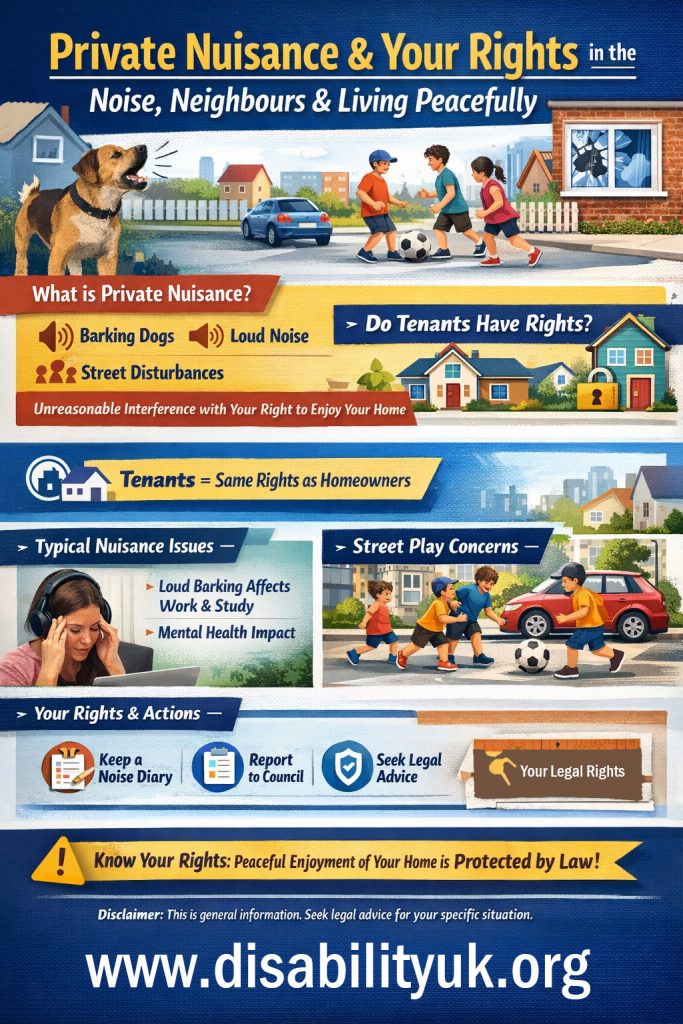
Private nuisance is a key concept in UK tort law that protects a person’s right to use and enjoy their land without unreasonable interference.
This principle was clearly established in cases such as Hunter v Canary Wharf Ltd, where the courts confirmed that nuisance is about interference with land, not just personal discomfort.
What Counts as Private Nuisance?
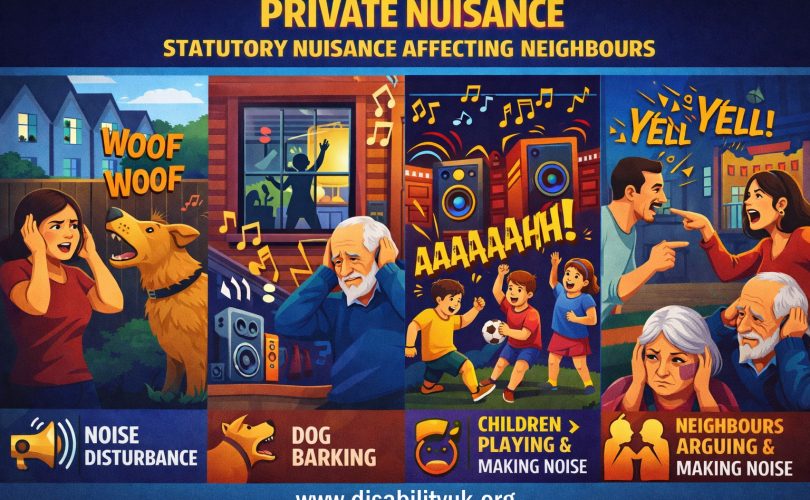
Private nuisance generally involves continuous or recurring interference, such as:
- Persistent dog barking
- Loud or excessive noise (music, shouting, slamming doors/windows)
- Vibrations or disturbances from neighbouring properties
- Smoke, smells, or other environmental intrusions
To succeed in a claim, the interference must be:
- Unreasonable (not just annoying)
- Substantial (more than trivial inconvenience)
- Continuous or repeated (not a one-off event)
Do Tenants Have the Same Rights as Homeowners?
Yes: this is very important for your scenario.
The law recognises that anyone with a legal interest in land can bring a claim in private nuisance.
- Homeowners ✔️
- Tenants (including renters) ✔️
- Leaseholders ✔️
This principle comes from Malone v Laskey, which clarified that only those with a proprietary interest (not guests) can claim.
👉 A tenant working or studying from home has the same protection against nuisance as a homeowner.
Scenario Breakdown: Dogs Barking & Remote Work Disruption
📌 Legal Perspective
Persistent dog barking may amount to a nuisance if it:
- Happens frequently
- Interferes with sleep, work, or study
- Impacts mental health
Courts will consider:
- Duration and frequency
- Time of day
- Local environment (quiet residential vs busy urban area)
A key case is Sturges v Bridgman:
“What would be a nuisance in Belgrave Square would not necessarily be so in Bermondsey.”
👉 Meaning: context matters.
📌 Practical Remedies
Before legal action:
- Keep a noise diary
- Record evidence (where lawful)
- Contact your local council (Environmental Health)
- Attempt an informal resolution
If unresolved, councils can act under the Environmental Protection Act 1990.
Children Playing in the Street: Nuisance or Not?
This is more nuanced.
⚖️ Legal Position
Children playing is generally not automatically a nuisance, especially if:
- It is temporary or periodic
- Approved by the council
- Occurs at reasonable hours
Courts recognise a level of “give and take” between neighbours.
🚨 When It May Become a Nuisance
- Excessive noise beyond normal play
- Damage to property (cars, windows)
- Repeated disruption impacting livelihood
Street Events & Liability: Who Is Responsible?
This is where your question becomes very relevant (and quite advanced legally 👏).
✔️ Should Residents Be Notified?
Yes — best practice (and often required by councils) includes:
- Advance notice to residents
- Details of timing and nature of the event
- Risk assessments
✔️ Insurance & Liability
Event organisers should typically have:
- Public Liability Insurance
- Risk assessment documentation
If damage occurs (e.g. scratched cars):
- The organiser may be liable
- A claim can be made against their insurance
❓ Should Insurance Certificates Be Sent to Residents?
Not legally required in all cases, but:
👉 Best practice would include:
- Providing reassurance of insurance cover
- Contact details for claims
- Clear accountability
Failure to do so could raise issues of:
- Negligence
- Failure to manage foreseeable risk
Balancing Rights: Quiet Enjoyment vs Community Living
The law does not expect complete silence, but it does protect against:
- Persistent disruption
- Loss of ability to work or study
- Impact on mental health
Courts will balance:
- Individual rights
- Community interests
- Reasonableness
Legal Remedies Available
If nuisance is proven, remedies include:
- Injunctions (to stop the behaviour)
- Damages (compensation)
- Council enforcement action
A classic authority on remedies is Shelfer v City of London Electric Lighting Co.
Know Your Rights (Quick Summary)
✔️ Tenants have equal protection under nuisance law
✔️ Persistent dog barking can be actionable
✔️ Noise affecting work/study strengthens your case
✔️ Council-approved events are not automatically lawful if damage occurs
✔️ Event organisers should carry liability insurance
✔️ You have the right to “quiet enjoyment” of your home
Final Thoughts
Our scenario highlights a modern legal tension:
Remote working and studying have increased the expectation of quiet, but the law has not fully evolved to reflect this shift.
This opens the door for future legal arguments, especially around:
- Mental health impact
- Digital working environments
- Reasonable use of residential property


Renata The Editor of DisabledEntrepreneur.uk - DisabilityUK.co.uk - DisabilityUK.org - CMJUK.com Online Journals, suffers From OCD, Cerebellar Atrophy & Rheumatoid Arthritis. She is an Entrepreneur & Published Author, she writes content on a range of topics, including politics, current affairs, health and business. She is an advocate for Mental Health, Human Rights & Disability Discrimination.
She has embarked on studying a Bachelor of Law Degree with the goal of being a human rights lawyer.
Whilst her disabilities can be challenging she has adapted her life around her health and documents her journey online.
Disabled Entrepreneur - Disability UK Online Journal Working in Conjunction With CMJUK.com Offers Digital Marketing, Content Writing, Website Creation, SEO, and Domain Brokering.
Disabled Entrepreneur - Disability UK is an open platform that invites contributors to write articles and serves as a dynamic marketplace where a diverse range of talents and offerings can converge. This platform acts as a collaborative space where individuals or businesses can share their expertise, creativity, and products with a broader audience.