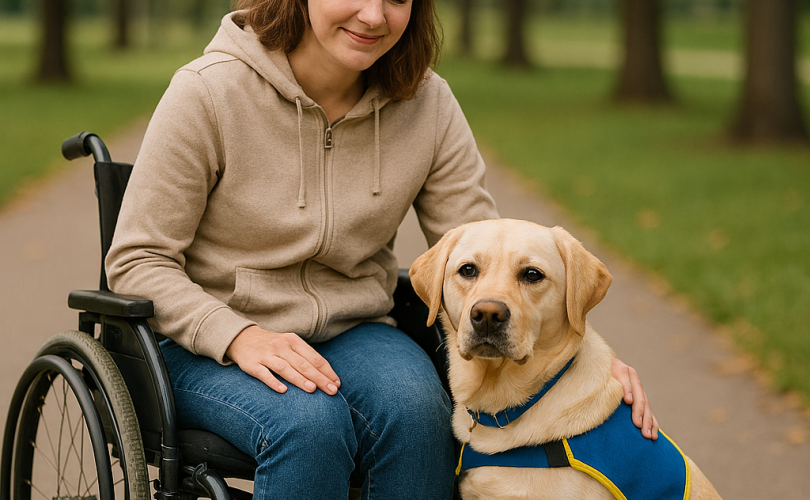
A Comprehensive Guide For People With Disabilities With Service Dogs
“Curious about what truly sets a service dog apart from a trained pet?In this guide, I break down the real disability-linked tasks, the day-to-day independence they unlock, and the training it takes to stay calm in public. Ready to choose wisely, and ethically?”
A well-trained service dog isn’t just a “helpful pet”, it’s a skilled partner that steps in when independence, safety, and dignity are on the line. From opening doors to retrieving medication, these dogs turn everyday barriers into manageable moments and help make public spaces feel accessible again.
Depending on where you live, you may also hear the term assistance dog, the label varies, but the principle is the same: the dog is trained to do specific work that mitigates disability and to behave safely and calmly in public. The precision behind that reliability is closer to working-dog obedience than casual pet manners, the same kind of crisp criteria and timing you’ll see emphasised in Doberman Pinscher training when accuracy really matters.
Scope note: This guide reflects equality-based access principles and widely accepted assistance-dog standards, but rules can vary by country and setting (especially for international travel). ([Equality and Human Rights Commission][1])
What “Service Dog” Truly Involves, And Why the Distinction Is Important
At its core, a service dog is individually trained to do specific tasks that help a disabled person function more safely, reliably, or independently. In day-to-day life, this matters because access is not about a vest or a label, it’s about whether the dog is trained, under control, and not disruptive.
In many places, equality law expects businesses and service providers to make reasonable adjustments so disabled people can access services with their trained dog, and refusing access simply because someone cannot show paperwork can be discriminatory. ([Equality and Human Rights Commission][1])
A quick note on “papers” and paid registries: there is no official government “registration” you can buy that automatically grants access rights. Some organisations issue ID booklets, but ID is not a universal legal requirement, and paid “certificates” sold online are often misunderstood or misused. ([Assistance Dogs UK][2])
If you’re reading from the United States, the ADA uses the term “service animal.” It allows staff to ask only two questions when the task isn’t obvious, whether the dog is required because of a disability and what work/task it’s trained to perform, and staff can’t require documentation. ([ADA.gov][3])
Tasks: The “Job Description” That Makes a Dog Medically and Legally Relevant
A useful way to think about a service dog is: the dog completes actions the disability makes unsafe, unreliable, or exhausting. Tasks typically fall into these buckets:
- Mobility and assistance tasks: retrieving dropped objects, carrying a phone, operating doors, moving laundry bins, and activating accessibility switches.
- Navigation assistance: steering around obstacles, pausing at curbs, locating exits, and finding a seated handler.
- Hearing alerts: signaling alarms, door knocks, a baby’s cry, a name being called.
- Medical response: fetching rescue medication, activating an emergency alert device, guiding a person to sit/lie down, creating space during an episode.
- Psychiatric support tasks: interrupting repetitive behaviors, tactile grounding, guiding to an exit, waking from nightmares, when trained as task work (not just“comfort”). ([ADA.gov][4])
The key is always the same: the task must directly relate to the disability, not simply make life nicer (even if it does both).
How Service Dogs Create Independence (The Benefits You Feel Hour by Hour)
The most meaningful benefits are often not “big moments,” but the steady removal of friction from daily life:
- Fewer dependency bottlenecks: When bending, standing, hearing alarms, or reaching items isn’t reliable, tiny needs become constant requests. A well-trained dog can transform a moment of struggle into a sense of independence.
- Safer routines: A dog trained to bring medication, guide you away from hazards, or help you stabilise during dizziness reduces risk during ordinary activities.
- Energy conservation: Offloading specific actions to a dog preserves energy for work, school, parenting, and social life.
- Confidence in public: When the dog is trained to be unobtrusive and predictable, public spaces become easier—not because the dog is “cute,” but because the team is functional.
This is the difference between a dog that accompanies you and a dog that extends what you can do.
Mobility and Balance Support: Training That Keeps Help Safe and Effective
Mobility service dogs can be life-changing, but mobility work also demands careful ethics and biomechanics.
✓ Common mobility tasks include:
- Retrieval chains: pick up item → deliver to hand/lap → hold position until released.
- Door routines: tug the strap to open → hold door → release on cue.
- Control activation skills: using nose or paw cues to operate accessible switches and controls.
- Light carry: bringing small bags, a wallet, or a water bottle.
A critical nuance: some tasks that look helpful online, like heavy bracing, may be unsafe if the dog’s size, structure, and training aren’t appropriate. High-quality training focuses on tasks that protect the dog’s body and build handler safety into every repetition.
Hearing and Vision Support: Reliable Alerts and Navigation Skills (Not Guesswork)
Hearing service dogs are trained to notice specific sounds, then perform a consistent alert behaviour, often a nose bump or paw touch, followed by a “lead” to the source (door, phone, alarm). This is a two-part behavior chain, and it must be demonstrated in real environments: kitchens, hallways, crowded streets, and noisy public spaces.
Guide work (for blindness/low vision) is its own specialised discipline: obstacle avoidance, intelligent disobedience (refusing an unsafe command), pace control, and route learning. The dog isn’t just following cues; it’s constantly evaluating safety.
Medical Alert and Response: What’s Realistic, What’s Trainable, What’s Overhyped
Medical assistance is one of the most misunderstood areas because marketing often outruns evidence.
• Diabetes alert
Some dogs can be trained to alert to out-of-range glucose events, and research suggests alerts can be meaningful, but performance can vary across teams and conditions. Good training emphasises:
- A clear, consistent alert behaviour (e.g., persistent nose-nudge)
- Immediate reinforcement for correct alerts
- Systems that reduce “handler cueing” (dogs responding to your body language instead of scent) ([PLOS][5])
• Seizure alert/response
Response behaviours (staying with the person, fetching help, blocking hazards) are widely trainable. Predicting seizures in advance is more complicated; reputable epilepsy organisations caution that popular claims can overstate reliability and that more research is needed.
If someone promises guaranteed seizure prediction, that’s a red flag. What matters is building a dog that responds safely and consistently when an episode occurs.
Psychiatric and Neurodevelopmental Disabilities: Task Work That Changes Daily Function
Psychiatric service dogs are not “therapy dogs with public access.” They are trained for functional, observable tasks that interrupt symptoms or create safety.
✓ Examples include:
- Panic interruption: nudging/pawing as a trained interruption sequence when specific cues appear.
- Grounding routines: deep pressure therapy on cue, sustained contact until breathing returns to baseline.
- Exit guidance: leading to a door or safe location during disorientation.
- Nightmare disruption: waking behaviour followed by a trained “lights on” or “meds” routine.
Research on psychosocial outcomes is active; systematic reviews show potential benefits while also noting limitations in study quality and the need for careful interpretation.
Selecting the Right Dog: Temperament, Health, and “Public Neutrality”
Service work is not about breed stereotypes, it’s about predictable temperament under pressure.
• High-success candidates tend to show:
- Low reactivity to sudden noises and movement
- Curiosity without impulsivity
- Ability to recover quickly after a surprise
- Comfort being handled (paws, ears, vet exams)
- Natural focus on humans without clingy anxiety
Health screening isn’t optional. Orthopaedic structure, respiratory health, skin/allergy stability, and longevity matter because training is a long-term investment and public work is physically demanding.
A dog can love you and still be wrong for service work. Honest “washouts” are responsible decision-making, not failure.
The Training Pipeline: From Puppy Potential to Working Partner
A legitimate service dog isn’t trained in a weekend course. Training is a layered system that builds reliability:
- Foundation behaviours: engagement, marker training, reinforcement history, impulse control.
- Obedience that holds under stress: cues that stay reliable in new places, around food, crowds, and other animals.
- Task training: disability-specific work (retrievals, alerts, guidance routines).
- Public access proofing: the dog learns that the world is “background noise,” not an invitation.
Organisations that follow established assistance-dog standards also emphasise client education and follow-up, because real-world success depends on the handler’s skill, not just the dog’s talent.
• Example: training a medication retrieval routine (built for consistency)
- Teach pick-up (the bottle) using shaping
- Add delivery (place into hand) with a clean “hold” and “give”
- Add context cues (“meds” after alarm sound)
- Generalise across rooms, lighting, and different bottle placements
- Proof against distractions (guests, TV, outdoor noise)
Medical alert tasks add complexity because the biological signal changes, so careful criteria, structured reinforcement, and objective tracking help reduce false alerts.
• Reality check: time, cost, and fake paperwork
- Time: Many pathways take around 18–24 months to reach reliable public-access standards (sometimes longer, depending on the dog and tasks).
- Cost: Training and maintaining a fully qualified dog can cost tens of thousands (one UK charity cites ~£27,000 over about two years).
- “Registration” scams: There’s no official registration/certification you can buy that magically grants rights; some dogs have ID booklets from recognised organisations, but “papers” aren’t a universal legal requirement.
- Travel note: Flying often requires advance notice and may involve specific documentation or destination rules.
Public Access Training: The “Invisible Manners” the Public Never Notices (Until They’re Missing)
Public access is where many dogs fail, not because they can’t do tasks, but because they can’t do anything.
A public-ready service dog should be stable, well-behaved, unobtrusive, and under handler control, especially around food, in tight spaces, in queues, and around other animals. Many programmes and trainers use public-access test criteria to evaluate this kind of reliability (even when no test is legally required).
• That means proofing for:
- Ignoring food on the floor
- Neutral behaviour around other dogs
- Settling under tables for long periods
- Calm lift/escalator routines (when appropriate and safe)
- Tight-space navigation in aisles, waiting rooms, and lines
This is trained through repetition across environments, not by “correcting” curiosity out of the dog.
Handler Training: The Team Is the Unit (Not the Dog)
A service dog’s reliability depends on the handler’s skill in:
- Timing reinforcement
- Reading stress signals (panting, avoidance, scanning)
- Preventing burnout (too much public work too soon)
- Advocating for access without escalating conflict
- Keeping routines consistent across good days and flare-ups
That’s why reputable programmes emphasise client education and long-term support: a dog that’s brilliant with one handler can unravel with another if communication isn’t clear.
Program-Trained vs Owner-Trained: The Real Tradeoffs
Legally, the deciding factor usually isn’t “certification”, it’s whether the dog is trained, under control, and behaving appropriately in public. Practically, the decision is about outcomes, support, and risk.
• Program-trained (often through established organisations) tends to offer:
- Structured selection pipelines
- Standardised public-access expectations
- Matching support and follow-up
• Owner-trained can work well when:
- The handler has time, capacity, and consistent training support
- An experienced trainer helps evaluate progress objectively
- The dog is assessed honestly at each stage
Biggest risk in owner-training: investing months into a dog who cannot cope with public neutrality. That’s emotionally and financially heavy, so frequent, objective assessments matter.
Welfare and Ethics: A Great Service Dog Life Is Still a Dog Life
A service dog isn’t a medical device. It’s a living being with limits.
• Ethical teams plan for:
- Off-duty time every day (real decompression)
- Age-appropriate work (no heavy expectations for young dogs)
- Veterinary care that supports long-term joints and teeth
- Mental well-being (play, sniffing, free movement)
- Retirement planning when performance or health declines
Keeping Performance Sharp: Maintenance Training That Prevents Regression
Even excellent dogs drift without maintenance. The best teams treat skills like fitness: small, regular sessions beat occasional “boot camps.”
• A simple maintenance framework:
- Weekly public-access tune-ups in a low-stakes environment
- Random reinforcement for great neutral behaviour (not just tasks)
- “Proofing field trips” to one new place each month
- Refreshing emergency routines (med retrieval, phone bring, exit guide)
- Logging distraction/stress patterns early so workload can be adjusted
Maintenance is where a good service dog becomes a long-term partner.
Final Takeaway: A Service Dog Is a Skilled Partnership, Built on Specific Work
Service dogs change lives when they’re trained for clear, disability-linked tasks and shaped into public-safe, unobtrusive partners, not because they’re comforting (though they often are), but because they’re functional. If you take one idea from this article, let it be this: the best service dogs aren’t defined by a vest, a breed, or a label, they’re defined by reliable training, ethical handling, and tasks that measurably improve daily access and safety.!!
References
- [1]:https://www.equalityhumanrights.com/guidance/assistance-dogs-guide-businesses-and-service-providers “Assistance dogs: a guide for all businesses| EHRC – Equality and Human …”
- [2]:https://www.assistancedogs.org.uk/information-hub/assistance-dog-registration-and-proof/ “Assistance Dog Registration and Proof – ADUK”
- [3]:https://www.ada.gov/resources/service-animals-2010-requirements/ “ADA Requirements: Service Animals – ADA.gov”
- [4]:https://www.ada.gov/topics/service-animals/ “Service Animals – ADA.gov”
- [5]:https://journals.plos.org/plosone/article?id=10.1371%2Fjournal.pone.0210092 “How effective are trained dogs at alerting their owners to … – PLOS”