Disclaimer: This article is for informational purposes only and does not constitute legal advice. Trademark law can be complex and fact-specific. For tailored advice, consult a qualified intellectual property solicitor or refer to the UK Intellectual Property Office (IPO).
Understanding Trademarks, and the Limits of Owning Language
Branding is the process of creating a distinct identity for a business, product, or individual that sets it apart from others. It goes beyond logos and names; it includes the values, messaging, tone, and overall perception that people associate with you, shaping how your audience recognises, trusts, and connects with your brand.
Individuals and businesses are attempting to trademark everyday words, terms like “Dream” or “Entrepreneur”. This raises an important question: can anyone really own a word from the dictionary? And if so, what does that mean for writers, entrepreneurs, and content creators who use those same words in ordinary language?
What Is a Trademark (and What It Is Not)
A trademark is a sign, word, phrase, logo, or combination that distinguishes the goods or services of one business from another. In the UK, trademarks are governed primarily by the Trade Marks Act 1994.
Key point:
A trademark does not give ownership of a word in all contexts; it only protects it within specific commercial uses and classes.
Can You Trademark Dictionary Words?
Yes, but with important limitations.
Words from the dictionary can be trademarked only if they meet certain criteria, such as:
- Distinctiveness (they identify a brand, not just describe something)
- Specific use in commerce (e.g., clothing, publishing, coaching services)
- Non-generic meaning in that context
For example:
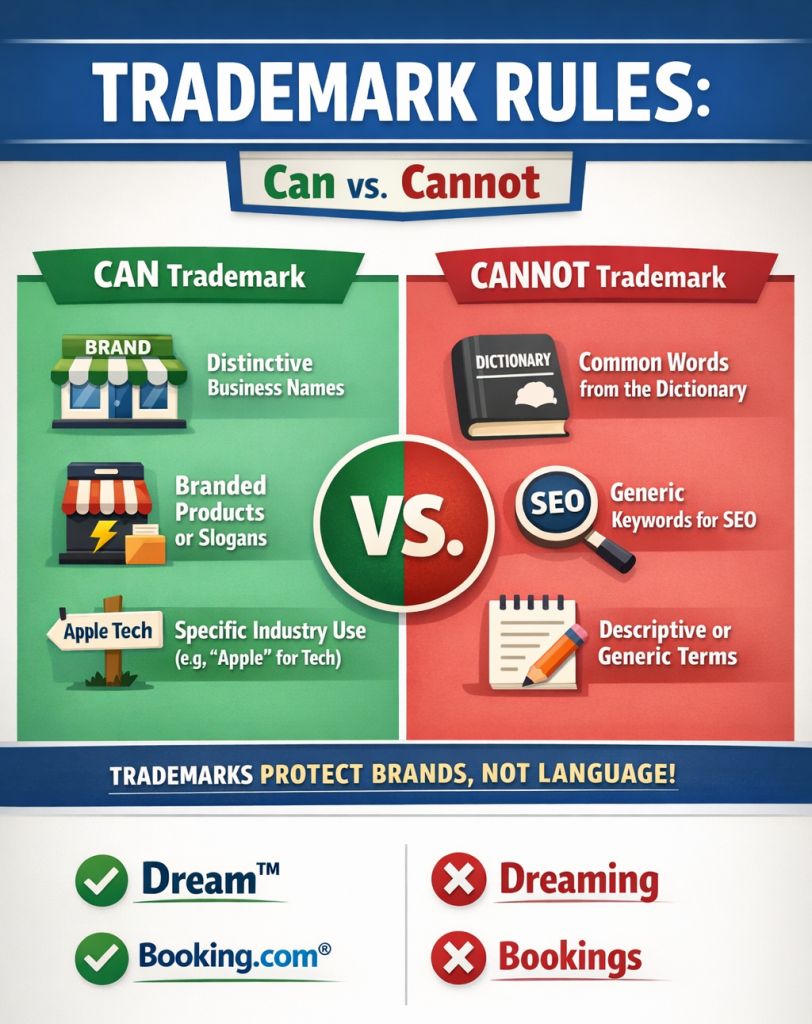
- “Apple” is trademarked, but not for fruit 🍎
- “Dream” could be trademarked, but not for general use in sentences
Example 1: “Dream” and Motivational Branding
Let’s take the example of “Dream” in motivational branding.
According to a recent post on LinkedIn, ‘Simon Squibb’ has trademarked the word ‘Dream’, this protection likely applies to:
- Coaching services
- Books or courses
- Business mentoring
What this means for you, the person reading this:
- You can still say “Follow Your Dream” in articles, blogs, or everyday speech
- You can write about dream states, manifestation, or aspirations
- You cannot create a competing brand or product that is confusingly similar in the same market
The law focuses on consumer confusion, not language restriction.
Example 2: “Entrepreneur” vs “Disabled Entrepreneur”
Now consider the scenario in which the word “Entrepreneur” is trademarked.
Important legal principle:
Generic words cannot be monopolised in their ordinary meaning
Considering the word has been trademarked “Entrepreneur”, it would likely be:
- Limited to a specific class (e.g., media, training, publications)
- Enforceable only if there is brand confusion
So, where does that leave the Disabled Entrepreneur?
- It is a distinct composite phrase
- It has a different meaning and audience
- It is unlikely to infringe unless it copies branding style, logos, or identical services
In fact, adding descriptive elements often strengthens distinctiveness, not weakens it.
Domain Names vs Trademarks: Who Owns What?
This is a common misconception.
Myth:
“If I own the domain name, I own the trademark”.
Reality:
- Domain names are governed by registrars (e.g., Nominet in the UK)
- Trademarks are governed by intellectual property law
- They are separate legal systems
You can:
- Own a domain but do not have trademark rights
- Have a trademark but do not own the domain
Disputes are often handled under policies like:
- UDRP (Uniform Domain-Name Dispute-Resolution Policy)
- UK-specific dispute services via Nominet
Can Someone Trademark Every Word in the Dictionary?
No, and here’s why:
1. Generic Words Are Not Protectable
Words like “bread”, “business”, or “entrepreneur” cannot be monopolised in their everyday meaning.
2. Descriptive Marks Are Weak
Words that describe a service (e.g., “Fast Delivery”) are difficult to enforce.
3. Use Must Be Specific
Trademark rights apply only to:
- Specific industries
- Specific uses
- Specific branding contexts
This ensures language remains free for communication.
Trademark vs Copyright: Key Differences
Many people confuse these two areas of law.
| Trademark | Copyright |
|---|---|
| Protects brands, names, logos | Protects creative works (text, images, music) |
| Focuses on commercial identity | Focuses on original expression |
| Prevents consumer confusion | Prevents copying |
A trademark does not automatically enforce copyright.
Key Takeaways for Creators & Entrepreneurs
- You can safely use dictionary words in writing, speech, and general content
- Trademarks only restrict specific commercial branding uses
- Adding context (e.g., Disabled Entrepreneur) increases uniqueness
- Domain ownership ≠ , trademark ownership
- The law protects fair competition, not language control
Businesses are not only branding logos and slogans but also strategic keywords, words that carry search engine value, consumer recognition, and market influence. From everyday terms like “Booking” to product names like “Ketchup”, the line between generic language and protected branding becomes blurred. Understanding how these words can be trademarked, and more importantly, how they cannot be monopolised in ordinary use, is essential for entrepreneurs, writers, and digital publishers navigating SEO, domain ownership, and intellectual property law.
Examples of Keyword-Based Trademarks
Here are well-known and illustrative examples of dictionary or keyword-style trademarks, including how they are legally treated:
1. Booking
- Trademarked by Booking.com
- The addition of “.com” helped make it distinctive
- Cannot stop others from using “booking” in general (e.g., “booking system”)
2. Ketchup
- The word itself is generic
- However, Heinz dominates through branding
- “Ketchup” cannot be trademarked exclusively as a word for sauce
3. Apple
- Trademarked by Apple Inc
- Protected by technology
- Not enforceable for actual fruit sellers
4. Windows
- Trademarked by Microsoft
- Refers to operating systems
- Cannot stop using “windows” in construction or general speech
5. Orange
- Trademarked by Orange S.A.
- Valid in telecoms
- Still freely used for the fruit or colour
6. Shell
- Trademarked by Shell plc
- Protected in the oil/gas industry
- Not enforceable for seashells or general use
7. Uber
- A dictionary word meaning “above” or “super.”
- Trademarked by Uber Technologies Inc
- Protected in transport/services
- Still usable descriptively (e.g., “uber cool”)
8. Meta
- Common prefix meaning “beyond.”
- Trademarked by Meta Platforms Inc
- Protected in tech/social media
- Still widely used in general language (e.g., “metadata”)
9. Vision
- Frequently trademarked in various industries
- Can be protected when paired with branding (e.g., “Vision Express”)
- Too generic to monopolise alone
10. Next
- Trademarked by Next plc
- Protected in retail fashion
- Cannot prevent normal use of the word “next.”
11. Premier
- Common descriptive word
- Trademarked in combinations (e.g., “Premier Inn”)
- Cannot be owned outright
12. LinkedIn
- Combination of keywords “linked” + “in.”
- Trademarked by LinkedIn
- Distinct due to the combination
- Individual words remain free to use
What These Examples Teach Us
Across all these cases, the law consistently applies the same principles:
✅ What CAN be trademarked:
- Words used in a distinctive commercial context
- Combinations (e.g., Booking.com, LinkedIn)
- Words that gain secondary meaning through branding
❌ What CANNOT be owned:
- Everyday use of language
- Descriptive or generic meanings
- SEO keywords in general use
Relating This Back to Content Creation Concerns
- “Dream” → can be trademarked in branding, but not in general expression
- “Entrepreneur” → too generic to be owned outright
- “Disabled Entrepreneur” → a unique, descriptive combination
- Domain names → helpful for branding, but not automatic trademarks
Key Insight for SEO & Content Creators
👉 Keywords ≠ trademarks
👉 Trademarks ≠ ownership of language
You can:
- Write articles
- Use keywords for SEO
- Build domains around common words
As long as you don’t confuse consumers or replicate a protected brand identity
Implications for Domainers, Designers & IT Professionals
Registering a domain name that contains a dictionary keyword, only to later discover that the same word has been trademarked, does not automatically amount to cybersquatting, but it can become a legal issue depending on intent and use. Under dispute policies such as the Uniform Domain-Name Dispute-Resolution Policy (UDRP) and UK procedures via Nominet, cybersquatting typically involves bad faith registration, meaning the domain was acquired primarily to profit from, mislead, or exploit an existing trademark (e.g., attempting to sell it to the trademark owner or divert their customers).
However, if a domainer, website designer, or IT professional registers a generic or descriptive term in good faith, for legitimate business use, such as SEO, content development, or future branding, this is often considered lawful. Problems arise where the domain creates a likelihood of confusion with an established brand, particularly if the trademark predates the domain registration and operates in the same commercial space. Therefore, the key legal distinction lies in intent, timing, and usage: good faith registration of a keyword is generally permissible, whereas targeting a known trademark for gain may expose the registrant to claims of cybersquatting, domain transfer, or legal action.
Final Thought
Trademark law is designed to strike a balance:
Protect businesses, but preserve freedom of language
If every word could be owned, communication itself would break down. Thankfully, the law recognises this and ensures that while brands can be protected, ideas, words, and expressions remain free for everyone to use.

Renata The Editor of DisabledEntrepreneur.uk - DisabilityUK.co.uk - DisabilityUK.org - CMJUK.com Online Journals, suffers From OCD, Cerebellar Atrophy & Rheumatoid Arthritis. She is an Entrepreneur & Published Author, she writes content on a range of topics, including politics, current affairs, health and business. She is an advocate for Mental Health, Human Rights & Disability Discrimination.
She has embarked on studying a Bachelor of Law Degree with the goal of being a human rights lawyer.
Whilst her disabilities can be challenging she has adapted her life around her health and documents her journey online.
Disabled Entrepreneur - Disability UK Online Journal Working in Conjunction With CMJUK.com Offers Digital Marketing, Content Writing, Website Creation, SEO, and Domain Brokering.
Disabled Entrepreneur - Disability UK is an open platform that invites contributors to write articles and serves as a dynamic marketplace where a diverse range of talents and offerings can converge. This platform acts as a collaborative space where individuals or businesses can share their expertise, creativity, and products with a broader audience.