Disclaimer: This article is for informational and awareness purposes only and does not constitute legal advice. Employment laws and workplace rights may vary depending on individual circumstances. Readers experiencing workplace discrimination should seek professional legal advice or contact relevant advisory services such as ACAS or qualified employment law specialists.
By DisabledEntrepreneur.UK Editorial Team
Why Inclusive Policies Must Be Matched by Action
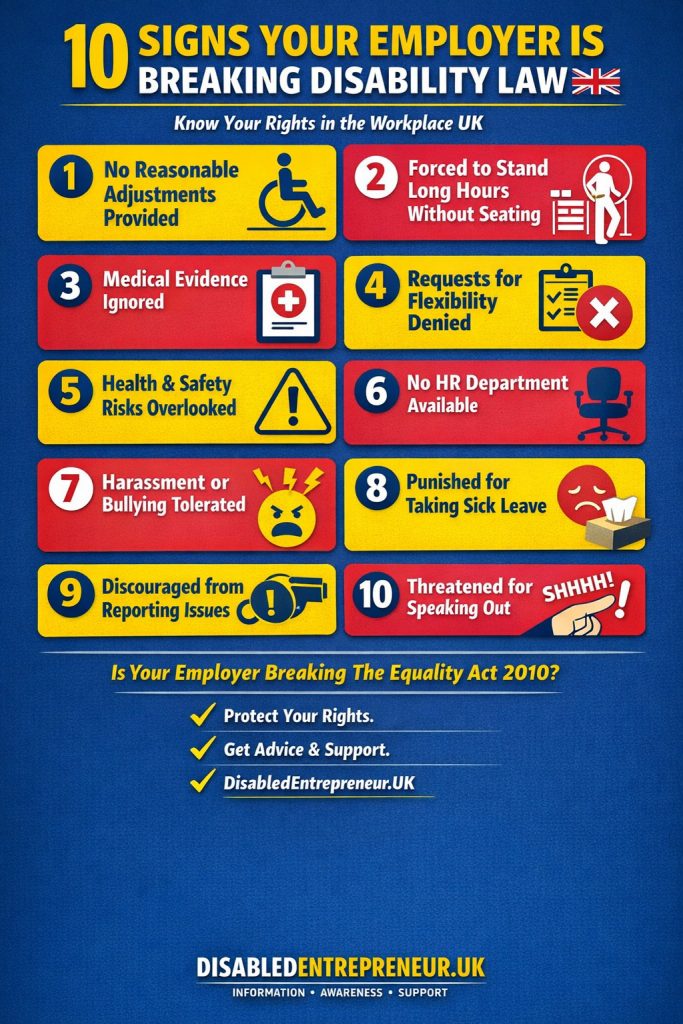
Across the UK, many organisations proudly advertise themselves as inclusive employers committed to diversity and equality. Yet for many disabled employees, the lived reality can be starkly different. Behind carefully crafted corporate statements, some workplaces fail to implement even the most basic reasonable adjustments, creating environments where employees with disabilities feel ignored, overworked, or fearful of speaking out.
When businesses claim to support inclusion but do not provide appropriate accommodations, fail to monitor employee well-being, or allow toxic workplace cultures to flourish, this behaviour may amount to disability discrimination and ableism under UK law.
Organisations such as DisabledEntrepreneur.uk play a vital role in raising awareness, holding employers accountable, and advocating for systemic change.
What Is Disability Discrimination?
Under the Equality Act 2010, disability discrimination occurs when a disabled person is treated unfairly because of their disability or when employers fail to take reasonable steps to remove barriers that disadvantage them.
Disability discrimination can include:
- Failing to provide reasonable adjustments
- Subjecting disabled employees to unfair treatment or harassment
- Ignoring health concerns related to working conditions
- Creating workplace policies that disproportionately harm disabled staff
- Discouraging employees from reporting concerns
Employers must actively ensure that disabled workers can perform their roles without unnecessary hardship.
Reasonable Adjustments Are a Legal Duty
One of the central obligations within the Equality Act 2010 is the duty to make reasonable adjustments.
Reasonable adjustments are changes that allow disabled employees to perform their jobs safely and effectively.
Examples include:
- Providing seating or kick stools for retail employees expected to stand for long periods
- Allowing flexible working arrangements
- Adjusting shift patterns or workloads
- Providing assistive equipment
- Allowing additional rest breaks
- Making physical changes to the workplace
For example, expecting a retail employee to stand for eight hours continuously without providing seating, stools, or knee support may be unreasonable if the employee has a disability affecting mobility or chronic pain.
Failure to make such adjustments can constitute unlawful discrimination.
Ableism in the Workplace
Ableism occurs when workplace systems or attitudes assume that all employees are able-bodied and can perform tasks without limitations.
This can manifest through:
- Dismissing requests for adjustments
- Ignoring medical evidence
- Treating disabled employees as burdens
- Pressuring workers to perform beyond their physical limits
- Failing to create safe reporting mechanisms
When management prioritises productivity over employee well-being, it can foster a toxic workplace culture where disabled employees feel powerless.
When “Inclusive Employers” Are the Opposite
Some organisations promote diversity publicly while internally failing to support disabled workers.
Warning signs include:
- No HR department or formal support structure
- Managers with little training in disability awareness
- Employees are relying on anonymous whistleblowing services to raise concerns
- Fear of retaliation or job loss
- Lack of formal health or well-being reviews
If employees must resort to anonymous whistleblowing to report discrimination, this suggests a breakdown in organisational governance and workplace protections.
The Importance of Regular Disability Reviews
Responsible organisations should monitor employee well-being through structured systems.
Area managers and senior leadership should:
- Maintain confidential records of employees who have disclosed disabilities
- Conduct six-month wellbeing reviews
- Ensure reasonable adjustments remain effective
- Update adjustments when conditions change
- Provide managers with disability awareness training
Failure to review adjustments regularly may lead to preventable harm, stress, and worsening health conditions.
Where no reviews exist, it may suggest that a company is prioritising profits over employee welfare.
Relevant UK Laws Employers Must Follow
Employers who ignore disability rights may breach several legal frameworks.
1. Equality and Disability Protection
The Equality Act 2010 protects employees from disability discrimination and requires employers to make reasonable adjustments.
2. Workplace Health and Safety
Under the Health and Safety at Work etc. Act 1974, employers must ensure the health, safety, and welfare of employees.
This includes preventing workplace practices that could cause physical harm.
3. Public Interest Disclosure (Whistleblowing)
The Public Interest Disclosure Act 1998 protects workers who report wrongdoing.
Employees who raise concerns about discrimination, unsafe working conditions, or legal breaches should be protected from retaliation.
4. Employment Rights
The Employment Rights Act 1996 provides protections related to unfair dismissal and workplace rights.
Dismissal linked to disability discrimination or whistleblowing may be unlawful.
How Organisations Like DisabledEntrepreneur.UK Can Campaign for Change
Advocacy platforms can play a critical role in challenging workplace discrimination.
Possible strategies include:
Public Awareness Campaigns
Publishing articles, case studies, and research exposing workplace ableism helps inform both employees and employers about legal responsibilities.
Employer Accountability
Highlighting best practices and naming systemic failures encourages organisations to improve policies and avoid reputational damage.
Education for Employers
Campaigns can promote training on:
- disability awareness
- workplace adjustments
- inclusive leadership
- mental health support
Supporting Whistleblowers
Creating safe spaces for employees to share experiences anonymously can expose harmful workplace practices while protecting individuals.
Policy Advocacy
Advocacy groups can lobby government departments to strengthen the enforcement of disability rights and ensure regulators take complaints seriously.
Why Public Awareness Matters
Many disabled employees remain silent because they fear losing their jobs.
By raising awareness through publications, campaigns, and social advocacy, organisations like DisabledEntrepreneur.uk can empower workers to understand their rights and encourage employers to improve their workplace culture.
Key Facts Every Disabled Employee Should Know
1️⃣ The Right to Reasonable Adjustments
Employers must make reasonable changes to help disabled employees do their job effectively. Examples include seating for retail workers, flexible hours, assistive equipment, modified duties, or additional breaks.
2️⃣ Protection from Discrimination
Under the Equality Act 2010, employers cannot treat someone unfairly because of a disability.
3️⃣ Safe Working Conditions
The Health and Safety at Work etc. Act 1974 requires employers to protect the health, safety, and welfare of employees.
4️⃣ Protection for Whistleblowers
Workers who report wrongdoing are protected under the Public Interest Disclosure Act 1998.
5️⃣ Freedom from Unfair Dismissal
Employees are protected under the Employment Rights Act 1996 if dismissed unfairly or due to discrimination.
True inclusion cannot exist only in marketing campaigns or corporate statements.
It must exist in policies, management behaviour, and daily workplace practices.
Know Your Rights: Disabled Employees Checklist
This checklist can be shared to help workers understand their rights.
1. Disclosure and Support
✔ You have the right to disclose a disability confidentially.
✔ Employers should discuss reasonable adjustments with you.
✔ Your medical information must be handled confidentially.
2. Reasonable Adjustments
Your employer may need to provide adjustments such as:
✔ Seating or kick stools for workers standing long hours
✔ Modified duties or reduced physical strain
✔ Flexible working hours
✔ Additional rest breaks
✔ Accessible equipment or software
✔ Adjusted performance targets if health impacts productivity
If adjustments are reasonable and practical, employers must provide them.
3. Workplace Reviews
A responsible employer should:
✔ Conduct regular wellbeing reviews (ideally every 6 months)
✔ Review existing adjustments to ensure they still work
✔ Monitor employee health and safety
✔ Train managers in disability awareness
Failure to review adjustments may put the employer at risk of breaching equality laws.
4. Protection from Ableism
You should not experience:
✖ Being mocked or dismissed because of your disability
✖ Being forced to work beyond medical limitations
✖ Managers ignoring adjustment requests
✖ Workplace harassment or exclusion
Ableism can create a toxic work environment and may be unlawful.
5. If Your Employer Refuses to Help
If an organisation ignores your rights, you can:
✔ Keep records of incidents
✔ Request adjustments in writing
✔ Use internal grievance procedures
✔ Report concerns anonymously through whistleblowing channels
✔ Contact employment advisers such as ACAS
✔ Seek legal advice regarding discrimination
6. Warning Signs of a Toxic Workplace
Disabled employees should be cautious if an organisation:
⚠ Has no HR department
⚠ Discourages complaints or whistleblowing
⚠ Ignores health concerns
⚠ Fails to review adjustments
⚠ Prioritises profits over employee wellbeing
These environments often silence employees through fear of retaliation.
How DisabledEntrepreneur.UK Can Raise Awareness
Your platform can help drive change by:
✔ Publishing real-life workplace stories
✔ Running “Know Your Rights” campaigns
✔ Encouraging ethical employers to adopt inclusive policies
✔ Producing shareable infographics and educational guides
✔ Supporting whistleblowers and vulnerable employees
Public awareness helps ensure that companies cannot hide toxic workplace cultures behind diversity slogans.
Simple Awareness Campaign Idea
Campaign Title:
“Inclusion Means Action — Not Just Words.”
Possible outreach ideas:
- Posters for workplaces
- Social media graphics
- Employee rights checklists
- Retail awareness campaigns
- Articles exposing workplace ableism
Conclusion
An organisation that claims to support diversity but fails to provide reasonable adjustments, ignores employee wellbeing, and discourages whistleblowing risks breaching both legal obligations and ethical responsibilities.
Employers must recognise that inclusive workplaces require more than slogans. They require systems that protect employees, managers trained in disability awareness, and leadership willing to prioritise human dignity over profit.
Platforms such as DisabledEntrepreneur.uk are essential in exposing discrimination, educating employers, and ensuring that disabled employees are treated with fairness, respect, and dignity in the workplace.
Only through transparency, accountability, and ongoing advocacy can workplaces truly become inclusive.
Further Reading & Resources
- Acas | Making working life better for everyone in Britain
- Protection from dismissal and detriment – Health and safety at work – Acas
- Advisory, Conciliation and Arbitration Service – GOV.UK
- Discrimination: your rights: Discrimination at work – GOV.UK
- Dealing with discrimination at work – Citizens Advice
- Whistleblowing for employees: What is a whistleblower – GOV.UK
- Protect – Speak up stop harm – Whistleblowing Homepage
- Whistle Blowing Risks for SMEs | What Employers Need to Know
- https://disabledentrepreneur.uk/?s=Ableism
- https://disabledentrepreneur.uk/category/disability-discrimination/


Renata The Editor of DisabledEntrepreneur.uk - DisabilityUK.co.uk - DisabilityUK.org - CMJUK.com Online Journals, suffers From OCD, Cerebellar Atrophy & Rheumatoid Arthritis. She is an Entrepreneur & Published Author, she writes content on a range of topics, including politics, current affairs, health and business. She is an advocate for Mental Health, Human Rights & Disability Discrimination.
She has embarked on studying a Bachelor of Law Degree with the goal of being a human rights lawyer.
Whilst her disabilities can be challenging she has adapted her life around her health and documents her journey online.
Disabled Entrepreneur - Disability UK Online Journal Working in Conjunction With CMJUK.com Offers Digital Marketing, Content Writing, Website Creation, SEO, and Domain Brokering.
Disabled Entrepreneur - Disability UK is an open platform that invites contributors to write articles and serves as a dynamic marketplace where a diverse range of talents and offerings can converge. This platform acts as a collaborative space where individuals or businesses can share their expertise, creativity, and products with a broader audience.