Disclaimer: This article is for informational and awareness purposes only and does not constitute legal, financial, or medical advice. Readers should seek professional support tailored to their individual circumstances.
Working Twice as Hard to Stay Afloat, Yet Still Falling Through the Cracks
Recent data highlights the scale of the issue, with approximately 746,000 self-employed individuals claiming Universal Credit as of 2020, accounting for around 13.4% of all claimants. With nearly 5 million people self-employed across the UK, and a significant proportion earning below the equivalent of the National Living Wage, it is clear that many entrepreneurs are operating on financially unstable ground. Projections suggest that once Universal Credit is fully rolled out, around one in ten claims will include a self-employed earner. While official figures do not isolate “entrepreneurs” specifically, these statistics demonstrate that hundreds of thousands of business owners rely on the benefits system to supplement fluctuating or insufficient income, reinforcing the reality that entrepreneurship does not always equate to financial security.
Key Statistics on Entrepreneurs / Self-Employed People on Universal Credit
- In August 2020, around 746,000 self-employed people were claiming Universal Credit, representing 13.4% of all UC claimants. [1]
- Research indicates that when Universal Credit is fully rolled out, around 1 in 10 claims are expected to include a self-employed earner.
- The UK has approximately 4.8–5 million self-employed workers, making up around 15% of the workforce, many of whom are in low or unstable income brackets. [2]
- A significant proportion of self-employed workers earn less than employees, with some estimates showing up to 45% earning below the National Living Wage equivalent. [3]
- Universal Credit itself supports a large working population: when fully implemented, around 8 million families (including millions in work) are expected to rely on it. [4]
Footnotes:
- [1] https://www.parallelparliament.co.uk/question/106488/universal-credit-self-employed
- [2] https://committees.parliament.uk/writtenevidence/85861/html/
- [3] https://www.tuc.org.uk/blogs/self-employment-compatible-universal-credit
- [4] https://ifs.org.uk/publications/universal-credit-incomes-incentives-and-remaining-roll-out?
The “Not Gainfully Self-Employed” Label
Being assessed as “not gainfully self-employed” can feel dismissive and patronising. It reduces complex entrepreneurial effort to income thresholds, ignoring the reality that business growth is rarely linear. Many entrepreneurs are actively building, learning, and reinvesting, yet are judged solely on short-term earnings rather than long-term viability.
The Catch-22 of Funding and Growth
Sole traders often face significant barriers when trying to scale. Access to funding typically requires proof of high turnover or limited company status. However, without funding, growth is difficult to achieve.
This creates a cycle:
- No funding → No growth
- No growth → No eligibility for funding
As a result, many entrepreneurs remain stuck in survival mode, unable to invest in the very tools that could help them succeed.
When Effort Doesn’t Equal Results
There are periods in business where, no matter how much effort you put in, nothing seems to work. You may refine your services, improve your website, promote consistently, and still see little to no return.
This can lead to:
- Feelings of failure
- Loss of motivation
- Questioning your purpose
It’s important to recognise that this phase is not uncommon. Many successful businesses experienced long periods of stagnation before gaining traction.
The Mental Health Impact
The emotional toll of running a struggling business while relying on Universal Credit can be overwhelming. Entrepreneurs often sacrifice financial security, social life, and personal well-being just to keep going.
Common challenges include:
- Chronic stress and anxiety
- Burnout and exhaustion
- Feelings of isolation
- Fear of being judged or misunderstood
For disabled entrepreneurs, these pressures can be intensified by health conditions and inconsistent work capacity.
Empowerment, Resilience, and Reclaiming Your Strength
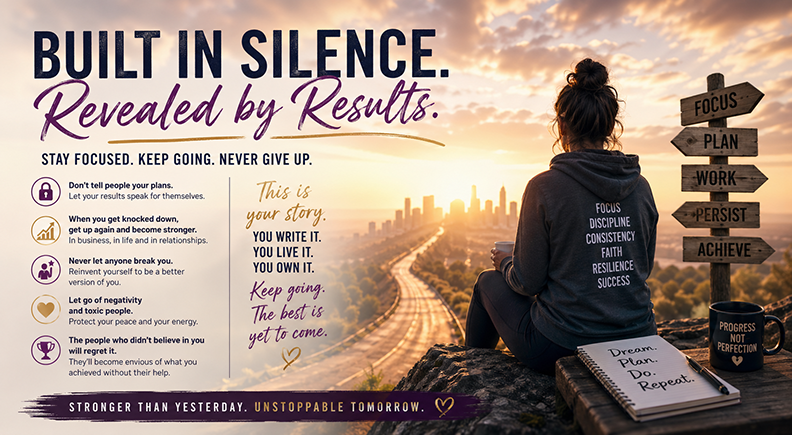
There will be moments in your journey where you feel invisible, overlooked, or even dismissed, but those moments do not define you. True empowerment often begins quietly. You do not need to announce your plans to the world or seek validation from those who doubt you. In many cases, it is wiser to move in silence and let your results speak for themselves. Progress built in private is often stronger, more focused, and less vulnerable to outside negativity.
Setbacks are not the end of your story. When life or business knocks you down, the act of getting back up, again and again, is where your strength is forged. Each challenge teaches resilience, and each failure refines your direction. This mindset is not only essential in business, but in life and relationships too. The ability to endure, adapt, and rise stronger is what separates those who remain stuck from those who evolve.
You may encounter people who doubt you, discourage you, or fail to support your vision. That can be painful, especially when it comes from those you expected encouragement from. But rather than allowing that to break you, use it as fuel to grow. Over time, your consistency and determination will speak louder than their doubt ever could. Some may come to recognise what they overlooked, not because you sought their approval, but because you proved to yourself that you could do it.
Letting go is also part of growth. Releasing negativity, distancing yourself from toxic influences, and protecting your energy are not signs of weakness; they are acts of self-respect. Surround yourself, where possible, with people who uplift rather than drain you, and if that circle is small, that is perfectly fine. Quality matters more than quantity.
Reinvention is always within your control. No matter your past, your setbacks, or your current circumstances, you have the ability to reshape your mindset, your direction, and your future. Becoming a better version of yourself is not about perfection; it is about progress, self-awareness, and the courage to keep going when it would be easier to stop.
Practical Ways to Support Mental Health
When you begin to feel like a failure, small, intentional steps can help stabilise your mindset:
- Reframe Progress
Focus on effort rather than outcome. Completing tasks, even without immediate results, is still progress. - Limit Comparison
Comparing yourself to others, especially online, can distort reality. Many visible “successes” hide struggles behind the scenes. - Create Structure
Set realistic daily goals. A manageable routine can restore a sense of control and purpose. - Take Strategic Breaks
Stepping away briefly can prevent burnout and often brings clarity when you return. - Talk to Someone
Whether a friend, peer, or support group, sharing your experience can reduce isolation and provide perspective.
What Entrepreneurs Can Do to Encourage Growth
While external barriers exist, there are still strategies that can improve visibility and potential income over time:
- Niche Your Services
Specialising in a specific audience or problem can make your offering more attractive and easier to market. - Leverage Content and Visibility
Publishing articles, blogs, or insights builds authority and attracts organic traffic over time. - Collaborate and Network
Partnering with others can expand your reach and open doors to new opportunities. - Use Multiple Income Streams
Diversifying income, such as offering digital products, services, or consultancy, can reduce reliance on one source. - Focus on Long-Term SEO and Branding
Growth often comes gradually. Consistent effort in visibility and brand building compounds over time. - Track What Works (and What Doesn’t)
Adjust strategies based on results. Not everything will work, but each attempt provides insight.
Recognising Strength in Survival
Entrepreneurs relying on Universal Credit are not failing; they are persisting in difficult circumstances. Continuing to show up, adapt, and try again demonstrates resilience, not weakness.
Even when progress feels invisible, survival itself is a form of success. The journey may be slower and more challenging, but it is no less valid.
There is a widespread misconception that individuals receiving Personal Independence Payment cannot work, which is simply untrue. PIP is a non-means-tested benefit designed to support people with the additional costs of living with a disability or long-term health condition, not to replace income or prevent employment. Many recipients are able to work, whether part-time, self-employed, or with reasonable adjustments, and can also claim Universal Credit alongside it. In reality, start-ups, particularly those run by sole traders or individuals with limited resources, often find it difficult to secure funding or investment, leaving them to build their businesses gradually from the ground up. In this context, labelling individuals as “not gainfully self-employed” can feel premature and discouraging, especially when they are actively trying to establish themselves. A more supportive and understanding approach, free from judgment, would better reflect the challenges of early-stage entrepreneurship and encourage long-term growth rather thanhinder it.
Further Reading & Resources
- Universal Credit Business Start-Up Grant – Is It Really Available in the UK?
- Help with moving from benefits to work: Starting or running your own business – GOV.UK
- Universal Credit Business Start-Up Grant Eligibility: A Guide for Entrepreneurs
- How Can the Universal Credit Business Start-Up Grant Help New Entrepreneurs?
- Comprehensive Guide For Universal Credit & Self-Employment | DISABLED ENTREPRENEUR – DISABILITY UK
- Starting a business while on Universal Credit: what you need to know | Small Good Stuff
- Can you start a side hustle business on Universal Credit? | Business Start Up Loans & Mentoring | Transmit Startups
- Starting a business | Disability charity Scope UK
- Financial Support for Self-Employed Disabled Individuals in the UK | DISABLED ENTREPRENEUR – DISABILITY UK
- How to Start a Business Whilst on Universal Credit – UK Benefits Guide
- Charities slam Tony Blair think tank report on disability benefits


Andrew Jones is a seasoned journalist renowned for his expertise in current affairs, politics, economics and health reporting. With a career spanning over two decades, he has established himself as a trusted voice in the field, providing insightful analysis and thought-provoking commentary on some of the most pressing issues of our time.