Disclaimer: This article is for educational and informational purposes only and does not constitute legal advice. Laws may change, and individual circumstances vary. Always seek professional legal advice where necessary.
Understanding Intellectual Property, Legal Protection, and the Rise of AI-Generated Content: Protecting Creativity, Identity, and Innovation
What Are Intellectual Property Rights (IPRs)?
People often unknowingly use copyrighted images, particularly when sourcing visuals from search engines, social media, or other websites where content is freely visible but not freely licensed. This is where due diligence becomes essential. Before using any image, you should actively verify its ownership, check the licence terms, and confirm whether permission is required or attribution is mandatory. Even where an image is labelled for reuse, some licences, such as those under Creative Commons, may still require you to credit the creator, link back to the source, or restrict commercial use. Failing to do so can still amount to copyright infringement, even if the use was unintentional.
As a matter of good practice, always include clear image credits and source links when using any third-party media, unless the licence explicitly states that attribution is not required. This not only demonstrates transparency and professionalism but can also serve as evidence that you have taken reasonable steps to comply with copyright law under the Copyright, Designs and Patents Act 1988. In an environment where copyright enforcement is becoming increasingly automated and aggressive, taking these precautions can significantly reduce the risk of disputes and protect both your reputation and your business from unnecessary legal exposure.
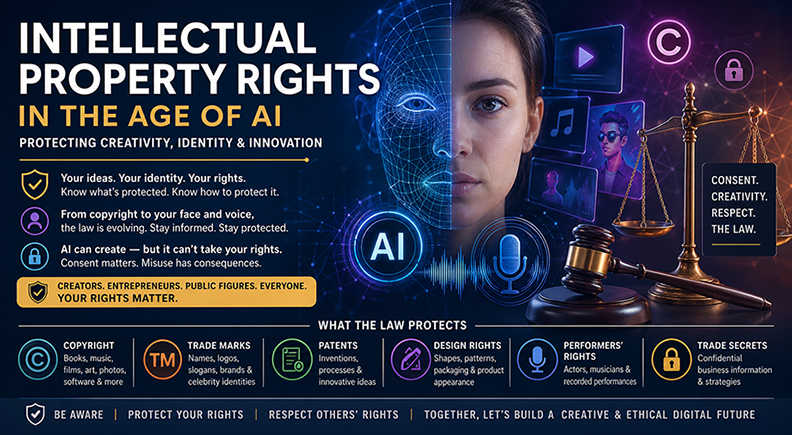
Intellectual Property Rights (IPRs) are legal protections granted to individuals or businesses for creations of the mind. These rights allow creators to control how their work is used, reproduced, or monetised. In the UK, IPRs are primarily governed by legislation such as the Copyright, Designs and Patents Act 1988, the Trade Marks Act 1994, and common law principles.
Intellectual property rights and copyright have a profound and often decisive impact on both individuals and businesses because they transform ideas, creativity, and innovation into legally protected assets that can be controlled, monetised, and enforced. At a personal level, these rights give creators, whether writers, designers, musicians, or entrepreneurs, the ability to prevent others from copying or exploiting their work without permission, ensuring they retain both recognition and financial benefit from their efforts. Copyright, for example, grants creators the exclusive right to control how their work is reproduced, distributed, or adapted, which means that even in a digital environment where content can be easily copied, there is still a legal framework that supports ownership and accountability. This protection is not just about preventing theft; it also encourages people to create in the first place, as they know their time, skill, and intellectual labour can be safeguarded and rewarded.
For businesses, intellectual property is often one of the most valuable assets they own, even though it is intangible. Brands, logos, proprietary processes, software, and original content form the foundation of competitive advantage, allowing businesses to distinguish themselves in crowded markets and build trust with consumers. Intellectual property rights enable companies to license, sell, or leverage their creations as revenue streams, and in many cases, they underpin the entire business model. Without such protection, competitors could simply replicate products, branding, or ideas at a lower cost, eroding innovation and profitability. The law therefore strikes a careful balance: it grants exclusive rights for a limited time to incentivise innovation and economic growth, while eventually allowing wider public access to those ideas. In essence, intellectual property rights shape how value is created, protected, and distributed in modern economies, influencing everything from individual livelihoods to global commercial success.
Copyright Trolls and Online Images: What You Need to Know Before You Click “Use”
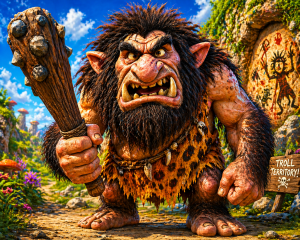
Copyright trolls are individuals or organisations that aggressively pursue alleged copyright infringements, often targeting people and small businesses who have unknowingly used images without proper permission. Their business model typically involves scanning the internet for unauthorised use of images and then issuing legal threats or settlement demands, sometimes for disproportionate amounts. The key issue is that just because an image appears on another website, Google search, or social media platform does not mean it is free to use or has been used legally in the first place. Many images online are protected by copyright automatically under the Copyright, Designs and Patents Act 1988, and the original creator retains rights unless they have clearly granted a licence.
To check whether an image is copyrighted, you should never rely on assumptions. Look for licensing information on the source website, check whether the image is marked as “royalty-free,” “Creative Commons,” or requires attribution, and verify the terms carefully. Reverse image search tools (such as Google Images) can help identify the original creator and whether the image is being widely misused. If in doubt, use reputable stock libraries or create your own content. If you are approached by a copyright troll, do not ignore the claim, but also do not panic or admit liability immediately. Request evidence of ownership, details of the alleged infringement, and how the fee has been calculated. In some cases, claims may be exaggerated or based on weak evidence, and you may be able to negotiate a reduced settlement or challenge the claim. Seeking legal advice can be crucial, particularly if the demand is high or threatening court action. Ultimately, the safest approach is to assume that every image is protected unless proven otherwise, and to adopt a proactive strategy of using properly licensed or original content to avoid unnecessary disputes.
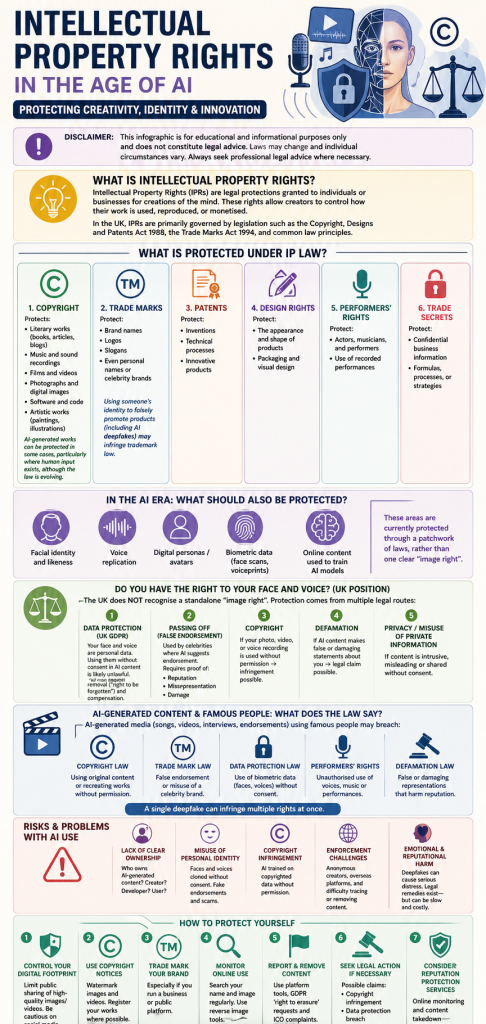
What Is Protected Under Intellectual Property Law?
IP law covers a broad range of creations, including:
1. Copyright Protects:
- Literary works (books, articles, blogs)
- Music and sound recordings
- Films and videos
- Photographs and digital images
- Software and code
- Artistic works (paintings, illustrations)
Even AI-generated works can be protected in some cases, particularly where human input exists, although the law is evolving
2. Trade Marks Protect:
- Brand names
- Logos
- Slogans
- Even personal names or celebrity brands
Using someone’s identity to falsely promote products (including AI deepfakes) may infringe trademark law
3. Patents Protect:
- Inventions
- Technical processes
- Innovative products
4. Design Rights Protect:
- The appearance and shape of products
- Packaging and visual design
5. Performers’ Rights Protect:
- Actors, musicians, and performers
- Use of recorded performances
6. Trade Secrets Protect:
- Confidential business information
- Formulas, processes, or strategies
What SHOULD Be Protected (Especially in the AI Era)?
With technological advances, there is growing recognition that the following should also be better protected:
- Facial identity and likeness
- Voice replication
- Digital personas / avatars
- Biometric data (face scans, voiceprints)
- Online content used to train AI models
These areas are currently protected through a patchwork of laws, rather than one clear “image right.”
Do People Have the Right to Their Face and Voice? (UK Position)
This is where things become complex.
⚠️ Key Legal Reality:
- The UK does NOT recognise a standalone “image right.”
- Instead, protection comes from multiple legal routes:
1. Data Protection (UK GDPR)
- Your face and voice are personal data
- Using them without consent in AI content is likely unlawful
- You can request removal (“right to be forgotten”) and compensation
2. Passing Off (False Endorsement)
- Used by celebrities where AI suggests endorsement
- Requires proof of:
- Reputation
- Misrepresentation
- Damage
3. Copyright
- If your photo, video, or voice recording is used → infringement is possible
4. Defamation
- If AI content damages reputation → legal claim possible
5. Privacy / Misuse of Private Information
- If the content is intrusive or misleading
AI-Generated Content and Famous People (YouTube, Social Media)
Legal Risks of These Practices
You may have seen:
- AI-generated songs using celebrity voices
- Fake interviews or videos
- Celebrity endorsements that never happened
AI-generated media may breach:
- Copyright law (using original content to train models or recreate works)
- Trade mark law (false endorsement)
- Data protection law (use of biometric data without consent)
- Defamation law (false or damaging representations)
- Performers’ rights (voice/music misuse)
A single deepfake can infringe multiple rights at once
New and Emerging Laws on AI & Deepfakes
The UK is tightening rules:
- Creating explicit deepfakes without consent is now a criminal offence
- Offenders can face prison sentences
- The government acknowledges AI impersonation is a growing threat
However:
- There is still no single law covering all AI likeness misuse
- Reform is being discussed due to legal gaps
Problems and Risks with AI Use
1. Lack of Clear Ownership
- Who owns AI-generated content?
- Creator? Developer? User?
2. Misuse of Personal Identity
- Faces and voices cloned without consent
- Fake endorsements and scams
3. Copyright Infringement
- AI trained on copyrighted data without permission
4. Enforcement Challenges
- Anonymous creators
- Overseas platforms
- Difficult to trace or remove content
5. Emotional and Reputational Harm
- Deepfakes can cause serious distress
- Legal remedies exist—but can be slow and costly
How to Protect Yourself (Practical Steps)
✅ 1. Control Your Digital Footprint
- Limit public sharing of high-quality images/videos
- Be cautious on social media
✅ 2. Use Copyright Notices
- Watermark images
- Register works where possible
✅ 3. Trade Mark Your Brand (if applicable)
- Especially if you run a business or public platform
✅ 4. Monitor Online Use
- Search your name/image regularly
- Use reverse image tools
✅ 5. Report & Remove Content
- Use:
- Platform reporting tools
- GDPR “right to erasure” requests
- ICO complaints
✅ 6. Seek Legal Action if Necessary
Possible claims:
- Copyright infringement
- Data protection breach
- Passing off
- Defamation
✅ 7. Consider Reputation Protection Services
- Online monitoring
- Content takedown specialists
What to Do If You’ve Used a Copyrighted Image (and Whether You’re Still Liable)
If you discover that you have used a copyrighted image without permission, the first step is to act quickly and responsibly. Remove the image from your website, social media, or any other platform as soon as possible to prevent further unauthorised use. This shows good faith, but it does not automatically resolve the issue. You should then try to identify the rightful owner and review whether a licence could have been obtained. In some cases, you may choose to contact the copyright holder to apologise and, where appropriate, offer to purchase a licence retrospectively. Keeping a record of your actions, such as when the image was removed, can be useful if the matter escalates.
You may also receive a take-down notice, which is a formal request demanding that the infringing content be removed. In the UK, this often falls within the framework of the Copyright, Designs and Patents Act 1988, while platforms like YouTube and Google operate their own notice-and-takedown procedures. It is important not to ignore these notices. Respond promptly, confirm that the content has been removed, and request evidence of ownership if anything is unclear. Ignoring such notices can increase the risk of further legal action or account penalties.
Crucially, removing the image does not necessarily eliminate liability. Copyright infringement occurs at the moment the unauthorised use takes place, meaning the copyright holder may still pursue compensation for past use, even after the content has been taken down. However, swift removal and cooperation can significantly reduce potential damages and demonstrate that the infringement was not deliberate. In some situations, claims may be negotiable, especially if the use was accidental and limited in scope. If the demand is substantial or threatening legal proceedings, it is advisable to seek legal advice before responding further.
Conclusion

Intellectual Property Rights remain essential in protecting creativity, innovation, and identity, but the rise of AI has exposed significant legal gaps.
While the UK offers protection through copyright, trademarks, data protection, and common law, individuals do not yet have a full legal right to control their image or voice.
As AI technology evolves, so must the law. “AI Digital Trust” domain name is now reserved, pending development of a law department specialising in ‘Intellectual Property Rights’.
Until then, awareness, proactive protection, and swift action are your best defence.
Further Reading & Resources
- AI cloning of celebrity voices outpacing the law, experts warn | AI (artificial intelligence) | The Guardian
- Should we introduce a new right against AI replicas? | LSE British Politics
- Can The Law Prevent AI From Duplicating Actors? It’s Complicated
- The Law Speaks Up: AI Voice Cloning and Consent – Juris Magazine
- Protecting Public Figures and Artists’ Likeness in the Age of AI
- Voice, Likeness, and Fair Use in the Age of AI – Disruptive Competition Project
- Celebrities Are Turning to Trademark Law to Protect Their Images and Voices from AI – Greenspoon Marder LLP
- Voice actors and generative AI: Legal challenges and emerging protections | IAPP
- Deepfakes and English Law | AI Misrepresentation Explained | Carruthers Law
- How AI Challenges Celebrity Personality Rights in the UK (UK)

Renata The Editor of DisabledEntrepreneur.uk - DisabilityUK.co.uk - DisabilityUK.org - CMJUK.com Online Journals, suffers From OCD, Cerebellar Atrophy & Rheumatoid Arthritis. She is an Entrepreneur & Published Author, she writes content on a range of topics, including politics, current affairs, health and business. She is an advocate for Mental Health, Human Rights & Disability Discrimination.
She has embarked on studying a Bachelor of Law Degree with the goal of being a human rights lawyer.
Whilst her disabilities can be challenging she has adapted her life around her health and documents her journey online.
Disabled Entrepreneur - Disability UK Online Journal Working in Conjunction With CMJUK.com Offers Digital Marketing, Content Writing, Website Creation, SEO, and Domain Brokering.
Disabled Entrepreneur - Disability UK is an open platform that invites contributors to write articles and serves as a dynamic marketplace where a diverse range of talents and offerings can converge. This platform acts as a collaborative space where individuals or businesses can share their expertise, creativity, and products with a broader audience.