Disclaimer: This article is for general informational and awareness purposes only and does not constitute legal advice. Blue Badge rules are governed by UK legislation and local authority policies, which may vary between councils. If you require legal guidance, seek advice from a qualified professional or your local council.
Rethinking Blue Badge Parking: Should Disabled Drivers Have Greater Freedom & Are Current Rules Discriminatory?
The UK’s Blue Badge scheme, administered under the Chronically Sick and Disabled Persons Act 1970, was designed to help people with disabilities maintain independence by allowing easier access to parking. While the intention is clear, the reality on the ground often tells a different story.
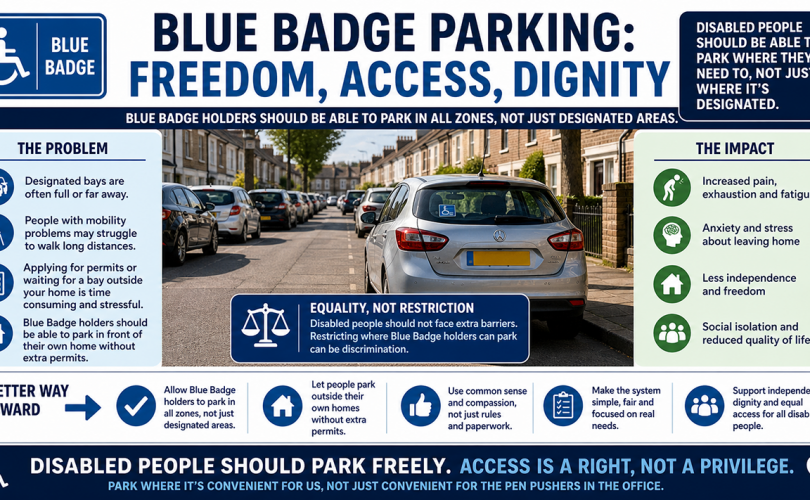
Many Blue Badge holders face a daily struggle, not just with mobility, but with navigating restrictive parking systems that seem to prioritise regulation over accessibility. Designated bays are frequently congested, poorly located, or simply unavailable, leaving disabled drivers with limited and sometimes impractical options.
This raises an important question: should Blue Badge holders be allowed to park more freely, including outside their own homes, without needing additional permits or council-approved spaces?
The Reality of Limited Designated Parking
Designated Blue Badge bays are intended to make life easier, but in many cases, they do the opposite. In busy residential areas and town centres, these bays are often occupied, forcing individuals with mobility issues to park further away.
For someone living with conditions such as Multiple Sclerosis, chronic pain, or reduced mobility, even a short additional walk can be exhausting, painful, or unsafe. The system assumes availability, but reality often fails to match that assumption.
Parking Outside Your Own Home: A Common-Sense Solution?
One of the most frustrating issues for Blue Badge holders is being unable to park directly outside their own home without:
- Applying for a resident permit
- Requesting a designated disabled bay from the council
- Waiting weeks or months for approval
For many, this process is not only bureaucratic but also impractical. Disabilities do not operate on a timetable, and access needs are immediate, not subject to administrative delays.
Allowing Blue Badge holders to park outside their homes without additional permits could significantly improve their quality of life. It would:
- Reduce physical strain
- Improve safety
- Support independence
- Acknowledge real-world mobility challenges
Is the Current System Discriminatory?
This is where the issue becomes more complex.
Under the Equality Act 2010, public bodies, including local councils, have a duty to make reasonable adjustments for disabled individuals. This means policies should not place disabled people at a substantial disadvantage compared to others.
However, this does not automatically mean unrestricted parking rights.
The legal reality:
- Councils can impose parking restrictions for traffic management
- Blue Badge holders are granted concessions, not unlimited exemptions
- Restrictions such as loading bans, bus lanes, and certain permit zones may still apply
The key question:
If a disabled person cannot reasonably access parking near their home or destination due to these restrictions, could that amount to a failure to make reasonable adjustments?
In some cases, it might.
But legally speaking, the system itself is not automatically discriminatory; it depends on how policies are applied in practice. If a council fails to consider individual needs or refuses reasonable accommodations, that is where potential discrimination may arise.
The Human Impact: More Than Just Parking
Behind every Blue Badge is a person managing daily challenges that are often invisible.
Parking restrictions may seem minor on paper, but in reality, they can lead to:
- Increased pain and fatigue
- Anxiety about leaving the house
- Reduced independence
- Social isolation
For individuals already navigating complex health conditions, these additional barriers can feel unnecessary and unjust.
A Balanced Way Forward
There is a strong argument for reform, not necessarily to remove all parking controls, but to make the system more flexible and responsive.
Possible improvements could include:
- Greater discretion for Blue Badge holders in residential areas
- Faster and simpler approval for home-based disabled bays
- Digital permits linked to Blue Badge status
- Increased monitoring to prevent misuse while supporting genuine need
The goal should not be unrestricted parking everywhere, but fair, practical access that reflects real-life mobility needs.
Conclusion
The Blue Badge scheme was created to support independence, but for many, rigid parking restrictions undermine that very purpose.
While the law does not currently grant unrestricted parking rights, there is a growing need to reassess whether existing systems truly meet the needs of disabled individuals in everyday life.
Accessibility should not be a privilege dependent on availability; it should be a right grounded in dignity, fairness, and common sense.
Further Reading & Resources
- Find out where Blue Badge holders can park – GOV.UK
- Free Parking in Cardiff: Where to Find It and How to Use It – free-parking.info
- Blue Badge Parking Rules: Where, When and How to Park Legally | Contend Legal
- Controlled parking zone locations
- The Blue Badge Rights and Responsibility booklet
- Guide To Blue Badge Parking | DISABLED ENTREPRENEUR – DISABILITY UK
- Do Parking Restrictions Apply on Bank Holidays in the UK? Avoid a £70 Fine (2026 Guide)
- On-street parking control signs and road markings – GOV.UK
- People with a Blue Badge can also apply for free travel boost – Daily Record
- Applying for a Blue Badge – Citizens Advice


Renata The Editor of DisabledEntrepreneur.uk - DisabilityUK.co.uk - DisabilityUK.org - CMJUK.com Online Journals, suffers From OCD, Cerebellar Atrophy & Rheumatoid Arthritis. She is an Entrepreneur & Published Author, she writes content on a range of topics, including politics, current affairs, health and business. She is an advocate for Mental Health, Human Rights & Disability Discrimination.
She has embarked on studying a Bachelor of Law Degree with the goal of being a human rights lawyer.
Whilst her disabilities can be challenging she has adapted her life around her health and documents her journey online.
Disabled Entrepreneur - Disability UK Online Journal Working in Conjunction With CMJUK.com Offers Digital Marketing, Content Writing, Website Creation, SEO, and Domain Brokering.
Disabled Entrepreneur - Disability UK is an open platform that invites contributors to write articles and serves as a dynamic marketplace where a diverse range of talents and offerings can converge. This platform acts as a collaborative space where individuals or businesses can share their expertise, creativity, and products with a broader audience.