
Disclaimer: This article is for informational and educational purposes only and does not constitute legal, financial, surveying, or professional property advice. Laws and regulations may change over time, and readers should seek independent legal advice, a qualified surveyor, a mortgage advisor, or a conveyancing solicitor before purchasing or selling property. Case law examples referenced are illustrative and should not be relied upon as legal advice.
The Hidden Risks of Buying a Home Without a Survey
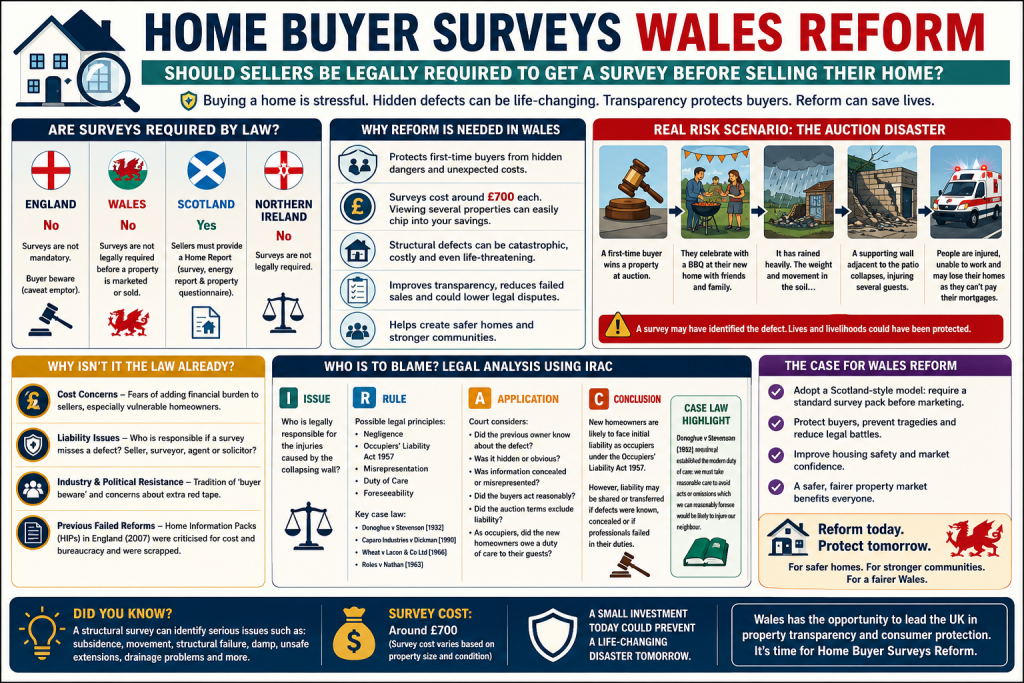
Buying a home is one of the biggest financial commitments most people will ever make. For first-time buyers especially, the process can be emotionally exhausting, financially draining, and legally confusing. Between deposits, solicitor fees, stamp duty, moving costs, insurance, and mortgage arrangements, many buyers are already stretched to their limits before they even collect the keys.
One of the biggest frustrations for homebuyers is the cost of property surveys. A professional survey in the UK can cost anywhere between £400 and £1,500, depending on the type of survey and the size or age of the property. If a buyer views multiple homes and repeatedly pays for surveys on properties that later fall through, thousands of pounds can disappear from their savings before they even complete a purchase.
This raises an important question: should homeowners in Wales be legally required to obtain a structural or condition survey before placing their property on the market?
Many argue the answer should be yes.
Are Property Surveys Required by Law in the UK?
Currently, there is no legal requirement across the UK for a seller to provide a full structural survey before selling a residential property.
However, the position varies slightly between the nations of the UK:
England
In England, surveys are not mandatory. Buyers are generally expected to carry out their own due diligence under the principle of “buyer beware” (caveat emptor). Mortgage lenders often require a valuation, but this is not the same as a detailed structural survey.
Wales
In Wales, surveys are also not legally required before a property is marketed or sold. Buyers can commission their own HomeBuyer Report or Building Survey, but many do not due to costs or auction time pressures.
Scotland
Scotland operates differently. Sellers are usually required to provide a Home Report before marketing a property. This includes:
- A survey,
- An energy report,
- A property questionnaire.
This system was introduced to improve transparency and reduce failed transactions.
Northern Ireland
In Northern Ireland, surveys are not legally required before sale, similar to England and Wales.
Why Is There No Mandatory Survey Law?
There are several reasons why mandatory surveys have not become law across the UK:
Cost Concerns
Critics argue compulsory surveys could place additional financial burdens on sellers, particularly elderly homeowners or low-income households.
Liability Issues
If a seller-provided survey missed defects, disputes could arise regarding who is legally responsible: the surveyor, seller, estate agent, or solicitor.
Political and Industry Resistance
The property market has historically operated under the principle that buyers must investigate properties themselves. Reforming this system would require major legislative change.
Previous Failed Reforms
England previously experimented with Home Information Packs (HIPs) in 2007, which included property information before sale. However, they were criticised for increasing costs and bureaucracy and were later abolished.
The Argument for Reform in Wales
Supporters of reform argue that mandatory surveys would:
- Protect first-time buyers,
- Reduce dangerous property sales,
- Prevent hidden defects,
- Reduce litigation,
- Improve transparency,
- Reduce failed property chains,
- Encourage safer housing standards.
Many believe Wales could follow Scotland’s model by requiring sellers to provide a standardised survey pack before marketing a property.
This could potentially save buyers thousands of pounds and reduce the risk of people unknowingly purchasing unsafe homes.
Example Scenario: The Auction Property Disaster
Imagine a young first-time buyer couple purchasing a property at auction in Wales.
Because auctions move quickly, they do not have enough time to commission a full structural survey before bidding. The property appears attractive on the surface and seems like a bargain.
They successfully win the auction and celebrate by inviting family and friends over for a barbecue that weekend.
Heavy rainfall had occurred days earlier. Unknown to the buyers, the property had underlying subsidence and unstable retaining structures. During the gathering, the movement of soil and pressure from people standing near the patio caused a supporting wall adjacent to an out-house to collapse.
Several guests are seriously injured.
Some suffer broken bones and long-term mobility problems. Others cannot work for months and fall behind on mortgage repayments and household bills.
The celebration becomes a catastrophe.
Who Could Potentially Be Liable?
This situation raises complicated legal questions involving negligence, occupiers’ liability, property disclosure, and causation.
A court would likely analyse the matter using the legal framework known as IRAC:
IRAC Method
Issue
Who is legally responsible for the injuries caused by the collapsing wall?
Rule
Relevant legal principles may include:
- Negligence,
- Occupiers’ Liability Act 1957,
- Misrepresentation,
- Duty of care,
- Foreseeability of harm.
Relevant case law may include:
- Donoghue v Stevenson: established the modern duty of care principle.
- Caparo Industries plc v Dickman: established the three-part test for duty of care involving foreseeability, proximity, and whether it is fair, just, and reasonable.
- Wheat v Lacon & Co Ltd: clarified who may qualify as an occupier.
- Roles v Nathan: considered warnings and specialist knowledge regarding dangerous premises.
Application
The court would consider several factors:
- Did the previous owner know about structural instability?
- Was the defect hidden or obvious?
- Did the seller deliberately conceal information?
- Did the buyers act reasonably by not obtaining a survey?
- Did the auction terms exclude liability?
- Did the new homeowners become “occupiers” immediately after completion and therefore owe duties to visitors?
The injured guests may argue that the homeowners owed them a duty of care as lawful visitors under the Occupiers’ Liability Act 1957.
However, the homeowners themselves may attempt to pursue the previous owner, surveyors, auctioneers, or insurers if evidence suggests the defect was known or fraudulently concealed.
Conclusion
The likely legal position is that the new homeowners could initially face liability as occupiers of the premises at the time of the collapse, even if they were unaware of the structural defect.
However, liability could potentially be shared or transferred depending on:
- Whether defects were concealed,
- Whether misrepresentations occurred,
- Whether professionals failed in their duties,
- Whether the danger was reasonably foreseeable.
This illustrates why property surveys are so important.
Could Mandatory Surveys Prevent Situations Like This?
Possibly.
A professionally conducted survey may identify:
- Subsidence,
- Structural movement,
- Unsafe retaining walls,
- Drainage failures,
- Damp,
- Roofing defects,
- Foundation instability,
- Unsafe extensions or outbuildings.
If these issues are discovered before the sale:
- Buyers can renegotiate,
- Sellers can repair defects,
- Mortgage lenders can reassess risk,
- Dangerous homes may never reach the market without disclosure.
Should Wales Lead the Way?
Many campaigners believe Wales has an opportunity to become a leader in property transparency and consumer protection.
Mandatory pre-sale surveys could:
- Improve housing safety,
- Protect vulnerable buyers,
- Reduce legal disputes,
- Improve confidence in the housing market,
- Prevent avoidable injuries and financial ruin.
While reform would undoubtedly increase responsibilities for sellers and professionals, supporters argue that public safety should outweigh convenience.
For many first-time buyers, purchasing a home is not merely a financial transaction; it is their future, security, and life savings on the line.
Further Reading & Resources
- Will Seller Surveys Become Mandatory? Housing Reform 2026 | Pine
- Senedd Polls 2026 – Latest Welsh Election Voting Intention | PollCheck
- Home buying and selling reform – GOV.UK
- RICS response to the Home Buying and Selling Reform consultation
- Home buying and selling reforms | The Law Society
- UK Home Buying And Selling Reforms Will ‘save Buyers £100s And Speed Up Process’ – HomeOwners Alliance
- Building Surveys Under RICS Home Buying Reforms 2026
- Mandatory Upfront Building Surveys Under 2026 Homebuying Ref
- Propertymark strongly welcomes Welsh Housing Survey | Propertymark
- How Much Does A House Survey Cost In 2026? – HomeOwners Alliance


Andrew Jones is a seasoned journalist renowned for his expertise in current affairs, politics, economics and health reporting. With a career spanning over two decades, he has established himself as a trusted voice in the field, providing insightful analysis and thought-provoking commentary on some of the most pressing issues of our time.