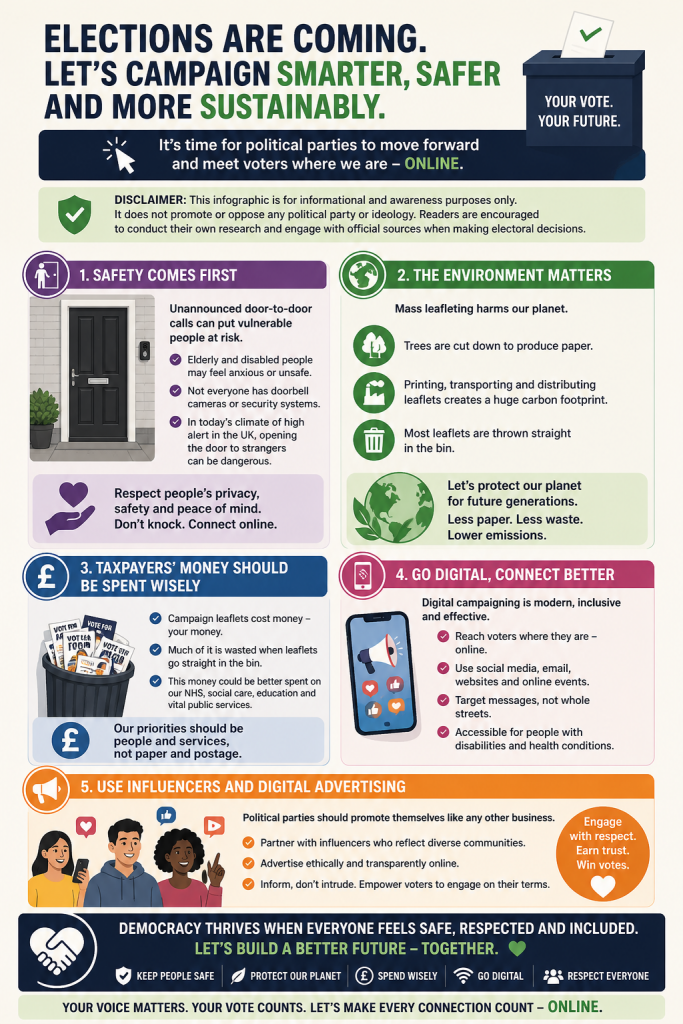
Disclaimer: This article is for informational and awareness purposes only. It does not promote or oppose any political party or ideology. Readers are encouraged to conduct their own research and engage with official sources when making electoral decisions.
The Shift from Doorsteps to Digital Democracy: Should Political Campaigning Move Online for Safety, Cost, and Sustainability?
As the UK approaches upcoming elections, the methods political parties use to engage voters are increasingly being questioned. Traditional campaigning, door-to-door canvassing, and unsolicited leafleting have long been staples of democratic engagement. However, in today’s climate, where safety, privacy, and environmental concerns are paramount, these approaches are beginning to feel outdated and, in some cases, inappropriate.
In an era shaped by digital transformation, the question arises: should political campaigning evolve in the same way businesses and public services have?
The Risks of Unannounced Doorstep Canvassing
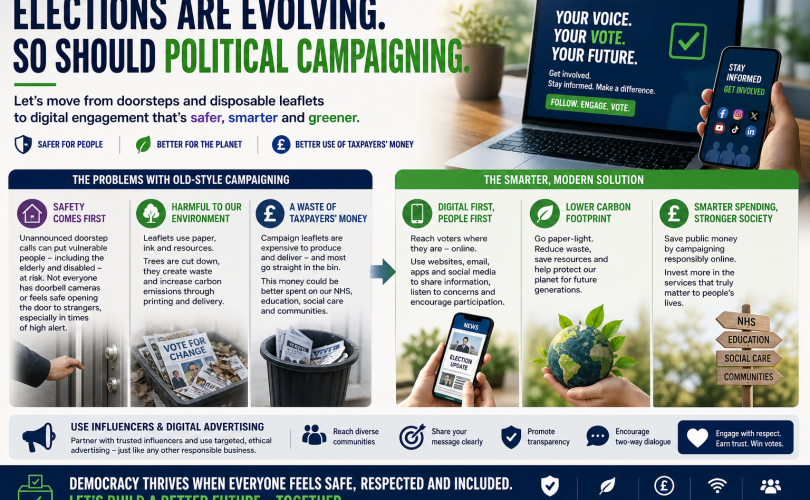
Door-to-door campaigning may once have symbolised grassroots democracy, but for many, particularly the elderly, disabled individuals, and vulnerable households, it now represents an unnecessary intrusion and potential risk.
Opening the door to an unannounced stranger is not a trivial act. In a society where security concerns are heightened, and many people live alone or with health conditions, such interactions can cause anxiety or even place individuals in danger. Not everyone has access to smart doorbells or CCTV systems to verify who is outside. In these cases, individuals may feel pressured to answer the door, despite discomfort or fear.
For people managing disabilities, including mobility issues or conditions such as OCD or anxiety, being interrupted unexpectedly can be distressing and physically demanding. In some cases, simply getting to the door can cause pain or disruption to daily routines.
The Environmental and Financial Cost of Leafleting

Beyond personal safety, there is also the environmental impact to consider. Political leaflets, often printed in bulk and distributed widely, frequently end up discarded shortly after being received. This raises serious concerns about sustainability.
The production of these materials involves the use of paper, ink, transportation, and manpower, all contributing to a larger carbon footprint. Trees are cut down, energy is consumed, and emissions are generated, only for much of this material to be thrown away.
There is also a financial dimension. While political parties may argue that campaign materials are a necessary expense, many voters question whether such spending, particularly if subsidised indirectly through public funding mechanisms, represents good value. At a time when public services are under strain, the optics of spending on disposable campaign literature can be difficult to justify.
A Case for Digital Campaigning
Modern campaigning does not need to rely on physical intrusion or environmental waste. Digital platforms provide a far more efficient, targeted, and accessible way to communicate with voters.
From social media campaigns to email newsletters and online debates, political parties have the tools to reach audiences where they already are, on their devices. Much like businesses, parties can use advertising, analytics, and even influencers to convey their message in a way that is engaging but non-intrusive.
Influencer partnerships, in particular, could help political messaging reach diverse communities in a more relatable and accessible way. When done ethically and transparently, this approach mirrors modern marketing strategies and respects the autonomy of the audience.
Respecting Boundaries in a Modern Society
The issue is not whether political parties should engage with voters; clearly, they must. Rather, it is how they do so. Respecting personal boundaries, prioritising safety, and minimising environmental harm should be central to any modern campaign strategy.
Unsolicited door-knocking and mass leafleting may have once been effective, but today they risk alienating the very people parties are trying to reach. A more thoughtful, inclusive approach would consider the needs of vulnerable individuals and the broader societal context.
Rethinking Priorities
In a time when governments emphasise sustainability, digital innovation, and public safety, campaign practices should reflect those same values. Reducing paper waste, lowering carbon emissions, and avoiding unnecessary intrusion into people’s homes are not radical ideas; they are aligned with broader public expectations.
Redirecting resources from physical campaigning to digital infrastructure, accessibility improvements, and community engagement initiatives could offer better long-term value for both voters and political organisations.
Conclusion
Democracy thrives on participation, but participation should never come at the expense of safety, dignity, or the environment. As society evolves, so too should the methods used to engage it.
Political parties have an opportunity to modernise their outreach, embracing digital tools, respecting personal boundaries, and reducing waste. In doing so, they may not only improve their public image but also build more meaningful and respectful connections with the electorate.
Further Reading & Resources
- 10 Essential Strategies for Successful Political Campaigns
- Political Campaign Strategies: Your Guide to Winning Elections
- Political Campaign Strategy | Run a Campaign & Win |TCW
- Political Campaign Strategies: Your Complete Guide to Winning Elections – Pulsar
- How to Run a Winning Local Campaign – County Watchers
- 8 Keys to Running an Effective Local Political Campaign
- The Road to Number 10 — UK Election Campaign Simulator | A-Level Politics | tutor2u
- How to Run a Successful Political Campaign in 7 Steps | NGP VAN
- 6 Election Campaign Ideas That Will Help You Win – Determ
- 10 Political Campaign Strategies: Step by Step Guide + Timeline — MFStrategies


Andrew Jones is a seasoned journalist renowned for his expertise in current affairs, politics, economics and health reporting. With a career spanning over two decades, he has established himself as a trusted voice in the field, providing insightful analysis and thought-provoking commentary on some of the most pressing issues of our time.