Disclaimer: This article is for informational and educational purposes only and does not constitute legal or political advice. Readers are encouraged to seek independent legal guidance or consult official government sources for the most up-to-date information.
A Deep Dive into Proposed Reforms, Political Reactions, and the Potential Impact on Equality and Human Rights
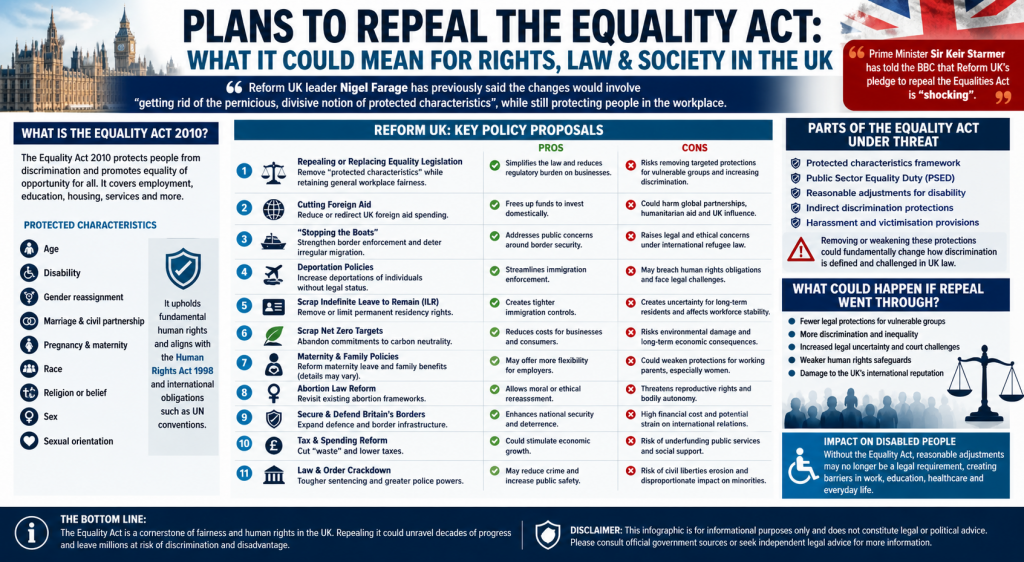
The prospect of repealing the Equality Act 2010 has sparked significant debate across the UK, particularly following comments by Nigel Farage, leader of Reform UK. Farage has previously suggested that reform would involve “getting rid of the pernicious, divisive notion of protected characteristics,” while maintaining workplace protections.
This position has drawn sharp criticism, including from Keir Starmer, who described the proposal in an interview with the BBC as “shocking.”
At the heart of the debate lies a fundamental question: what happens to human rights, legal protections, and social cohesion if such a cornerstone of UK law is repealed?
What Is the Equality Act 2010?
The Equality Act consolidated previous anti-discrimination laws into a single framework, protecting individuals from unfair treatment based on “protected characteristics,” including:
- Disability
- Race
- Gender reassignment
- Sex
- Sexual orientation
- Religion or belief
- Age
- Pregnancy and maternity
- Marriage and civil partnership
It plays a crucial role in upholding principles aligned with the Human Rights Act 1998 and international obligations under frameworks like the United Nations human rights conventions.
What Parts of the Equality Act Could Be Under Threat?
If proposals to repeal or significantly amend the Act were pursued, the following elements could be at risk:
- Protected Characteristics Framework: The legal backbone preventing discrimination across society
- Public Sector Equality Duty (PSED): Obligating public bodies to consider equality in decision-making
- Reasonable Adjustments for Disability: Requirements for employers and services to accommodate disabled individuals
- Indirect Discrimination Protections: Safeguards against policies that disproportionately disadvantage groups
- Harassment and Victimisation Provisions: Legal recourse for individuals subjected to hostile environments
Removing or weakening these provisions could fundamentally alter how discrimination is defined and challenged in UK law.
Reform UK’s Broader Policy Proposals
Beyond the Equality Act, Reform UK has outlined a wider political agenda. Below is an overview of key proposals, alongside potential advantages and drawbacks.
1. Repealing or Replacing Equality Legislation
Proposal: Remove “protected characteristics” while retaining general workplace fairness.
Pros:
May simplify legal frameworks and reduce regulatory burdens on businesses.
Cons:
Risks of removing targeted protections for vulnerable groups, particularly disabled individuals, leading to increased inequality.
2. Cutting Foreign Aid
Proposal: Reduce or redirect UK foreign aid spending.
Pros:
Potential to reallocate funds domestically.
Cons:
Could weaken global humanitarian efforts and the UK’s international standing.
3. “Stopping the Boats” and Immigration Control
Proposal: Strengthen border enforcement and deter irregular migration.
Pros:
Addresses public concerns around border security.
Cons:
Raises legal and ethical concerns under international refugee law and human rights obligations.
4. Deportation Policies
Proposal: Increase deportations of individuals without legal status.
Pros:
May streamline immigration enforcement.
Cons:
Could lead to legal challenges, especially where human rights protections apply.
5. Scrapping Indefinite Leave to Remain (ILR)
Proposal: Remove or limit permanent residency rights.
Pros:
Creates tighter immigration controls.
Cons:
Generates uncertainty for long-term residents and may affect workforce stability.
6. Scrapping Net Zero Targets
Proposal: Abandon commitments to carbon neutrality.
Pros:
Could reduce costs for businesses and consumers in the short term.
Cons:
Risks environmental harm and long-term economic consequences tied to climate change.
7. Maternity and Family Policies
Proposal: Potential reforms to maternity leave and benefits (details vary).
Pros:
May offer flexibility for employers.
Cons:
Could weaken protections for working parents, disproportionately affecting women.
8. Abortion Law Reform
Proposal: Revisit existing abortion frameworks.
Pros:
Framed as a moral or ethical reassessment.
Cons:
Raises significant concerns about bodily autonomy and established healthcare rights.
9. “Secure and Defend Britain’s Borders.”
Proposal: Expand defence and border infrastructure.
Pros:
Enhances national security narrative.
Cons:
May come at a high financial cost and strain international relations.
Impact on Disabled People
For individuals with disabilities, the repeal of the Equality Act could be particularly significant. Current legal protections require employers and service providers to make reasonable adjustments, ensuring accessibility and fairness.
Without these safeguards, disabled individuals could face increased barriers in employment, education, healthcare, and public services. This would also raise questions about compliance with international obligations such as the UN Convention on the Rights of Persons with Disabilities.
Human Rights and Legal Implications
Repealing or weakening the Equality Act would likely create tension with existing legal frameworks, including the Human Rights Act. Courts may face increased litigation as individuals seek alternative routes to challenge discrimination.
It could also lead to fragmentation in legal protections, where rights become less clear and more difficult to enforce, undermining confidence in the justice system.
What Would Happen If Repeal Went Through?
If such reforms were enacted, the UK could see:
- A shift from group-based protections to more generalised legal standards
- Increased reliance on courts to interpret fairness without clear statutory guidance
- Potential rise in discrimination claims with fewer defined protections
- Greater inequality between different social groups
- International scrutiny regarding the UK’s commitment to human rights
While proponents argue for simplification and fairness without categorisation, critics warn that removing targeted protections risks ignoring systemic inequalities that still exist in society.
Conclusion
The debate surrounding the future of the Equality Act is not just legal, it is deeply societal. It touches on how fairness is defined, who is protected, and whether equality should be treated as a universal principle or one that recognises the realities of disadvantage.
As political discussions continue, the outcome will have lasting implications for law, human rights, and the everyday lives of millions across the UK.
Further Reading & Resources:
- Policies | Reform UK
- Starmer says Reform plans to repeal Equality Act ‘shocking’ – BBC News
- Reform UK plan to rip up Equality Act shocking and un-British, says Starmer | Equality Act 2010 | The Guardian
- Reform plans to scrap Equality Act – what it would mean for Britain | The Independent
- Amnesty responds to Reform UK proposals to repeal the Equality Act | Amnesty International UK
- Reform will repeal the Equality Act if elected, says Braverman
- Reform UK manifesto suggests huge cuts, threats to disability rights, and risks to safety of benefit claimants – Disability News Service
- The Equality Act and Disabled people | Disability Rights UK
- Why does Reform want to tear up the vote-winning Equality Act? | The Independent
- The Equality Act 2010: Impact on disabled people – House of Lords Library
- The Equality Act 2010: the impact on disabled people Follow-up report
- being-disabled-in-britain_0.pdf
- We don’t need an inquiry to tell us the government has failed Disabled people – Politics.co.uk
- Legal Action Group | Making the Equality Act work for disabled people
- House of Lords – The Equality Act 2010: the impact on disabled people – Select Committee on the Equality Act 2010 and Disability


Andrew Jones is a seasoned journalist renowned for his expertise in current affairs, politics, economics and health reporting. With a career spanning over two decades, he has established himself as a trusted voice in the field, providing insightful analysis and thought-provoking commentary on some of the most pressing issues of our time.